Bootstrap for Email Marketing: A Developer's Guide
Bootstrap is a front-end framework built for the browser, not the inbox. That distinction is the whole story of using it for email. You cannot ship a Bootstrap page as a campaign and expect it to survive Gmail, Outlook, and Apple Mail, but Bootstrap is an excellent tool for the part of the job that comes before the send: prototyping the layout, locking in the brand, and agreeing on a design fast. This page is the hub for that workflow. It explains where Bootstrap fits, where it stops, and which guide to read next for each step.
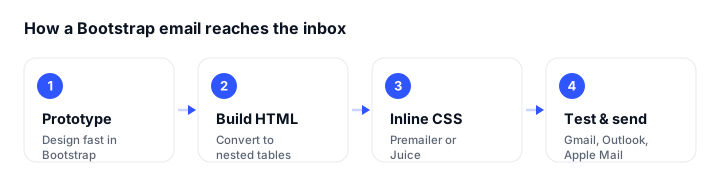
How Bootstrap fits into an email workflow
Bootstrap (currently on the 5.3.x line) gives you a grid system, responsive breakpoints, utility classes, and pre-built components. In normal web work those features render in any modern browser. Email clients are a different runtime: Outlook on Windows uses the Word rendering engine, Gmail strips <style> blocks in some contexts, and most clients ignore JavaScript and modern layout CSS like flexbox and grid.
So the practical model is two stages:
- Prototype and theme in Bootstrap. Build the layout, pick colors and spacing, get sign-off. This is where Bootstrap earns its place: it is fast and everyone on the team already reads it.
- Convert to table-based, inlined HTML for the send. Translate the approved design into
<table>layout with CSS inlined onto each element, then test it across clients.
The mistake to avoid is treating stage one as the final product. Below is the conversion that turns a Bootstrap mockup into something an email client renders the same way every time.
Caveat in one line: Bootstrap’s grid, flexbox utilities, and JavaScript components (carousel, modal, accordion, tooltip) are for the browser. Use them to design, then ship table-based HTML with inlined CSS.
Prototype in Bootstrap, then convert to email HTML
Start with a Bootstrap row that prototypes a simple hero plus a call to action. This is what you would show a stakeholder:
<div class="container" style="max-width: 600px;">
  <div class="row text-center">
    <div class="col-12 p-4">
      <h1 class="h3 mb-3">Summer Sale</h1>
      <p class="text-muted mb-4">30% off everything this week only.</p>
      <a href="https://example.com/sale" class="btn btn-primary">Shop now</a>
    </div>
  </div>
</div>
That layout is built on Bootstrap’s grid and .btn component, both of which depend on external CSS and flexbox. Outlook will not honor either. Here is the same block rewritten as table-based HTML with inlined styles, which renders consistently across clients:
<table role="presentation" width="600" cellpadding="0" cellspacing="0"
       style="margin: 0 auto; max-width: 600px;">
  <tr>
    <td align="center" style="padding: 32px; font-family: Arial, sans-serif;">
      <h1 style="font-size: 24px; margin: 0 0 12px; color: #212529;">Summer Sale</h1>
      <p style="font-size: 16px; margin: 0 0 24px; color: #6c757d;">
        30% off everything this week only.
      </p>
      <a href="https://example.com/sale"
         style="display: inline-block; background: #0d6efd; color: #ffffff;
                text-decoration: none; padding: 12px 24px; border-radius: 6px;
                font-family: Arial, sans-serif; font-size: 16px;">
        Shop now
      </a>
    </td>
  </tr>
</table>
Notice what carried over and what changed. The colors (#0d6efd, #6c757d) and the rough spacing came straight from the Bootstrap prototype, so the design intent is preserved. The structure changed entirely: div and col-12 became a single-cell <table>, the .btn class became an inlined anchor styled to look like a button, and every style moved from a stylesheet to a style attribute. You do not inline by hand for a whole email; a tool like Premailer or the Maizzle pipeline does it. The full step-by-step is in building HTML email templates with Bootstrap.
Bootstrap vs email-specific frameworks
Bootstrap is the right tool for prototyping, but for the production build you may want a framework designed for the inbox. Here is how the common options compare for email work in 2026:
| Framework | Built for email? | Output | Best for |
|---|---|---|---|
| Bootstrap | No (browser-first) | Browser HTML/CSS | Prototyping and theming, then convert by hand or with Premailer |
| MJML | Yes | Responsive table HTML, auto-inlined | Most teams; largest community and client coverage |
| Foundation for Emails (Inky) | Yes | Responsive table HTML via Inky | Existing Foundation users; note new work has moved to Inky v2 |
| Maizzle | Yes | Inlined HTML from Tailwind utilities | Teams already using Tailwind who want full control |
MJML remains the most popular and the safest default for broad client support. Foundation for Emails still works, but its maintainers have shifted active development to the Rust-based Inky v2, so weigh that before starting something new on it. Maizzle suits Tailwind shops and gives you a configurable build pipeline that handles inlining and cleanup for you. None of these replaces Bootstrap at the design stage; they replace the hand-conversion at the build stage.
Designing responsive email templates with Bootstrap
When you prototype, design mobile-first and keep the body around 600px wide, because that is the width your table-based export will use. Favor a single column where you can: stacked columns survive client rendering far better than multi-column layouts that depend on flexbox or floats.
Embracing a mobile-first prototype
Use Bootstrap’s responsive utilities to sketch how the email reshapes on small screens, then carry that intent into media queries on the table version. Remember that media query support is uneven, so the layout must look acceptable even when the queries are ignored. For the cross-client testing that follows, see our notes on responsive email templates that render well in Gmail.
Customizing the theme
Tailor colors, spacing, and typography to your brand at the prototype stage so the conversion inherits them. The customize Bootstrap 5 guide covers adjusting Sass variables for color and spacing, which is the fastest way to make a mockup look on-brand before you export it.
Where to go next
This page is the concept hub. Depending on what you are doing right now, follow the matching spoke:
- Building the actual template: HTML email templates with Bootstrap walks through the full conversion to table-based markup.
- Fixing rendering in a specific client: responsive email templates for Gmail covers the quirks that trip up the most-used inbox.
- The deeper developer workflow: the Bootstrap email marketing guide for developers goes into tooling, inlining, and testing in depth.
- Protecting your sending domain: DMARC monitoring walks through reading DMARC reports and moving safely from
p=nonetop=reject. - Adding urgency to a sale email: how to add a countdown timer to your Black Friday email covers how email timers render and where Outlook and Apple Mail break them.
- Campaign ideas and planning: browse the monthly newsletter guides, such as June newsletter ideas, for seasonal content and subject-line prompts. To map the sends across a year, Designmodo’s guide to building an organized email marketing calendar is a practical framework.
Best practices for Bootstrap in email
Bootstrap is best used to prototype and theme an email, not to ship one as-is. A few rules keep your campaigns rendering reliably:
- Do use Bootstrap to mock up the layout and lock in colors, spacing, and typography, then export a table-based version with inlined CSS for the actual send.
- Do inline your CSS (a tool like Premailer automates it) and keep the body width around 600px, since many clients ignore
<style>blocks and media queries. - Don’t rely on Bootstrap’s JavaScript components (carousels, modals, accordions, tooltips) or its flex and grid utilities inside the email: Gmail, Outlook, and Apple Mail strip scripts and most layout CSS.
- Don’t skip client testing. Preview in Email on Acid or Litmus, then send real test messages to Gmail, Outlook, and Apple Mail before you launch.
Used this way, Bootstrap speeds up the design and theming stage, and a clean table-based export carries that design safely into the inbox.
FAQ
Can I send a Bootstrap page directly as an email?
No. Bootstrap’s grid, flexbox utilities, and external stylesheet are built for browsers, and email clients like Outlook (Word engine) and Gmail will break the layout. Use Bootstrap to prototype, then convert the approved design to table-based HTML with inlined CSS before sending.
What is the difference between Bootstrap and MJML for email?
Bootstrap is a browser-first framework you use to design and theme an email. MJML is an email-specific markup language that compiles to responsive, table-based, auto-inlined HTML ready to send. They are complementary: prototype in Bootstrap, then build the production version in MJML (or convert Bootstrap output with a tool like Premailer).
What are the best practices for testing Bootstrap-based email templates?
Test across multiple email clients and devices before launching. Preview your template in a tool like Email on Acid (affordable and widely used; Litmus is now enterprise-only), then send test emails to real accounts (Gmail, Outlook, and Apple Mail) to confirm the rendering holds up where it counts.
How can I ensure my Bootstrap email templates are accessible?
Use semantic HTML with descriptive alternative text for images, add role="presentation" to layout tables so screen readers skip them, and keep adequate color contrast and legible font sizes. Set a language attribute and a clear reading order. Accessibility in email comes from the table-based export, not from Bootstrap classes.
Can I use Bootstrap’s JavaScript components in email templates?
No. Avoid JavaScript in email templates entirely: components like Bootstrap’s carousel, modal, accordion, and tooltip rely on JS, and email clients strip it for security. Stick to plain HTML and inlined CSS for anything you actually send.
Should I use Bootstrap, MJML, Foundation for Emails, or Maizzle?
Use Bootstrap to prototype. For the production build, MJML is the safest default thanks to its community and client coverage. Choose Maizzle if your team already works in Tailwind, and consider Foundation for Emails only if you have an existing setup, since active development has moved to the Rust-based Inky v2.
What should I consider when customizing Bootstrap components for email?
Keep customizations simple, since many email clients do not understand modern web standards. Favor minimal dependencies, avoid relying on external CSS, and inline your styles wherever possible. Decide the colors and spacing in Bootstrap, but expect to re-express buttons and layout as inlined table HTML.
How can I stay updated with the latest Bootstrap features for email marketing?
Follow the latest Bootstrap releases through the official blog posts and GitHub repositories, where the changelogs live. Web development communities are also a good way to hear about recent updates and new features that can streamline your work, and, in our case, improve your email marketing.
Build your Bootstrap theme
Design a custom Bootstrap 5 theme visually with a live preview, then export clean Sass or CSS.
Open the Builder