Coolify Alternatives: 7 Self-Hosted and Managed Options
Coolify is the most popular open-source platform for self-hosting apps: install it on a VPS, and you get Git push deploys, databases, more than 360 one-click services, and HTTPS on your own domains, for the price of the server. People look for Coolify alternatives for different reasons. Some want a lighter or differently designed self-hosted tool, some want to spread one app across several servers, and some decide they’d rather not maintain servers at all. This guide covers seven alternatives in each of those groups, with versions and pricing checked in November 2026.
TL;DR
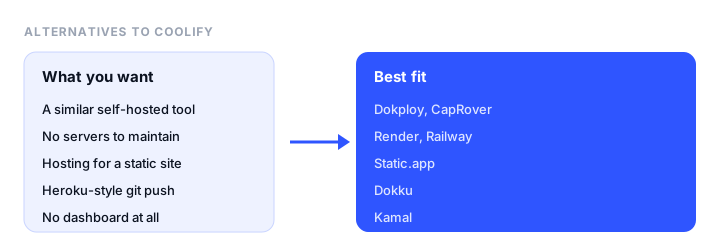
- Best self-hosted alternative: Dokploy. A similar dashboard with Docker Swarm clusters and built-in monitoring, free to self-host.
- Best if you’d rather not run servers: Render, a managed platform with fixed prices from $7 a month per service.
- Best for static sites: Static.app, if what you host on Coolify is a landing page, docs, or a frontend build, from $6 a month with nothing to maintain.
- Best Heroku-style workflow: Dokku,
git pushdeploys with buildpacks on one server. - Best without a dashboard: Kamal, which deploys Docker containers to any server from one config file.
Why look for a Coolify alternative?
- You maintain everything. Coolify is free, but you update the server, Coolify itself, the databases, and the backups. A bad update or a full disk is your problem to fix.
- It needs a reasonably sized server. Coolify needs 2 CPU cores and 2 GB of RAM to run comfortably, before your apps, and the recommended setup uses a separate server for Coolify itself.
- It’s a big tool. Hundreds of services and many settings per resource are more than some projects need.
- One app across several servers. Coolify manages many servers well, but places each app on a chosen server rather than spreading it across a cluster.
- Static sites don’t need it. Running a server to host HTML, CSS, and JavaScript adds maintenance with no benefit.
Coolify alternatives at a glance
| Tool | Type | Price | License | Best for |
|---|---|---|---|---|
| Dokploy | Self-hosted dashboard | Free; Cloud from $4.50/mo | Apache-2.0 (plus a source-available part) | Similar dashboard, Swarm clusters |
| Render | Managed platform | Free tier; services from $7/mo | Proprietary | No servers to maintain |
| Static.app | Managed static hosting | From $6/mo | Proprietary | Static sites and frontends |
| Railway | Managed platform | Hobby $5/mo incl. $5 usage | Proprietary | Usage-based pricing, one-click databases |
| CapRover | Self-hosted dashboard | Free | Open source | Docker Swarm with one-click apps |
| Dokku | Self-hosted CLI | Free | MIT | Heroku workflow on one server |
| Kamal | Deploy tool (CLI) | Free | MIT | Docker deploys without a dashboard |
The best Coolify alternatives, reviewed
1. Dokploy: best self-hosted alternative
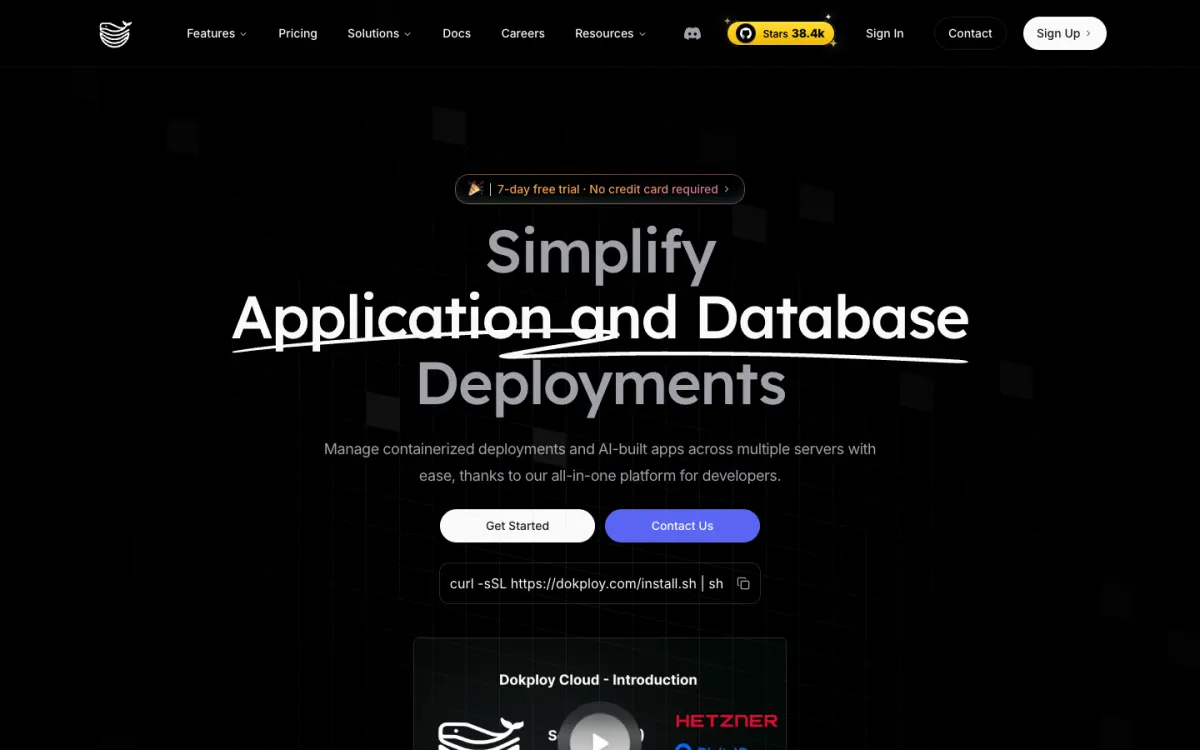
What it is. An open-source, self-hosted platform for applications, databases, and Docker Compose stacks, with Traefik routing, scheduled backups, and more than 600 one-click templates.
Why it replaces Coolify. The workflow is almost the same: install with one command, connect Git, deploy, and add databases. Dokploy goes further on clusters, joining servers into a Docker Swarm so one app runs as replicas across nodes, and it shows CPU, memory, disk, and network per resource, with logs and metrics shipped to Grafana, Datadog, Better Stack, and others.
Pricing. Free to self-host on a server with 2 GB of RAM and 30 GB of disk. Dokploy Cloud runs the dashboard for you from $4.50 a month for one server, or $15 a month for up to 3 servers with unlimited users.
The catch. It’s younger than Coolify, at version 0.31.1, and code in its proprietary folder is under a source-available license. Our Coolify vs Dokploy comparison covers the differences in detail.
2. Render: best if you’d rather not run servers
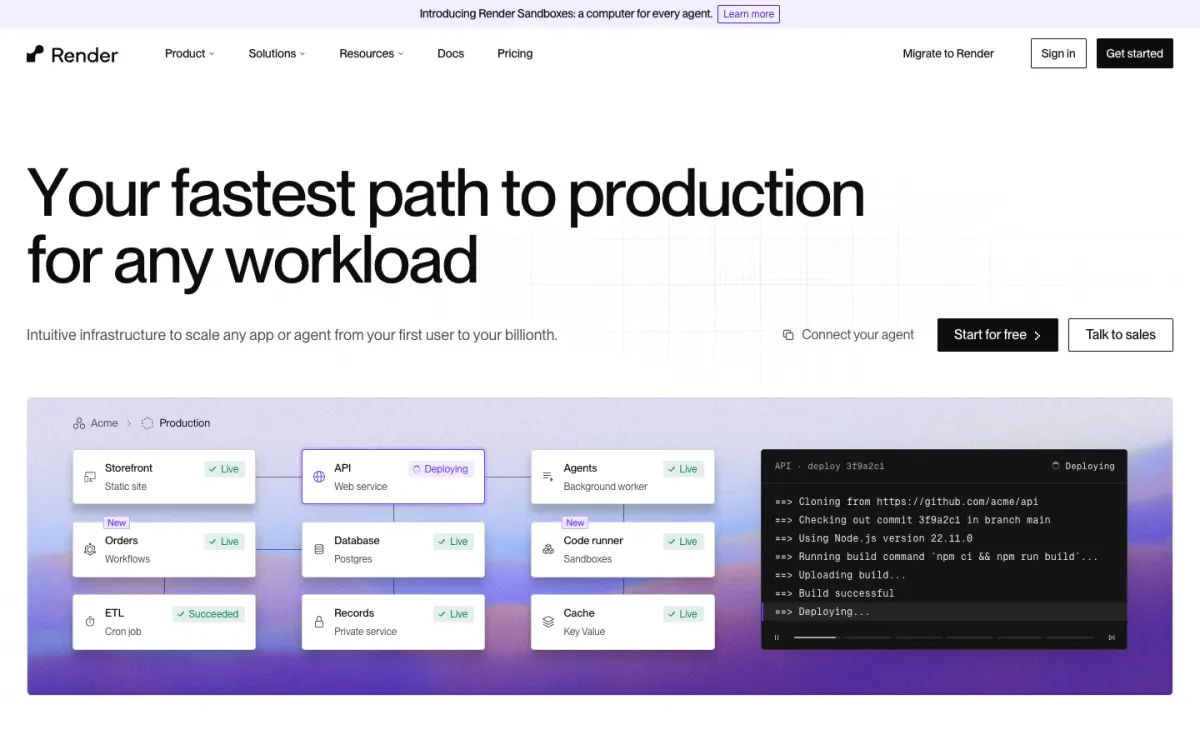
What it is. A managed platform for web services, background workers, cron jobs, static sites, and managed Postgres, deployed from Git or a Docker image.
Why it replaces Coolify. Everything Coolify does on your server, Render does on its own, so there are no updates, disks, or security patches to look after. Postgres comes with backups, point-in-time recovery, and high availability.
Pricing. The Hobby workspace is free for one person, and Pro is $25 a month for teams. Web services start at $7 a month, and Postgres at $6. Bandwidth beyond 5 GB (Hobby) or 25 GB (Pro) is $0.15 per GB.
The catch. It costs more than a VPS once you run several apps, because each service and database is billed separately.
3. Static.app: best for static sites
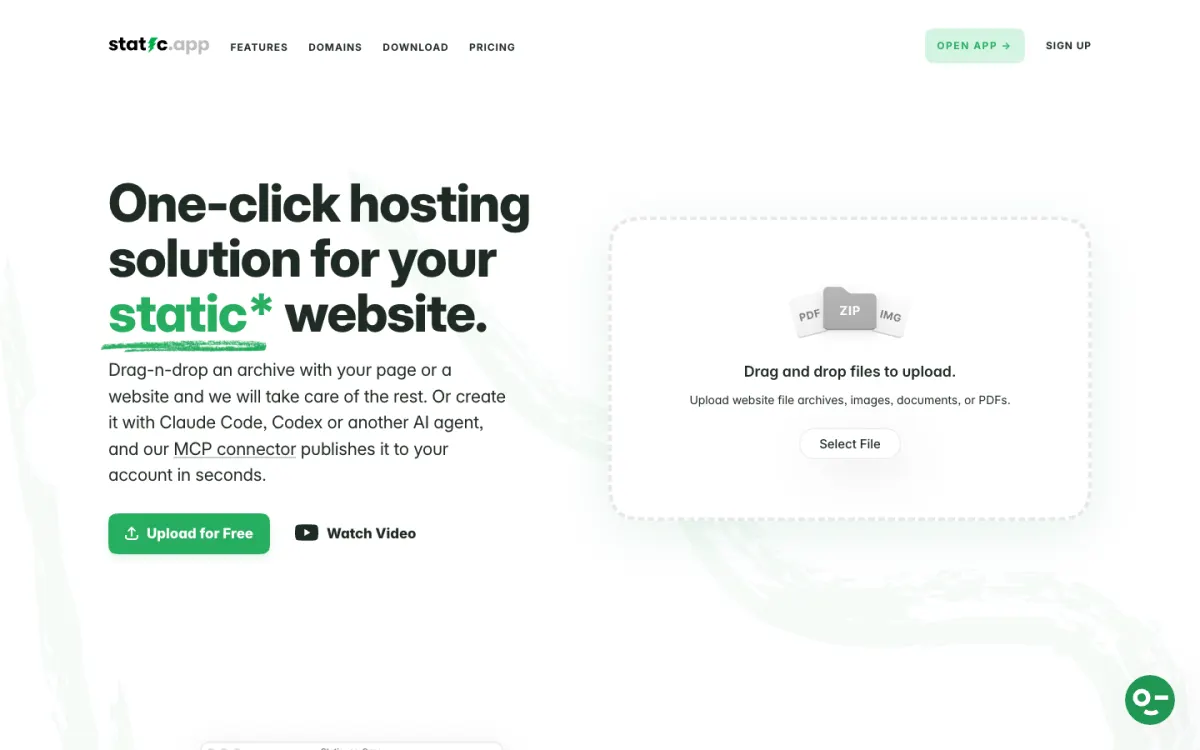
What it is. A static website host where you publish a folder or ZIP by drag-and-drop, with free SSL, built-in forms, cookieless analytics, and password protection.
Why it replaces Coolify. Many Coolify servers host a landing page, documentation, a portfolio, or a single-page app built with React, Vue, Astro, or a Next.js static export. These are just files, and Static.app serves them with nothing to update or back up, unlimited traffic, and forms that replace a small backend kept only for a contact form.
Pricing. A 7-day free trial without a card. Starter is $6 a month, or $5 billed yearly, for 2 sites with custom domains. Medium is $12 for 7 sites, and Large $18 for 30.
The catch. Static only: no server code, databases, or background jobs. Keep those on Coolify, or another platform here, and move the frontend.
4. Railway: managed, with usage pricing
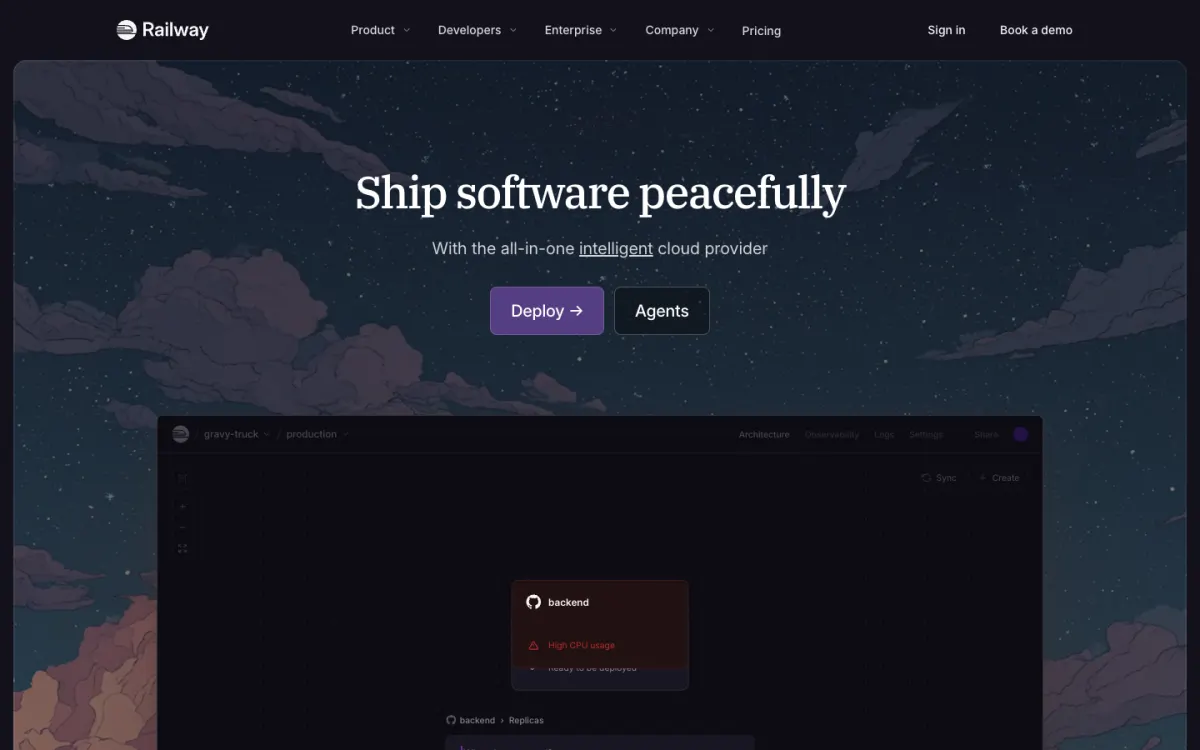
What it is. A managed platform that runs services, databases, cron jobs, and volumes on a visual canvas, billed by the CPU and memory you use.
Why it replaces Coolify. It keeps Coolify’s best feature, one-click databases next to your apps, without a server to maintain. Small or idle apps cost little, and Pro is $20 a month per workspace with unlimited seats.
Pricing. Hobby is $5 a month including $5 of usage. Memory costs about $10 per GB a month and CPU about $20 per vCPU. After a 30-day trial, the Free plan includes $1 of credit a month.
The catch. Usage billing is less predictable than a fixed VPS, and there are four regions. See our Render vs Railway comparison.
5. CapRover: Docker Swarm with one-click apps
What it is. An open-source, self-hosted platform built on Docker Swarm and nginx, with automatic Let’s Encrypt certificates, a web dashboard, a CLI, and a library of one-click apps and databases.
Why it replaces Coolify. It’s lighter and simpler, and because it runs on Docker Swarm, adding servers to the cluster is built in from the start. It has been around since 2017 and is still updated, with version 1.16.0 released in November 2026.
Pricing. Free. You pay for the servers.
The catch. The interface is older, there are no pull request previews, and fewer features than Coolify or Dokploy.
6. Dokku: Heroku on one server
What it is. The original open-source “mini-Heroku”: git push to your server, and Dokku builds the app with Heroku buildpacks or a Dockerfile, runs it from a Procfile, and adds Postgres, Redis, and Let’s Encrypt with plugins. It’s MIT-licensed, with about 32,000 GitHub stars.
Why it replaces Coolify. If you like working in the terminal, Dokku is smaller and has fewer moving parts than a web dashboard, and Heroku apps often move over unchanged.
Pricing. Free. You pay for the server.
The catch. No web interface by default, and it’s designed for one server, so scaling and high availability are up to you.
7. Kamal: deploys without a dashboard
What it is. An MIT-licensed deploy tool from 37signals, the makers of Basecamp and HEY. Kamal builds your app as a Docker image and deploys it over SSH to any servers listed in a deploy.yml file, with zero-downtime switches through its own proxy and HTTPS. Databases and other services run as “accessories”.
Why it replaces Coolify. There’s nothing to host or maintain besides your app: no dashboard, no extra server. The whole setup lives in your repository, and kamal deploy ships the app to one server or many.
Pricing. Free. You pay for the servers and a container registry.
The catch. It’s a command-line tool for developers, with no web interface, one-click services, or built-in backups.
Which Coolify alternative should you choose?
- You want a similar self-hosted dashboard: Dokploy.
- You want to stop maintaining servers: Render for fixed pricing, or Railway for usage pricing.
- Your project is a static site or frontend: Static.app.
- You want a lightweight Swarm cluster: CapRover.
- You like Heroku’s
git pushworkflow: Dokku. - You want deployment config in your repository, and no dashboard: Kamal.
Whichever you choose, monitor your sites from outside the server. A self-hosted platform can’t alert you if the whole server goes down, while an external monitor such as Pulsetic can. Our free uptime monitoring guide compares the options.
FAQ
What is the best alternative to Coolify?
Dokploy is the best self-hosted alternative, with a similar dashboard, Docker Swarm clusters, and built-in monitoring. If you’d rather not run servers, Render and Railway are managed platforms with Git deploys and databases. For static sites, Static.app hosts them with nothing to maintain.
Is Dokploy better than Coolify?
Not overall. Coolify is more mature, at version 4.7.5, with more than 360 one-click services. Dokploy is better for running one app across several servers with Docker Swarm, and for shipping logs and metrics to tools like Grafana or Datadog.
Is there a free alternative to Coolify?
Yes. Dokploy, CapRover, Dokku, and Kamal are all free and open source. You pay only for the servers you run them on.
What is the difference between Coolify and Dokku?
Coolify is a web dashboard that manages many servers, databases, and hundreds of one-click services. Dokku is a command-line tool for one server that copies Heroku’s workflow, with git push deploys, buildpacks, and plugins for databases.
Should I self-host or use a managed platform?
Self-host with Coolify or Dokploy if you’re comfortable maintaining a Linux server and want to run many apps for a fixed monthly cost. Use a managed platform such as Render or Railway if you’d rather pay more per app and have someone else handle updates, backups, and uptime.
Build your Bootstrap theme
Design a custom Bootstrap 5 theme visually with a live preview, then export clean Sass or CSS.
Open the Builder