Railway Alternatives: 9 Platforms Compared (2026)
Railway made deploying an app and its database feel effortless: connect a repository, click to add Postgres or Redis, and pay only for the CPU and memory your services use. Teams look for Railway alternatives when that usage bill becomes hard to predict, when they need a region Railway doesn’t have, when the $1-a-month free plan isn’t enough to keep a project running, or when the app turns out to be a static site that doesn’t need a server at all. This guide covers why teams switch, nine alternatives with pricing checked on each vendor’s site in November 2026, and how to move an app over.
TL;DR
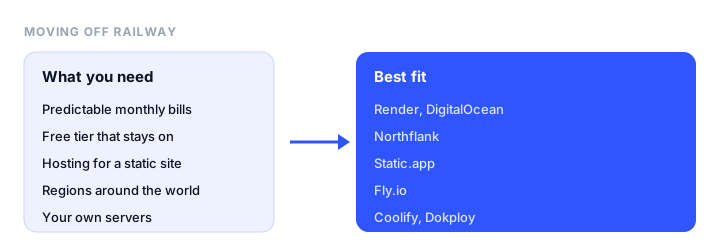
- Best overall: Render. Fixed instance prices from $7 a month, managed Postgres, a free tier for testing, and free static sites.
- Best free tier that doesn’t sleep: Northflank, whose free Sandbox keeps 2 services and a database running.
- Best for static sites and frontends: Static.app, if your Railway service only serves HTML, CSS, and JavaScript, from $6 a month with unlimited traffic.
- Best for global apps: Fly.io, with machines in 18 regions.
- Best self-hosted option: Coolify, free on your own server.
Why teams leave Railway
- Usage billing is hard to predict. Memory costs about $10 per GB a month and CPU about $20 per vCPU, billed by the second. A service that holds memory all month, or a traffic spike, raises the bill, and the plan fee only covers the first $5 (Hobby) or $20 (Pro) of usage.
- The free plan is small. After the 30-day trial with $5 of credit, the Free plan includes $1 of credit a month and limits services to 1 vCPU and 0.5 GB, which isn’t enough to run an app all month.
- Four regions. Railway runs in California, Virginia, Amsterdam, and Singapore. Apps that need users in South America, Australia, or other parts of Europe are farther away.
- Databases are services you look after. One-click Postgres is fast, but it runs as a service on a volume, so backups, replication, and upgrades need more attention than a fully managed database.
- Many apps don’t need a server. A frontend or marketing site deployed as a Railway service pays for compute and egress that a static host doesn’t charge for.
What Railway does well: one-click databases, a visual canvas of your services, preview environments for pull requests, and team pricing per workspace ($20 a month with unlimited seats) rather than per developer.
Railway alternatives at a glance
| Platform | Free tier | Paid from | Pricing model | Databases | Best for |
|---|---|---|---|---|---|
| Render | Free web service (sleeps), free static sites | $7/mo per instance | Fixed instances + workspace plan | Managed Postgres from $6/mo | Best overall |
| Northflank | Sandbox, always on | About $2.70/mo smallest service | Per second | Postgres, MySQL, Redis, MongoDB | Free tier that doesn’t sleep |
| Static.app | 7-day trial | $6/mo (2 sites) | Flat | None (static only) | Static sites and frontends |
| Fly.io | No (small invoices waived) | About $2.19/mo smallest machine | Per second | Managed Postgres from $38/mo | Global apps |
| DigitalOcean App Platform | 3 static sites | $5/mo per container | Fixed | Dev database $7/mo, managed from $15.15/mo | Simple fixed pricing |
| Heroku | No (Eco $5/mo, sleeps) | $7/mo per Basic dyno | Fixed per dyno | Heroku Postgres | Mature add-on ecosystem |
| Koyeb | 1 small instance | Pro $29/mo + compute | Per second | Managed Postgres | Serverless containers that scale to zero |
| Coolify | Free self-hosted | Cloud $5/mo + your servers | Your server | One-click databases | Self-hosted Railway |
| Dokploy | Free self-hosted | Cloud $4.50/mo per server | Your server | One-click databases with backups | Self-hosted, Docker Swarm |
The best Railway alternatives, reviewed
1. Render: best overall Railway alternative
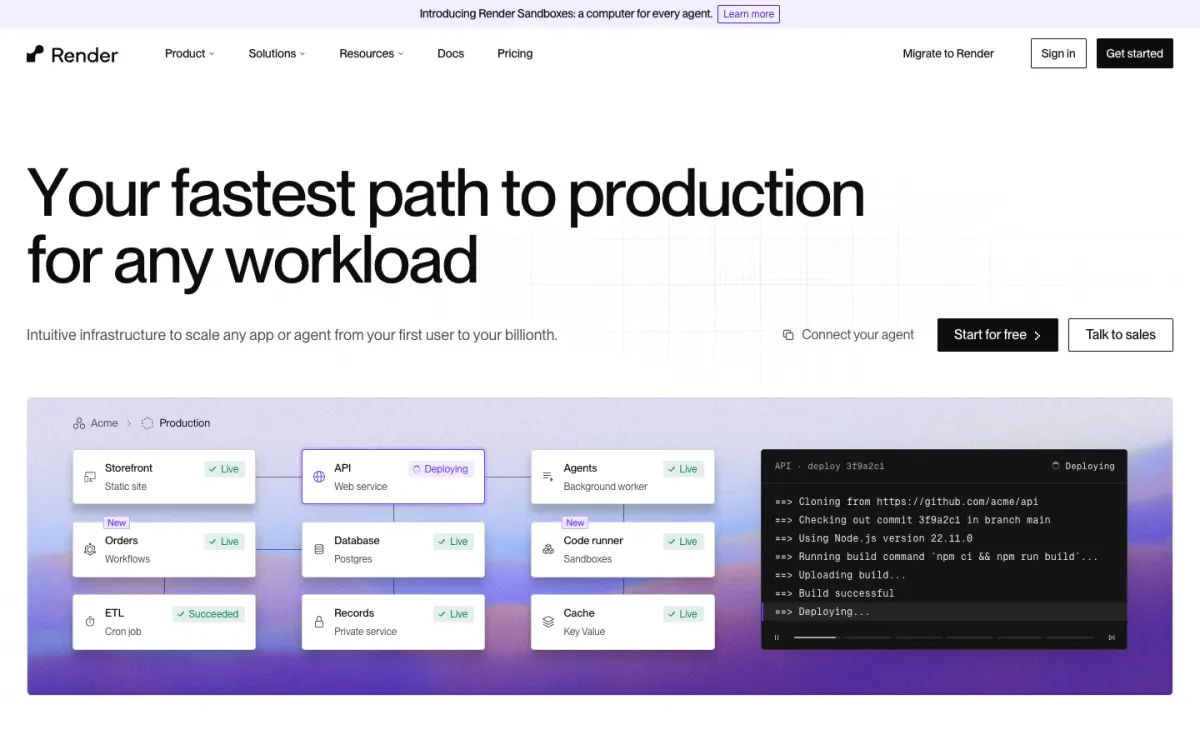
What it is. A platform for web services, background workers, cron jobs, static sites, managed Postgres, and a Redis-compatible Key Value store, deployed from Git or a Docker image.
Why it replaces Railway. The same Git-based workflow, but with fixed prices: a service on the $7 instance costs $7 every month, whatever its traffic. Render Postgres is fully managed, with point-in-time recovery, high availability, and read replicas, and static sites are free. Pro workspaces add preview environments for the whole stack and autoscaling.
Pricing. The Hobby workspace is free for one person. Pro is $25 a month with unlimited seats, plus compute. Web services start at $7 a month (512 MB), $25 for 1 CPU and 2 GB. Postgres starts at $6 a month. A free web service sleeps after 15 minutes idle and takes about a minute to wake.
The catch. Bandwidth is metered: 5 GB a month on Hobby and 25 GB on Pro, then $0.15 per GB. Our Render vs Railway comparison goes deeper.
2. Northflank: best free tier that doesn’t sleep
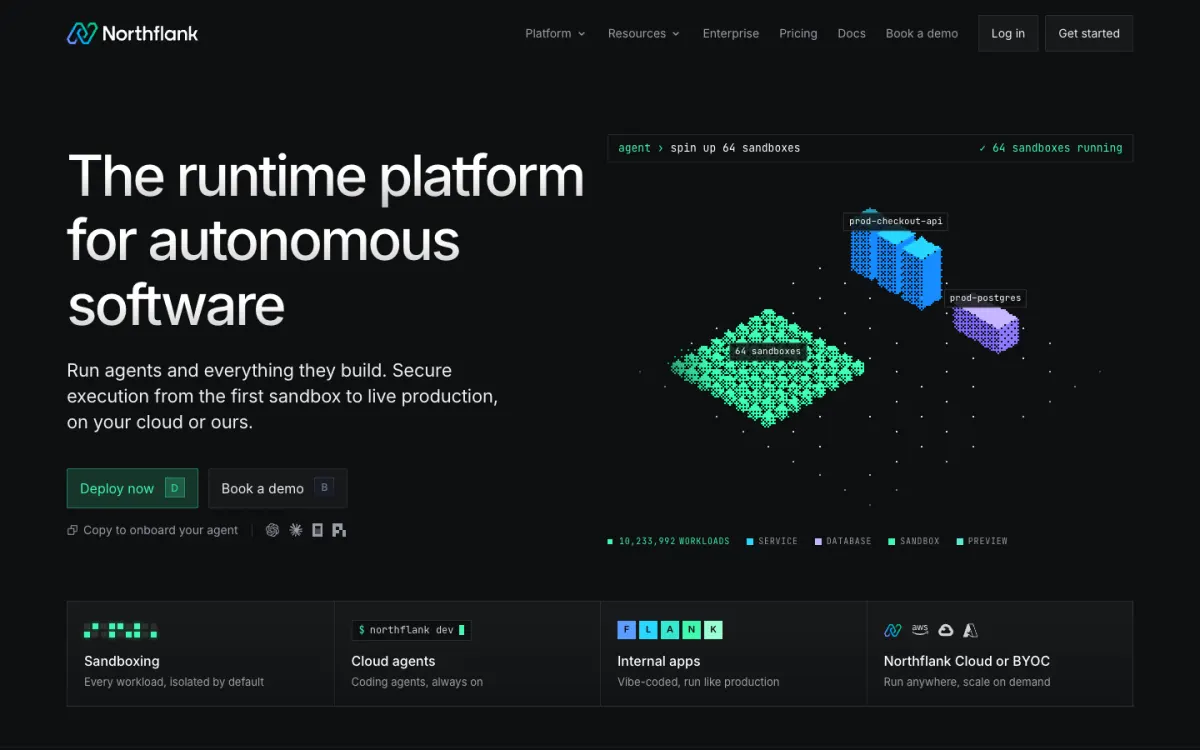
What it is. A platform for services, jobs, and databases, on Northflank’s cloud or in your own AWS, GCP, or Azure account.
Why it replaces Railway. Its free Sandbox gives you 2 services, 2 jobs, and a database that stay running, with no card required, which is far more than Railway’s $1 of monthly credit. Billing is per second like Railway’s, and preview environments and cron jobs are built in.
Pricing. $0.01667 per vCPU-hour and $0.00833 per GB-hour, so the smallest service costs about $2.70 a month.
The catch. The dashboard has more options than Railway’s canvas, so it takes longer to learn.
3. Static.app: best for static sites and frontends
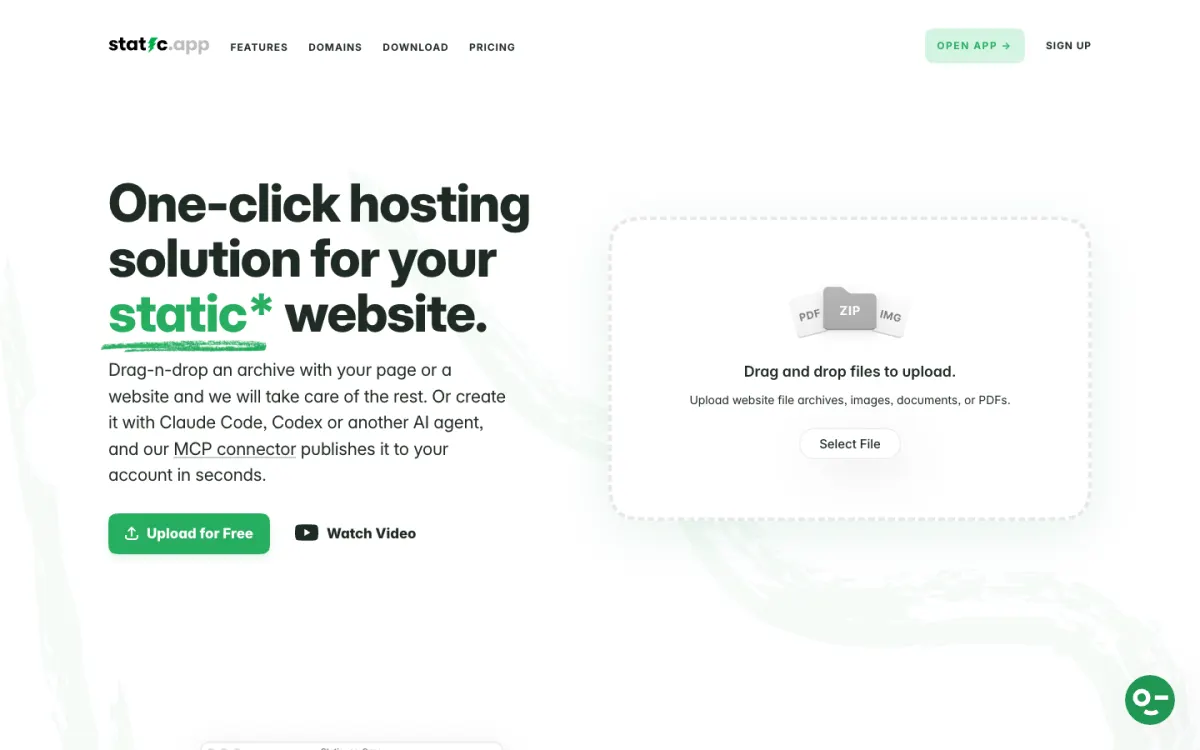
What it is. A static website host. You publish a folder or ZIP by drag-and-drop, with free SSL, built-in forms, cookieless analytics, and password protection.
Why it replaces Railway. Many Railway services exist only to serve a marketing site, documentation, or a single-page app with a small Node server in front of it. If the project builds to HTML, CSS, and JavaScript, including a Next.js static export, Astro, or Vite build, Static.app hosts it with no server, flat pricing, and unlimited traffic, so there’s no compute or egress to pay for. Built-in forms replace the endpoint many sites only kept for a contact form.
Pricing. A 7-day free trial without a card. Starter is $6 a month, or $5 billed yearly, for 2 sites with custom domains. Medium is $12 for 7 sites, and Large $18 for 30.
The catch. Static only: no server runtime, database, or background workers. If your app has an API, host the frontend here and keep the backend on Railway or another platform in this list.
4. Fly.io: best for global apps
What it is. A platform that runs your app as lightweight virtual machines in 18 regions, deployed from a Dockerfile with the flyctl command line.
Why it replaces Railway. It covers far more regions, so you can run the app close to users in several parts of the world at once. Billing is per second, and small machines are cheap.
Pricing. A shared-CPU machine with 256 MB costs about $2.19 a month, and invoices under $5 aren’t charged. Managed Postgres starts at $38 a month with high availability.
The catch. It’s more hands-on than Railway, with configuration in a fly.toml file, and managed Postgres is expensive for a small app.
5. DigitalOcean App Platform: simplest fixed pricing
What it is. DigitalOcean’s managed platform for web services, workers, jobs, and static sites, deployed from GitHub, GitLab, a container registry, or a Dockerfile.
Why it replaces Railway. Each container has a fixed monthly price, so the bill doesn’t move with usage, and it reads Heroku-style buildpacks.
Pricing. Three static sites are free. Web services start at $5 a month for 512 MiB. A development database is $7 a month, and managed PostgreSQL starts at $15.15.
The catch. The development database has no backups, so production apps need the managed database.
6. Heroku: the mature original
What it is. The original platform for git push deploys, with dynos, Heroku Postgres, and a large add-on marketplace.
Why it replaces Railway. Fixed dyno prices and a long list of add-ons for email, logging, search, and monitoring.
Pricing. Eco dynos are $5 a month for personal accounts and sleep after 30 minutes idle. Basic dynos are $7 a month, and Standard dynos $25 to $50.
The catch. Heroku moved to a “sustaining engineering” model in February 2026, focused on stability rather than new features, and production features start at the Standard tier. See our Heroku alternatives guide.
7. Koyeb: serverless containers
What it is. A serverless platform that deploys from GitHub or a Docker image to regions in the US, Europe, and Asia, with autoscaling and scale-to-zero.
Why it replaces Railway. Apps scale down to zero when idle, so you don’t pay for quiet hours, and managed Postgres is included.
Pricing. One small free instance per organization, which scales to zero after an hour idle. Pro is $29 a month plus compute, from about $1.61 a month per small instance. Koyeb has announced it is joining Mistral AI.
The catch. The $29 Pro plan costs more than Railway Hobby for a single small app.
8. Coolify: best self-hosted Railway
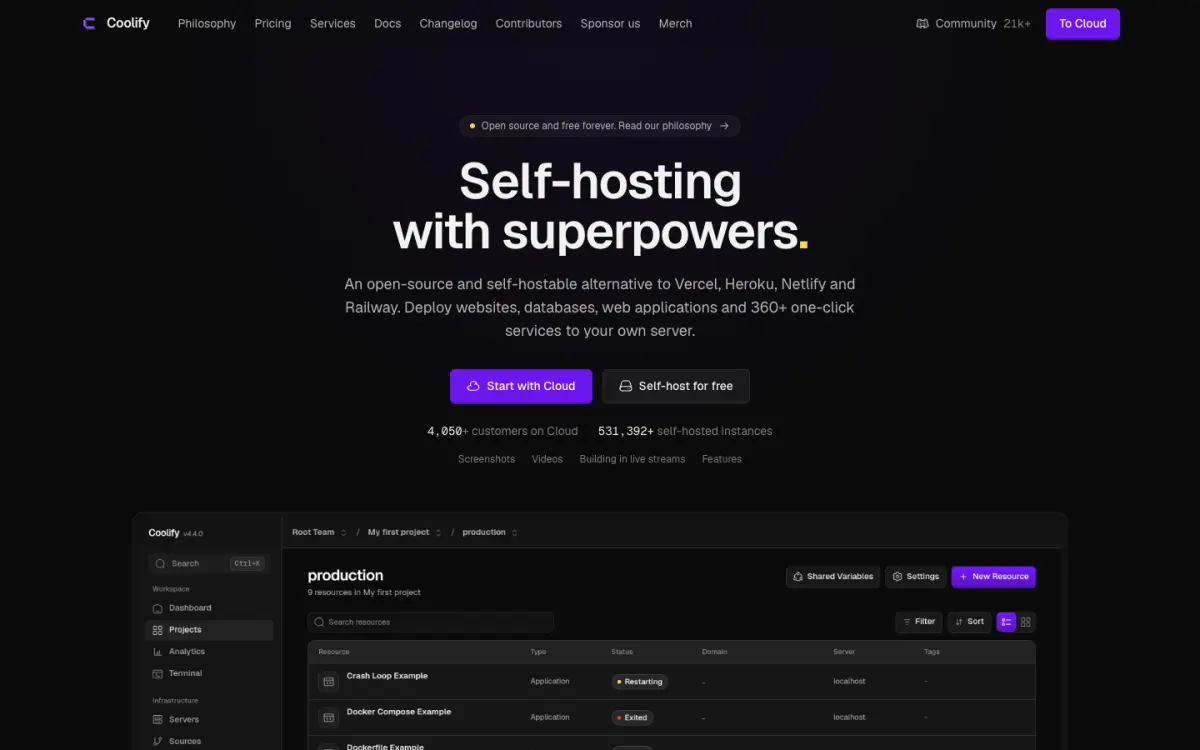
What it is. An open-source, Apache-2.0 platform that turns your own servers into a Railway-like dashboard: deploy from Git with Nixpacks, a Dockerfile, or Docker Compose, with one-click databases and more than 360 one-click services.
Why it replaces Railway. A VPS with a few gigabytes of RAM costs a fixed few dollars a month, and Coolify runs as many apps and databases on it as fit, with no usage billing.
Pricing. Free to self-host. Coolify Cloud runs the dashboard for you from $5 a month for 2 servers, plus $3 for each extra server, and you bring your own servers.
The catch. You’re responsible for the servers, backups, and security updates. Our Coolify vs Dokploy comparison covers both self-hosted options.
9. Dokploy: self-hosted with Docker Swarm
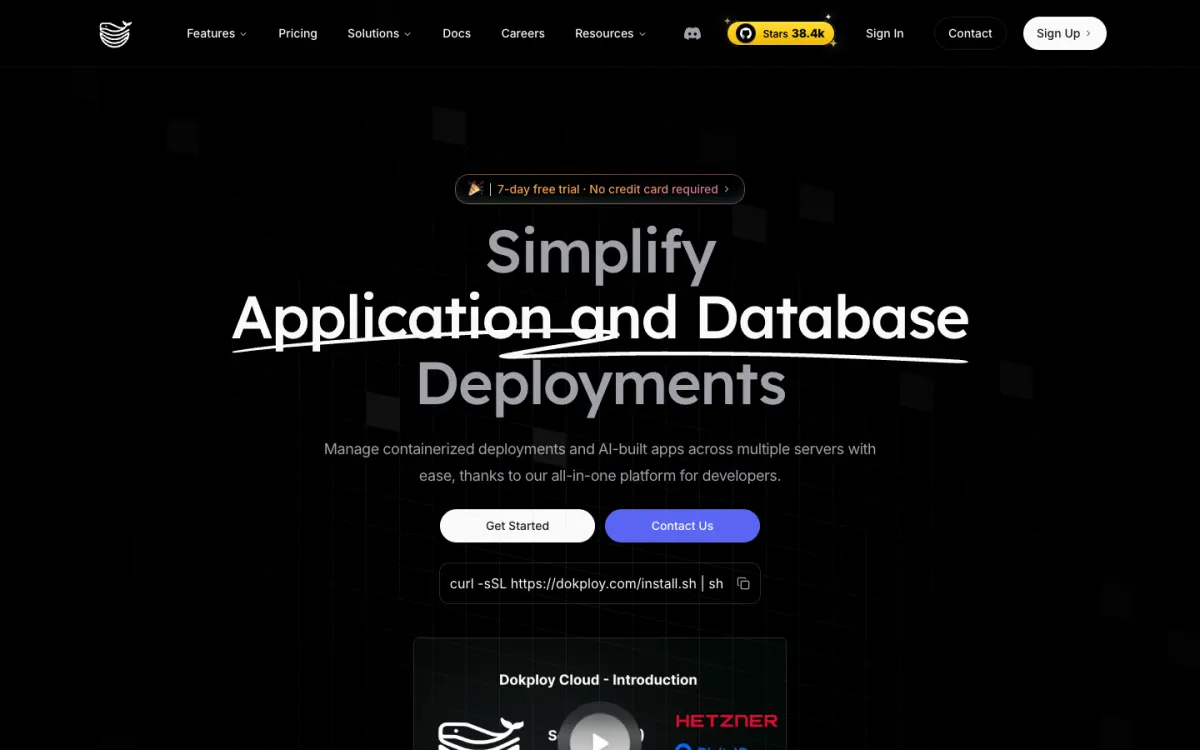
What it is. An open-source, self-hosted platform for apps and databases (Postgres, MySQL, MariaDB, MongoDB, and Redis) with Docker Compose, Docker Swarm clusters, Traefik routing, and scheduled backups.
Why it replaces Railway. Like Coolify, it puts your apps on servers you control at a fixed price, and Docker Swarm support makes multi-server setups straightforward.
Pricing. Free to self-host. Dokploy Cloud’s Hobby plan is $4.50 a month for one server, and Startup starts at $15 a month for up to 3 servers.
The catch. Most of the code is Apache-2.0, but the license reserves anything in a proprietary folder for paying customers, so read the terms if you plan to build on or resell it. It’s also younger than Coolify, at version 0.31.
Which Railway alternative should you choose?
- You want predictable bills and managed Postgres: Render.
- You want a free tier that keeps running: Northflank.
- Your project is a static site or frontend: Static.app.
- Your users are around the world: Fly.io.
- You want a fixed price per container: DigitalOcean App Platform.
- You want to run your own servers: Coolify or Dokploy.
How to move an app off Railway
- List the services. Each box on the Railway canvas becomes a service, worker, cron job, or database on the new platform.
- Copy variables. Export each service’s variables from the Railway dashboard or with
railway variables, and recreate them. Replace Railway’s reference variables, such as${{Postgres.DATABASE_URL}}, with the new database’s connection string. - Move the database. Dump it with
pg_dumpusing the public connection URL, and restore it withpg_restoreinto the new Postgres. - Move volumes. Copy files from any volume to the new platform’s disk or to object storage.
- Switch DNS once the new app passes your checks, then remove the Railway services.
After the move, set up uptime monitoring on the new URL so you know if anything breaks.
FAQ
What is the best alternative to Railway?
Render is the best overall alternative, with the same Git-based workflow, fixed instance prices from $7 a month, managed Postgres, and free static sites. Northflank is better if you want a free tier that doesn’t sleep, Fly.io for global regions, and Coolify for self-hosting.
Is there a free alternative to Railway?
Northflank’s free Sandbox keeps 2 services, 2 jobs, and a database running at no cost. Render’s free web services sleep after 15 minutes idle. Coolify and Dokploy are free if you run them on your own server, and static sites can go on a static host instead.
Is Render cheaper than Railway?
It depends on the app. Railway is often cheaper for small apps that are idle much of the time, because it bills actual usage. Render is easier to predict and can be cheaper for apps that hold memory all month, with fixed instances from $7 a month.
Why is my Railway bill so high?
Railway bills memory, CPU, and egress by the second. Services that hold a lot of memory, databases that run all month, extra replicas, and environments for every pull request all add usage. Check the usage page for the costliest service, lower its memory, or set a usage limit in the workspace settings.
Can I self-host something like Railway?
Yes. Coolify and Dokploy are open-source platforms that give you a Railway-style dashboard on your own server, with Git deploys, one-click databases, and SSL. You pay only for the server, but you’re responsible for updates and backups.
Where should I host a static site I deployed on Railway?
On a static host. Static.app publishes a folder or ZIP by drag-and-drop from $6 a month with unlimited traffic, and Render serves static sites for free with metered bandwidth. Neither needs a running server.
Build your Bootstrap theme
Design a custom Bootstrap 5 theme visually with a live preview, then export clean Sass or CSS.
Open the Builder