Render vs Railway (2026): Pricing, Free Tiers and Verdict
Render and Railway are the two most popular places to deploy a full-stack app after Heroku: connect a Git repository, and each one builds and runs your web service, workers, cron jobs, and database, with HTTPS on your own domain. The difference is how they charge. Render sells fixed instance sizes on top of a workspace plan, so the bill is predictable. Railway bills the CPU and memory your services actually use, by the second, so small and idle apps cost less but the bill moves with your traffic. This comparison covers both as they are in November 2026, with prices from each vendor’s pricing page.
The short answer
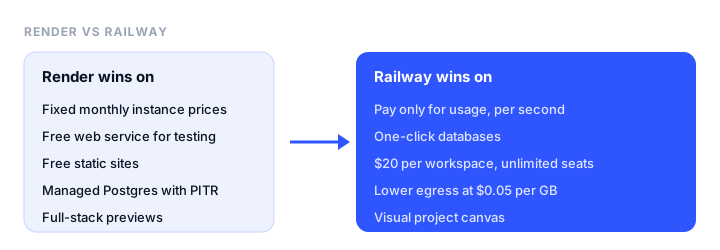
Choose Render if:
- You want a fixed monthly price per service, the same every month.
- You want a free web service to test with, and a free static site host.
- You want managed Postgres with point-in-time recovery, high availability, and read replicas.
- Your team values features like preview environments for the whole stack and autoscaling.
Choose Railway if:
- Your apps are small or idle much of the time, so paying for actual usage is cheaper than a fixed instance.
- You want to add Postgres, MySQL, Redis, or MongoDB in one click, as a service next to your app.
- You have a team: Pro is $20 a month per workspace with unlimited seats.
- You like a visual canvas that shows every service and how they connect.
Render vs Railway at a glance
| Render | Railway | |
|---|---|---|
| Pricing model | Workspace plan + fixed instance prices | Plan fee that includes usage credit, then per-second usage |
| Free option | Free web service (sleeps after 15 min), free static sites, free Postgres for 30 days | $5 trial credit for 30 days, then $1 of credit a month |
| Entry paid plan | Hobby workspace $0 + Starter instance $7/mo | Hobby $5/mo including $5 of usage |
| Team plan | Pro $25/mo per workspace + compute | Pro $20/mo per workspace, $20 of usage included |
| Smallest always-on service | $7/mo (512 MB, less than 1 CPU) | Usage-based: about $10 per GB of RAM and $20 per vCPU a month |
| Postgres | Managed, from $6/mo, PITR, HA and replicas | One-click Postgres template on a volume, billed as usage |
| Static sites | Free | Served by a service, billed as usage |
| Bandwidth | 5 GB (Hobby), 25 GB (Pro), then $0.15/GB | $0.05/GB egress |
| Custom domains | 2 (Hobby), 15 (Pro), then $0.25/domain/mo | Included on paid plans |
| Regions | Oregon, Ohio, Virginia, Frankfurt, Singapore | California, Virginia, Amsterdam, Singapore |
| Seats | 1 on Hobby, unlimited on Pro | 3 per project on Hobby, unlimited on Pro |
Pricing
How Render charges
Render bills three things: a workspace plan, compute for each service, and metered extras such as bandwidth and build minutes.
- Workspace plans. Hobby is free for one person and up to 25 services. Pro is $25 a month with unlimited seats and services, full-stack preview environments, and autoscaling. Scale is $499 a month for larger organizations.
- Compute. Web services and workers have fixed sizes: free (512 MB, sleeps when idle), $7 a month (512 MB, less than one CPU), $25 (1 CPU, 2 GB), $85 (2 CPU, 4 GB), and up. Billing is prorated by the second if you delete a service.
- Postgres. Free for 30 days (1 GB), then from $6 a month for 256 MB of RAM, $19 for 1 GB, and $40 for 1 CPU and 2 GB. Storage is $0.30 per GB.
- Extras. Hobby includes 5 GB of bandwidth and 500 build minutes a month; Pro includes 25 GB and 1,000 minutes. Bandwidth beyond that is $0.15 per GB.
A small production app on Render, with one web service and the smallest paid database, costs about $13 a month on the free Hobby workspace, or $38 on Pro.
How Railway charges
Railway bills a plan fee that includes the same amount of usage, then charges per second for what your services use.
- Plans. The free trial gives $5 of credit for 30 days. After that, the Free plan includes $1 of credit a month, with services limited to 1 vCPU and 0.5 GB. Hobby is $5 a month including $5 of usage. Pro is $20 a month per workspace, with $20 of usage included and unlimited seats.
- Usage. Memory costs about $10 per GB a month, CPU about $20 per vCPU a month, volume storage $0.15 per GB, and egress $0.05 per GB. Stopped services cost nothing.
A small app that uses a fraction of a CPU and 256 MB of RAM, with a small Postgres database, can stay within the $5 Hobby credit. An app that holds 1 GB of RAM all month uses $10 of memory on its own, before CPU.
Which is cheaper?
For hobby projects and apps that sit idle most of the day, Railway is usually cheaper, because you don’t pay for capacity you don’t use. For steady production traffic, Render is easier to predict, and its fixed instances can work out cheaper than holding the same memory on Railway all month. For teams, Railway Pro at $20 per workspace undercuts Render Pro at $25 plus compute.
Watch Render’s bandwidth: 5 GB a month on Hobby is small for a site with images, and $0.15 per GB beyond that is three times Railway’s egress rate.
Free plans
Render’s free tier is the more useful one for testing. A free web service has 512 MB of memory and sleeps after 15 minutes without traffic; the next request wakes it in about a minute. Each workspace gets 750 free instance hours a month. A free Postgres database is limited to 1 GB and expires after 30 days, and static sites are free with no time limit.
Railway’s free option is a 30-day trial with $5 of credit, then $1 of credit a month on the Free plan. That’s enough for a tiny service or a short experiment, not for an app that runs all month.
Neither free tier is meant for production.
Deploys and developer experience
Both platforms deploy on every push to GitHub, detect the language automatically or use your Dockerfile, run a pre-deploy command for migrations, and roll back with one click.
- Render uses a dashboard organized by service and a
render.yamlblueprint to describe the whole app as code. Pro adds preview environments that copy the full stack, including databases, for each pull request. - Railway shows each project as a canvas, with services, databases, and volumes as connected boxes. Environments such as staging are copies of the project, and pull request environments are built in. Its
railwayCLI runs your code locally with the project’s environment variables.
Railway feels faster to start with, especially when an app needs several services and a database. Render feels more structured for teams that want separate services, roles, and audit logs.
Databases
This is the clearest difference.
- Render Postgres is a managed product: backups, point-in-time recovery (3 days on Hobby, 7 on Pro), high availability, read replicas, connection pooling, and storage you can expand. Render also has a Redis-compatible Key Value store from $10 a month.
- Railway deploys Postgres, MySQL, Redis, and MongoDB from templates as services with a volume, in one click, billed by usage like everything else. It’s fast and cheap for small databases, but backups, replication, and upgrades are more your responsibility.
For a production database you’d rather not manage, Render has the edge. For a side project, Railway’s one-click databases are hard to beat.
Regions and scaling
Render runs in Oregon, Ohio, Virginia, Frankfurt, and Singapore, and Pro adds horizontal autoscaling. Railway runs in California, Virginia, Amsterdam, and Singapore, and scales by replicas: up to 6 per service on Hobby and 42 on Pro, with per-service limits of 48 vCPU and 48 GB on Hobby.
Which should you choose?
- A side project or prototype: Railway, for one-click databases and usage pricing that stays inside the $5 Hobby credit.
- A production app with a steady load: Render, for fixed prices and managed Postgres.
- A team of five developers: Railway Pro ($20 a month, unlimited seats) or Render Pro ($25 a month, unlimited seats), plus compute. Both are far cheaper than per-seat platforms.
- An app that must never sleep, on a tiny budget: a $7 Render instance, or a Railway service that fits within the Hobby credit.
- A frontend or static site with no server: neither. A static host is simpler and cheaper.
If your project is only a static site
Many projects deployed to Render or Railway are a marketing site, documentation, or a single-page app built with React or Vue. These don’t need a server. Static.app publishes a folder or ZIP of HTML, CSS, and JavaScript by drag-and-drop, from $6 a month with unlimited traffic, forms, and free SSL, so you aren’t paying for compute or bandwidth. Our guide to static website hosting compares more options.
For more choices, see our Render alternatives, Railway alternatives, and Heroku alternatives guides.
FAQ
Is Render or Railway better?
Render is better for predictable pricing and managed Postgres, with fixed instances from $7 a month. Railway is better for small or idle apps and one-click databases, because you pay only for the CPU and memory you use, from $5 a month including $5 of usage.
Is Railway cheaper than Render?
For small apps that are idle much of the time, usually yes, since Railway bills usage by the second and its Hobby plan includes $5 of usage. For apps that hold memory all month, Render’s fixed instances can be cheaper. For teams, Railway Pro is $20 per workspace, against $25 plus compute on Render Pro.
Does Render or Railway have a free tier?
Render has a free web service that sleeps after 15 minutes idle, free static sites, and a free Postgres database that expires after 30 days. Railway has a 30-day trial with $5 of credit, then a Free plan with $1 of credit a month.
Does Railway sleep like Render’s free tier?
Railway services don’t sleep by default on paid plans: they run and bill continuously. Railway has an optional serverless setting that stops idle services to save usage. Render’s free web services always sleep after 15 minutes without traffic, while its paid instances stay on.
Can I move an app from Render to Railway or back?
Yes. Both deploy from the same Git repository or Dockerfile, so moving the app means connecting the repository, copying environment variables, and moving the database with pg_dump and pg_restore. Then point your domain’s DNS at the new service.
Which is better for a Heroku replacement?
Render is the closer match to Heroku, with web services, background workers, cron jobs, and managed Postgres that map one to one. Railway suits teams who want lower costs for small apps and don’t mind usage-based billing.
Build your Bootstrap theme
Design a custom Bootstrap 5 theme visually with a live preview, then export clean Sass or CSS.
Open the Builder