Google Analytics Alternatives: 10 Best Tools for 2026
Google Analytics 4 is free and powerful, and for many site owners it is also the wrong tool. Its reports take training to read, it needs a cookie consent banner in the EU and UK, which means losing data from everyone who declines, and its tag is the heaviest analytics script you can add to a page. If you mostly want to know how many people visited, where they came from, and what they read, a simpler tool answers that faster, and many do it without cookies at all.
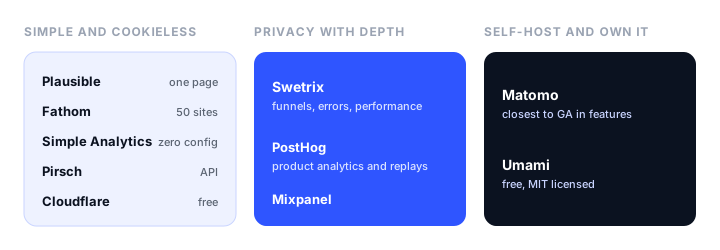
This guide compares ten Google Analytics alternatives in November 2026: privacy-first dashboards, open-source tools you can host yourself, and product analytics for apps. Prices are from each vendor’s own pricing page; several show prices in your local currency, so confirm the final figure before you buy.
The short version:
- Best overall Google Analytics alternative: Swetrix, cookieless and EU-hosted, with funnels, error tracking, and performance data alongside traffic.
- Simplest dashboard: Plausible, with everything on one page.
- Best for agencies: Fathom, with 50 sites on the entry plan.
- Closest to GA in features, self-hosted: Matomo.
- Best for SaaS and product teams: PostHog, with a generous free tier.
- Best free self-hosted option: Umami.
- Best developer API: Pirsch, from $6 a month.
- Easiest zero-config option: Simple Analytics.
- Best free hosted option: Cloudflare Web Analytics.
- Best for funnels and retention: Mixpanel.
Why people replace Google Analytics
- Consent banners cost you data. GA4 sets cookies and collects identifiers, so in the EU and UK it needs consent first. Every visitor who declines or ignores the banner disappears from your reports, and on many sites that is a large share of traffic. Cookieless tools are designed to count visits without that consent step.
- It is hard to use. GA4 is built around events and custom reports. Questions that used to be one click, such as which pages people landed on from a campaign, now mean building an exploration.
- Data limits. The free version keeps detailed event data for at most 14 months, and reports can apply thresholds that hide rows when numbers are small.
- The script is heavy. The Google tag is about 155 KB compressed, against roughly 1 to 7 KB for the alternatives here, which matters for Core Web Vitals on a fast static site.
- Your data feeds Google. For some businesses and regulated industries, sending visitor data to Google is the problem in itself.
GA4 is still the right choice if you run Google Ads and need conversion tracking through to revenue, or if your team works in BigQuery: its free export of raw events is hard to match. Many sites run a privacy-first tool for day-to-day reporting and keep GA4 only for ad conversions.
Google Analytics alternatives at a glance
| Tool | Free option | Paid from | Self-host | Cookieless | Best for |
|---|---|---|---|---|---|
| Swetrix | Self-hosted free, 14-day trial | €17/mo | Yes (AGPLv3) | Yes | Privacy plus product depth |
| Plausible | Self-hosted free, 30-day trial | $9/mo (10K pageviews) | Yes (AGPLv3) | Yes | The simplest dashboard |
| Fathom | 7-day trial | $15/mo (100K pageviews, 50 sites) | No | Yes | Agencies |
| Matomo | Self-hosted free, 21-day cloud trial | About €29/mo cloud | Yes | Optional mode | GA-like features you own |
| PostHog | 1M events a month | Usage-based | Yes | Configurable | SaaS product analytics |
| Umami | Self-hosted free; cloud Hobby free | $20/mo cloud Pro | Yes (MIT) | Yes | Free self-hosting |
| Pirsch | 30-day trial | $6/mo (10K pageviews, 50 sites) | Enterprise only | Yes | Developer API |
| Simple Analytics | Free plan, 5 sites | €20/mo | No | Yes | Zero configuration |
| Cloudflare Web Analytics | Free | Free | No | Yes | Free hosted basics |
| Mixpanel | 1M events a month | From $100/mo (yearly) | No | No | Funnels and retention |
| Google Analytics 4, for comparison | Free | GA360 by quote | No | No, needs consent | Google Ads and BigQuery |
The best Google Analytics alternatives, reviewed
1. Swetrix: best overall Google Analytics alternative
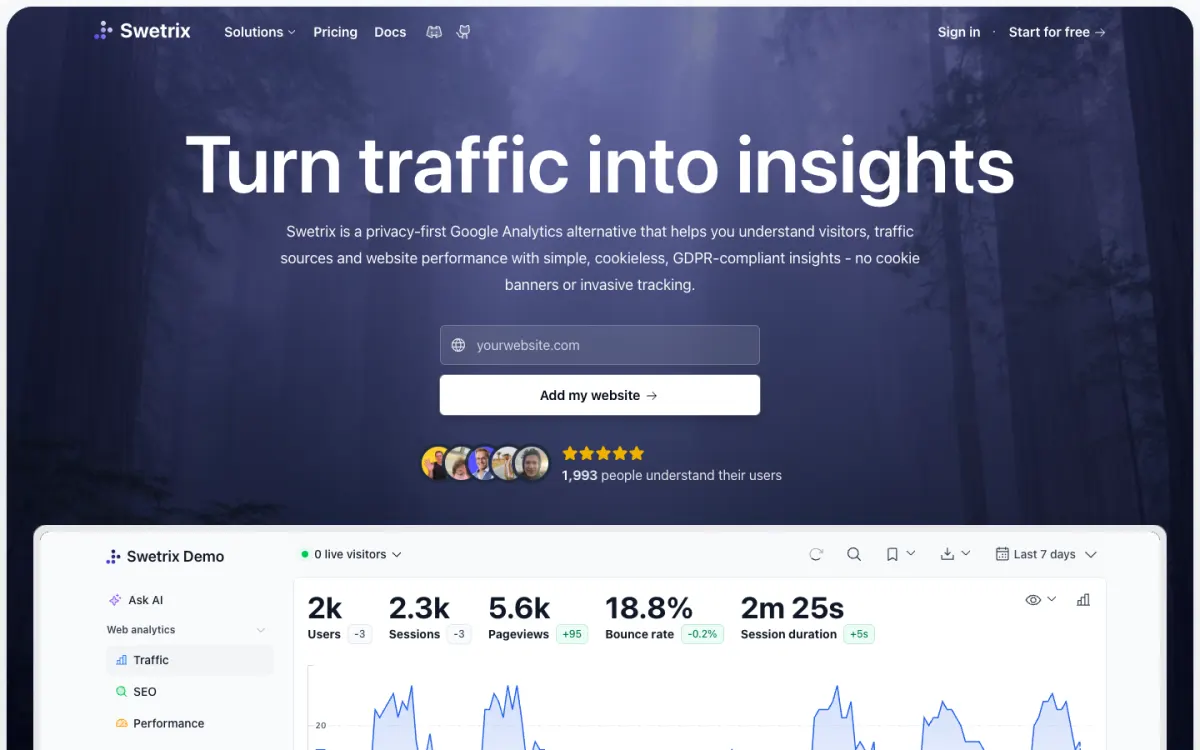
What it is. Swetrix is open-source, cookieless web analytics, hosted in the EU, that goes well past a traffic dashboard.
Why it replaces GA. It covers the reports most people opened GA for, top pages, sources, UTM campaigns, countries, and devices, on one screen, and adds what GA4 makes you build or buy elsewhere: events and goals, funnels, sessions with anonymous profiles, revenue analytics with Stripe and Paddle, error tracking, and real-user performance timings, plus an AI assistant for questions about your data. The Plus plan adds session replays, feature flags, and A/B testing. The script is under 5 KB and handles single-page app routing out of the box.
What to know. It is not a Google Ads conversion tool, and the cloud plans start higher than the simplest dashboards. The self-hosted Community Edition is free, and since October 2026 records session replays to your own S3 bucket.
Pricing. Cloud Standard from €17/mo, Plus from €35/mo, 17% off yearly. Self-hosted: free. 14-day free trial.
2. Plausible: simplest dashboard
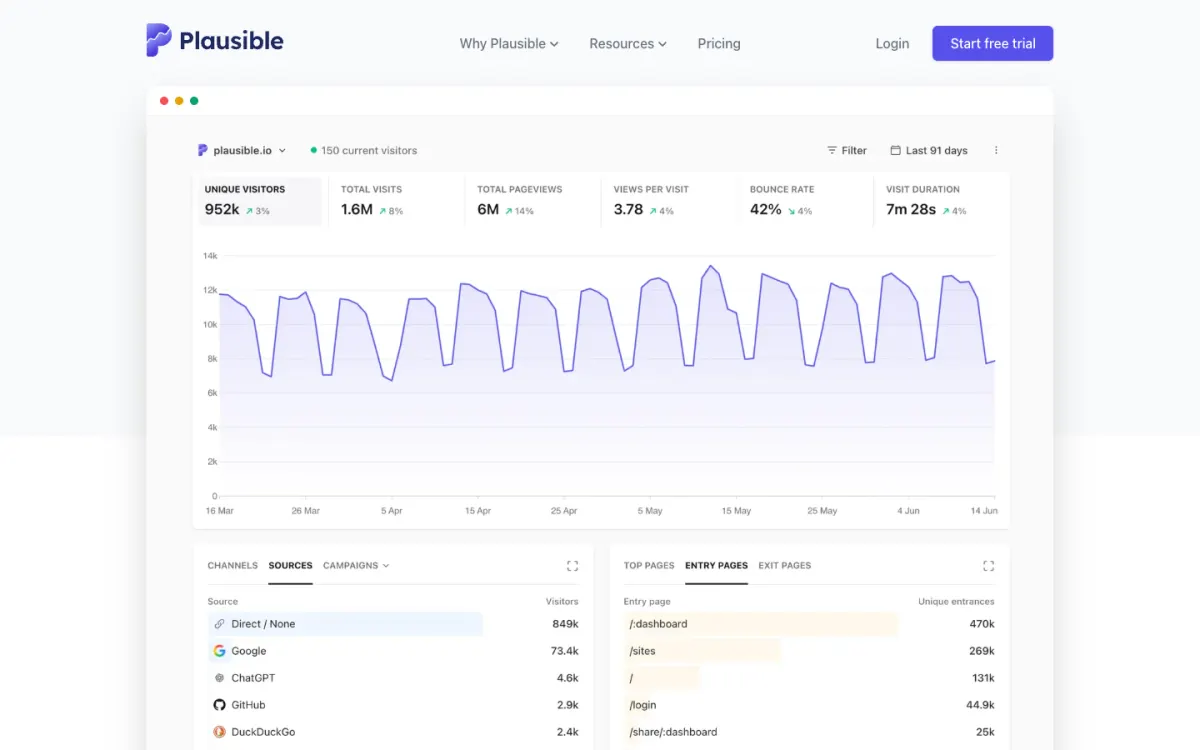
What it is. Plausible is open-source, cookieless analytics hosted in Germany, with every report on a single page.
Why it replaces GA. Visitors, pageviews, bounce rate, visit duration, top pages, sources, and countries, readable at a glance by anyone, with a script of under 3 KB. It also reports traffic from AI tools such as ChatGPT and Perplexity, and it can import your historical Google Analytics data so your charts don’t start from zero.
What to know. No session replay, A/B testing, or error tracking. The self-hosted Community Edition leaves out funnels, revenue goals, and SSO.
Pricing. Starter $9/mo (1 site, 10K pageviews), Growth $14/mo (3 sites), Business $19/mo (10 sites, Stats API, funnels, revenue attribution). Two months free yearly. 30-day free trial.
3. Fathom: best for agencies
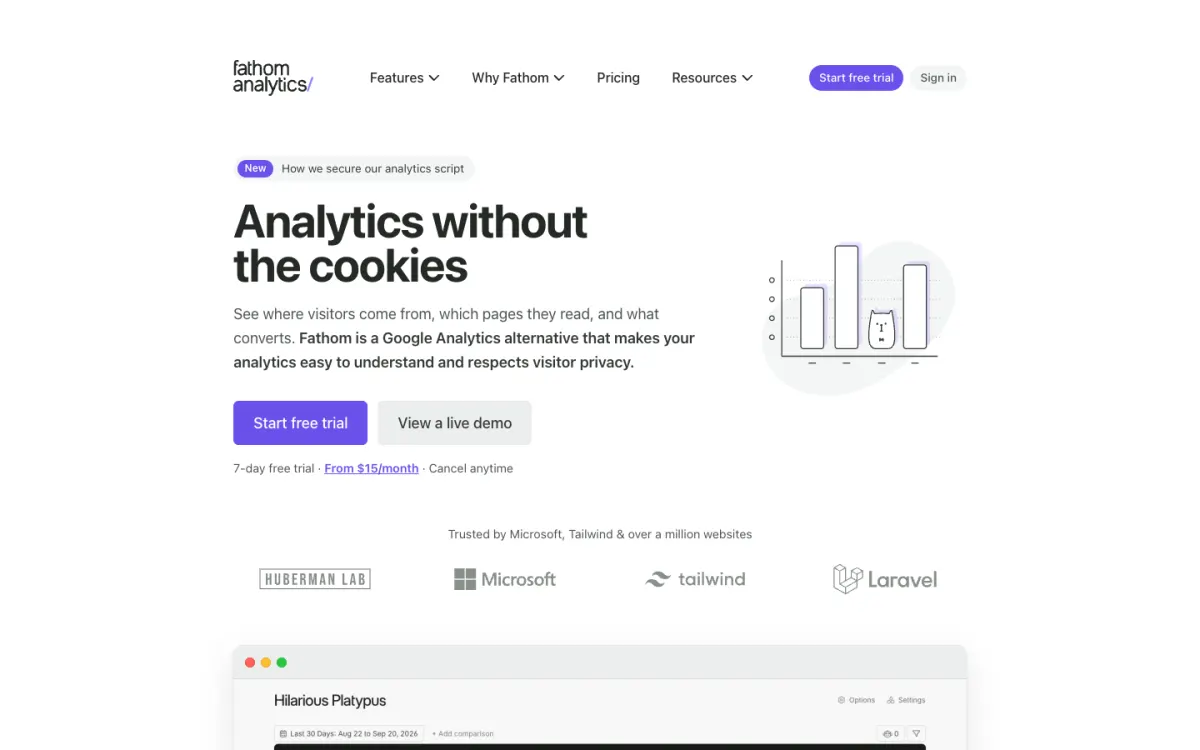
What it is. Fathom is cookieless, privacy-first analytics with a polished dashboard. Visits from the EU go through EU servers that strip the IP address before anything is stored.
Why it replaces GA. The entry plan covers 50 sites, and more come in packs of 50, so an agency can give every client a clear dashboard for one bill. Recent additions include an AI referrer report, an AI assistant for questions about your stats, and firewall rules to keep unwanted traffic out of the numbers.
What to know. It is a traffic tool, not product analytics, and there is no self-hosted version or free plan.
Pricing. From $15/mo (100K pageviews, 50 sites); extra 50-site packs $10/mo. Two months free yearly. 7-day free trial.
4. Matomo: closest to GA in features

What it is. Matomo, formerly Piwik, is the open-source analytics platform with the broadest feature set here: ecommerce tracking, goals, funnels, heatmaps, session recordings, A/B testing, and a plugin marketplace.
Why it replaces GA. It feels the most like Google Analytics, so teams that rely on detailed reports lose the least when they switch, and self-hosting gives you complete ownership of the data, which suits healthcare, finance, and government. A Google Analytics importer brings your history across.
What to know. Self-hosting needs server administration. The most useful extras, heatmaps, session recordings, and A/B testing, are paid add-ons even when you host it yourself. Cookieless tracking is an option you turn on, not the default.
Pricing. Self-hosted: free. Cloud from about €29/mo for 50K hits, with a 21-day free trial.
5. PostHog: best for SaaS and product teams
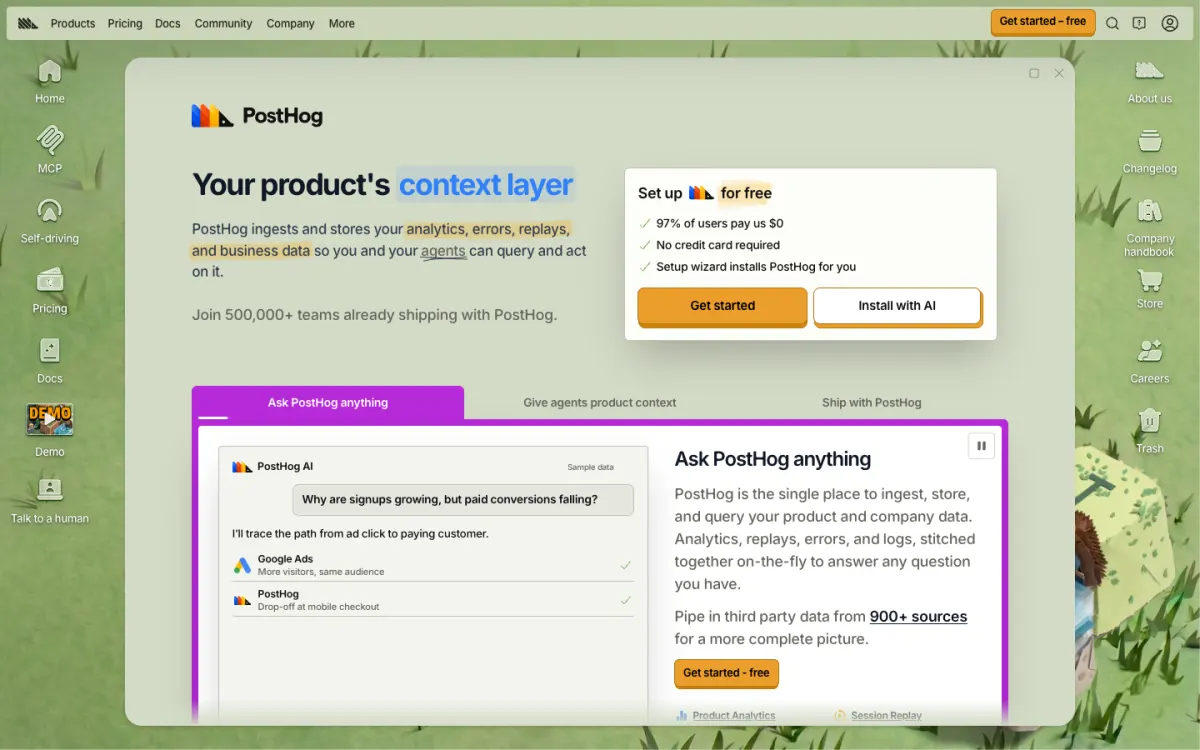
What it is. PostHog is an open-source product platform: product analytics, a web analytics dashboard, session replay, feature flags, A/B testing, error tracking, and surveys.
Why it replaces GA. For an app, it answers what GA4 struggles with: what signed-in users do, where they drop off, and which release changed it. The free tier is large, web analytics counts toward the same event allowance, and Core Web Vitals from real visitors are included on every plan.
What to know. It is more than a blog or marketing site needs, and usage-based pricing takes watching as traffic grows.
Pricing. Free each month: 1M analytics events, 5K session replays, 1M feature flag requests, 100K exceptions. Then pay as you go, from $0.05 per 1,000 events.
6. Umami: best free self-hosted option
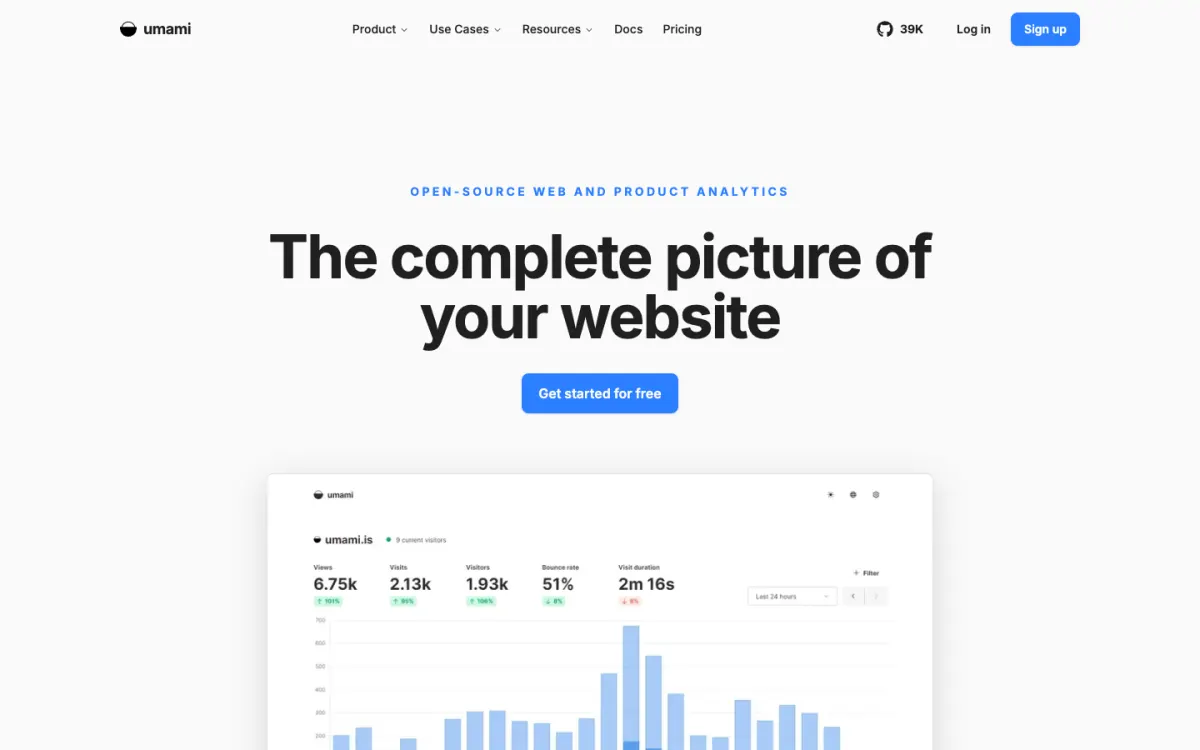
What it is. Umami is lightweight, open-source, cookieless analytics under the MIT license, which you can deploy on your own server in minutes, or use on Umami Cloud.
Why it replaces GA. It is free, simple, and yours: pageviews, events, referrers, and devices in a clean interface, for as many sites and users as you like. Since version 3.1 it can also collect Core Web Vitals and TTFB from real visitors.
What to know. Funnels and journeys are basic, and you maintain the server and database yourself unless you pay for the cloud.
Pricing. Self-hosted: free. Cloud Hobby free (100K events a month, 1 site, 6 months of data), Pro $20/mo (1M events, 20 sites), Business $200/mo.
7. Pirsch: best developer API
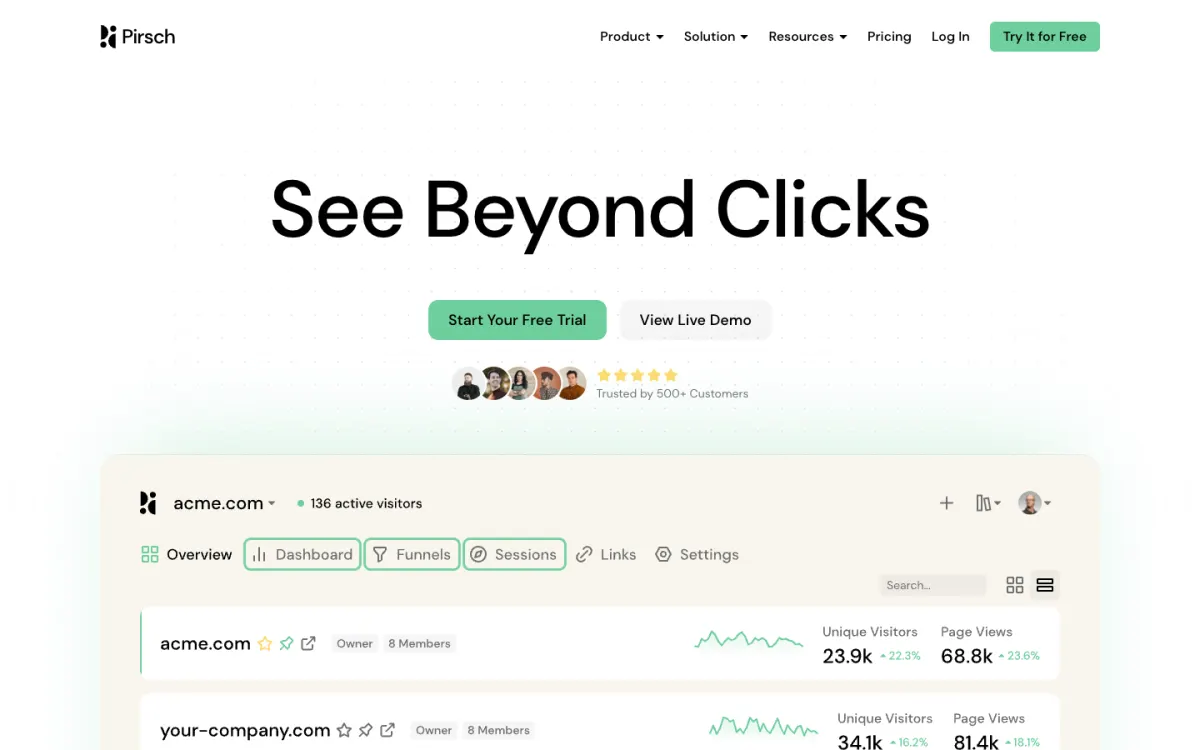
What it is. Pirsch is cookieless analytics made and hosted in Germany, with a strong REST API and SDKs.
Why it replaces GA. It is the cheapest paid option here, covers 50 sites on the entry plan, keeps data with no retention limit, and has a Google Analytics importer. The API makes it easy to build your own dashboards or pull numbers into other tools.
What to know. Funnels, A/B testing, and unlimited sites start on Plus. Self-hosting is Enterprise only.
Pricing. Standard from $6/mo (10K pageviews, 50 sites). Plus from $12/mo. Unlimited team members and data retention on all plans. 30-day free trial.
8. Simple Analytics: easiest zero-config option
What it is. Simple Analytics is cookieless analytics with data stored in the Netherlands, designed to need no setup at all.
Why it replaces GA. Add one script tag and you are done: no events to configure, no reports to build. Extras include an AI assistant, automated email reports, and public dashboards.
What to know. It is deliberately simple, so teams that need funnels or product analytics will outgrow it.
Pricing. Free plan (5 sites, 1 month of history, badge required). Paid from €20/mo for 100K pageviews and events, up to €120/mo for 2.5M. Two months free yearly. 14-day free trial.
9. Cloudflare Web Analytics: best free hosted option
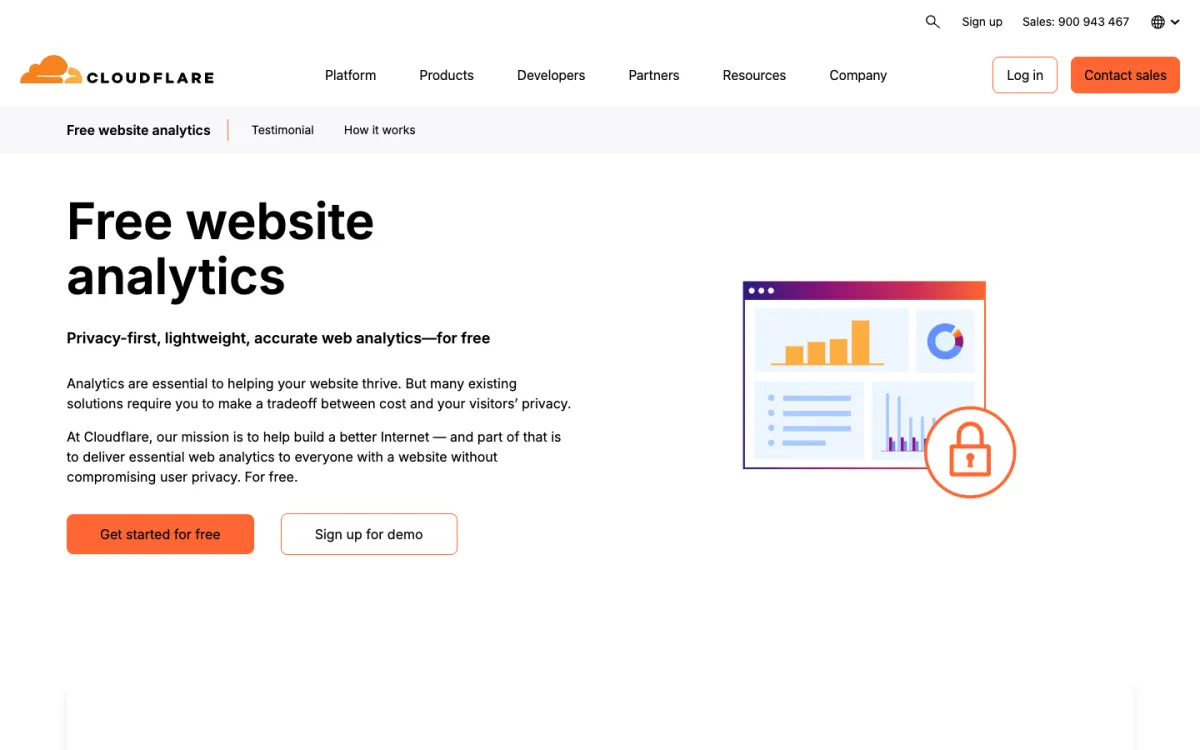
What it is. Cloudflare Web Analytics is free, privacy-first analytics from Cloudflare, added with a small JavaScript beacon. Your site doesn’t need to use Cloudflare’s DNS or proxy.
Why it replaces GA. It costs nothing, needs no account beyond a free Cloudflare one, and shows visits, top pages, referrers, countries, and page load performance from real visitors. Single-page apps are tracked on each route change.
What to know. It is basic: there are no custom events or conversions yet. Detailed data is kept for 7 days and aggregated data for six months, queries can be sampled, and there is a soft limit of 10 sites per account. Ad blockers can block the beacon.
Pricing. Free.
10. Mixpanel: best for funnels and retention
What it is. Mixpanel is product analytics built around user actions: funnels, flows, retention cohorts, and impact analysis.
Why it replaces GA. If what you really used GA for was conversion paths, Mixpanel is much better at it: you track specific actions such as sign up, onboarding, and purchase, and see exactly where people drop off. The free tier includes 1 million events and 10,000 session replays a month.
What to know. It is not a traffic tool, so it won’t give you landing page and referrer reports the way GA did, and it is not cookieless.
Pricing. Free up to 1M events a month. Growth is priced by volume, for example $100/mo billed yearly for 1.5M events.
Do you need a cookie banner with these tools?
Cookieless tools such as Swetrix, Plausible, Fathom, Pirsch, Simple Analytics, Umami, and Cloudflare Web Analytics don’t set cookies or store personal data in the visitor’s browser, and their vendors state that they can be used without a consent banner under GDPR. That is the main reason people switch. Your situation depends on everything else on your site, such as embedded videos, chat widgets, and ad pixels, so check the whole page, and take your own legal advice if you are unsure.
Matomo, PostHog, and Mixpanel can be configured to run without cookies or personal data, but their default setups need the same care as GA4.
How to switch from Google Analytics
- Run both side by side for two to four weeks. The numbers won’t match: cookieless tools count visitors differently, and GA4 misses everyone who declines consent, so expect the new tool to show more visits on sites with a consent banner.
- Import your history if the tool supports it. Plausible, Matomo, and Pirsch can import Google Analytics data, so your year-on-year charts keep working.
- Recreate your goals. List the GA4 events and conversions you actually look at, and set up only those as goals or events in the new tool.
- Keep UTM tags on your campaigns. Every tool here reads them.
- Remove the Google tag once you trust the new numbers, or keep it only on the pages that need Google Ads conversion tracking.
If your site is built with a website builder, check what it includes before adding anything: Siter.io, for example, has cookieless analytics built in. For a static or Bootstrap site, setup is one script tag in your shared layout; our guide to the best web analytics tools shows the snippets and covers single-page app tracking.
How to choose
- You want privacy-first analytics with funnels, errors, and performance in one tool: Swetrix.
- You want the simplest possible dashboard: Plausible.
- You manage many client sites: Fathom, or Pirsch on a smaller budget.
- You need GA-level features and full data ownership: Matomo.
- You build a SaaS product: PostHog, or Mixpanel if funnels are the priority.
- You want it free and self-hosted: Umami.
- You want it free and hosted for you: Cloudflare Web Analytics.
- You want zero setup: Simple Analytics.
- You run Google Ads and need conversion tracking: keep GA4 for that, alongside one of the above.
Analytics shows what visitors do; it doesn’t tell you when the site is down for them. Pair it with uptime monitoring so an outage doesn’t show up first as a drop in your traffic chart.
If you also want heatmaps and session recordings, see Hotjar alternatives, and for product analytics, PostHog alternatives and Mixpanel alternatives.
FAQ
What is the best alternative to Google Analytics?
Swetrix is the best overall Google Analytics alternative, with cookieless, EU-hosted analytics plus funnels, error tracking, and performance data. Plausible is best if you want the simplest dashboard, Matomo if you want GA-level features on your own server, and PostHog for SaaS product analytics.
Is there a free alternative to Google Analytics?
Yes. Cloudflare Web Analytics is free and hosted for you, Umami is free to self-host and has a free cloud tier for one site, and Matomo, Plausible, and Swetrix are free to self-host. PostHog and Mixpanel have free tiers of 1 million events a month, and Simple Analytics has a free plan for up to 5 sites.
What is the best privacy-friendly alternative to Google Analytics?
Plausible, Swetrix, Simple Analytics, and Pirsch are all cookieless and keep data in the EU (Fathom is cookieless too, but stores anonymized data in the US), and their vendors state they can be used without a consent banner under GDPR. Matomo and Umami give you full control of the data when you host them yourself.
Do I need a cookie banner for Plausible or Fathom?
Plausible and Fathom don’t use cookies or store personal data, and both state that they can be used without a cookie consent banner under GDPR, PECR, and similar laws. Other scripts on your site, such as embedded videos or ad pixels, may still need consent.
Can I import my Google Analytics data into another tool?
Some tools can. Plausible, Matomo, and Pirsch have importers for Google Analytics data, so your historical charts carry over. With other tools, export the GA4 reports you want to keep before you remove the tag, because the free version of GA4 keeps detailed data for at most 14 months.
Is Google Analytics still worth using in 2026?
Google Analytics 4 is still worth using if you run Google Ads and need conversion tracking, or if you analyze raw event data in BigQuery. For most content sites, small businesses, and developers, a privacy-first alternative is simpler to read, lighter on the page, and doesn’t need a consent banner.
Which Google Analytics alternative is best for a small website?
Plausible, Simple Analytics, and Pirsch suit small websites best: one script tag, a single readable dashboard, and plans from $6 to about €20 a month. For no cost at all, use Cloudflare Web Analytics or self-host Umami.
Build your Bootstrap theme
Design a custom Bootstrap 5 theme visually with a live preview, then export clean Sass or CSS.
Open the Builder