incident.io Alternatives in 2026: 9 Tools Compared
The best incident.io alternatives are Rootly and FireHydrant if you want the same Slack-first incident response, PagerDuty or Spike.sh if on-call paging matters most, and Better Stack if you want uptime checks in the same product. This guide is for teams that like incident.io’s workflow but not its per-user bill, its Slack or Teams dependence, or the separate monitor it needs. Prices were checked on vendor pages in November 2026.
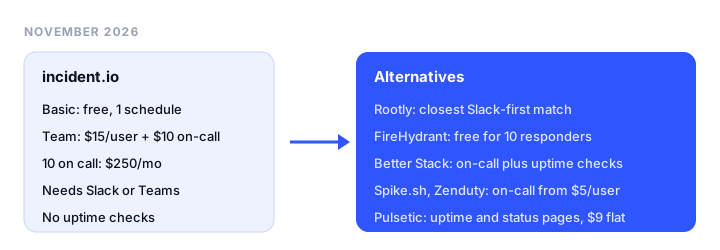
TL;DR
- Best like-for-like replacement: Rootly. Incidents run in Slack, Teams, or Google Chat, and status pages come with its $20 per user Incident Response product.
- Best free tier for incident response: FireHydrant. Its Free plan covers up to 10 responders with a Slack and Teams chatbot and a public status page. On-call starts on Pro at $25 per responder a month, billed annually.
- Best when monitoring has to be built in: Better Stack. It runs its own uptime checks and pages a responder for $29 a month billed yearly, with unlimited phone and SMS.
- Cheapest on-call with a status page included: Spike.sh, from $6.40 per user a month billed yearly.
- Best for small teams that mainly need uptime alerts and a status page: Pulsetic. Flat plans from $9 a month, not per user. It has no incident channels, schedules, or escalations.
incident.io pricing in 2026
We loaded incident.io/pricing on November 19, 2026. Here is what it lists:
| Plan | Price per user/month | On-call add-on | What you get |
|---|---|---|---|
| Basic | Free | Included (single team) | Slack or Teams incident response, 1 on-call schedule, 1 public status page, 1 workflow, 2 integrations |
| Team | $15 billed annually, $19 monthly | +$10 per user | Multi-team on-call, 2 schedules, 3 workflows, unlimited integrations, heartbeats |
| Pro | $25 | +$20 per user | Unlimited schedules, AI-native post-mortems, private incidents, 1 internal status page, 1 live call routing number |
| Enterprise | Custom | Custom | Unlimited public, internal, and customer status pages, SCIM, custom roles |
On-call alone is $20 per user a month. Root cause analysis on Pro and Enterprise is an add-on with no public price.
What incident.io does well
- Slack-native response. An incident opens a channel where roles, updates, and follow-ups happen. Microsoft Teams works on every plan.
- A real free plan. Basic includes on-call for a single team.
- Status pages on every plan, with unlimited subscribers and a custom domain, in English plus eight languages since August 2026.
- On-call depth. Shadow rotations, holiday calendars, cover requests, overrides, and WhatsApp escalations.
Why teams look for an incident.io alternative
- The per-user price stacks. A Team user who takes pages costs $25 a month on annual billing ($15 plus $10), or $29 month to month. On Pro, it is $45.
- Seats grow on their own. Viewers are free, but incident.io’s docs say a user who takes a Responder action is upgraded to a paid Responder seat automatically.
- It needs Slack or Teams. If your company chats in Google Chat or Discord, the core workflow does not fit. Rootly and Zenduty support Google Chat.
- No uptime checks. incident.io routes alerts that other tools raise. Heartbeat monitoring for cron jobs is included from Team up, but there are no HTTP, ping, or SSL checks, so you still pay for a monitor.
- Status page limits. incident.io’s docs list custom colors, layout changes, custom CSS, and removing the incident.io footer as unavailable.
Some teams are also re-planning their whole alerting stack because Opsgenie support ends on April 5, 2027. Our Opsgenie alternatives guide covers that move.
incident.io alternatives at a glance
| Tool | Free plan | Paid from | On-call scheduling | Slack/Teams incident channels | Status pages | Built-in monitoring |
|---|---|---|---|---|---|---|
| incident.io | Basic, single-team on-call | $15/user annual + $10 on-call | Yes (1 to unlimited schedules) | Yes, Slack and Teams | 1 public page on Basic to Pro | Heartbeats from Team |
| Rootly | No (trial) | $20/user per product | Yes, 20 schedules | Yes, plus Google Chat | 1 external, 1 internal with Incident Response | Heartbeats |
| FireHydrant | Free, up to 10 responders | $25/responder, annual | Pro and up | Yes, Slack and Teams chatbot | 1 on Free, unlimited on Pro | No |
| PagerDuty | 5 users, 1 schedule | $21/user annual, $25 monthly | Yes | Chat in Slack and Teams | Add-on on Professional | No |
| Better Stack | 10 monitors, 1 status page | $29/responder yearly | Yes | Channel per incident at $9/responder extra | 1 included | Yes, uptime and cron |
| Pulsetic | 10 monitors, 3 status pages | $9/mo flat | No | No (alerts only) | 3 free, unlimited paid | Yes, uptime, SSL, cron, DNS |
| Grafana Cloud IRM | 3 active users | $19 fee + $20/active user | Yes | Coordinate from Slack and Teams | Not listed | Synthetics, separate meter |
| Spike.sh | No (14-day trial) | $6.40/user annual, $7 monthly | Yes (1 schedule on Standard) | Slack and Teams apps | Included | Not listed |
| Zenduty (IMR by Xurrent) | No (14-day trial) | $5/user annual, $6 monthly | Yes | Slack, Teams, Google Chat | Add-on on Growth | No |
| SolarWinds Incident Response | No (14-day trial) | $15/user, annual | Yes | Not named on pricing page | Premium ($24) and up | No |
What a 10-person team pays per month
Prices assume all 10 people are on call, at list price, on the cheapest billing shown.
| Tool | Setup for 10 people | Per month | Gaps vs incident.io Team |
|---|---|---|---|
| incident.io | Basic | $0 | One team, 1 schedule, 2 integrations |
| incident.io | Team + on-call, annual | $250 | Reference point ($290 monthly) |
| incident.io | Pro + on-call | $450 | None |
| Pulsetic | Team ($19, 2 teammates and 3 notify-only seats) + 5 notify-only seats at $2 | $29 | No incident channels, schedules, or escalations ($83 if all 10 need logins) |
| Spike.sh | Standard, annual | $64 | 1 schedule ($128 on Business for unlimited) |
| Zenduty (IMR by Xurrent) | Growth, yearly (Starter stops at 5 users) | $140 | Status page is an unpriced add-on |
| SolarWinds Incident Response | Pro, annual | $150 | No status page ($240 on Premium) |
| Grafana Cloud IRM | $19 fee incl. 3 users + 7 active users at $20 | $159 | No status page listed |
| Rootly | On-Call only | $200 | No incident channels or status page ($400 with Incident Response) |
| PagerDuty | Professional, annual | $210 | Status pages are an add-on |
| FireHydrant | Pro, annual | $250 plus alert charges | SMS and voice sold separately |
| Better Stack | 10 responders, yearly | $290 | Channel per incident adds $90 ($380) |
Better Stack and Grafana bill only responders or active users, so teams with fewer people on call pay less. Pulsetic’s row is not like for like: people get alerts, not rotations.
The best incident.io alternatives, reviewed
1. Rootly: best like-for-like replacement
What it is. An incident response and on-call platform that runs in Slack, Microsoft Teams, or Google Chat, sold as separate products you can buy alone or together.
Vs incident.io. Same shape: incidents as channels, AI notes, retrospectives, and a status page. Rootly adds Google Chat, and On-Call allows 20 schedules where incident.io Team stops at 2. Its migration team imports PagerDuty or Opsgenie schedules and runs both tools side by side.
Pricing. Incident Response is $20 per user a month and includes 1 external and 1 internal status page. On-Call is a separate $20 per user. AI SRE (root cause and draft fixes) is priced on request. The page does not say whether prices are monthly or annual. A startup program offers up to 50% off.
Limitations. No free plan, and response plus on-call is $40 per user, more than incident.io Team with on-call.
Good for: teams that want the incident.io workflow with Google Chat support or more schedules.
2. FireHydrant: best free tier for incident response
What it is. An incident management platform with runbooks, retrospectives, a service catalog, and Signals, its on-call and alerting product. Freshworks announced it was acquiring FireHydrant in December 2025; the site now says “A Freshworks Company” and still sells it on its own.
Vs incident.io. One Pro price covers incident management and on-call, so there is no separate on-call line. Pro also includes unlimited public status pages, where incident.io gives you 1 until Enterprise.
Pricing. Free covers up to 10 responders, 2 runbooks, a Slack and Teams chatbot, 1 public status page, and 3 integrations, but no on-call. Pro is $25 per responder a month billed annually, with on-call scheduling, unlimited escalation policies, and push, Slack, Teams, and email notifications. There is a 14-day Pro trial.
Limitations. SMS and voice notifications are sold separately, and the FAQ says Signals is charged by alerts sent, with no public rates. Pro allows only 5 integrations.
Good for: teams of up to 10 that want free incident response now and on-call later.
3. PagerDuty: most established on-call
What it is. The longest-running on-call platform, now pushing its AI-heavy PD Reliability Platform.
Vs incident.io. PagerDuty is built around alert routing and escalation rather than incident channels, and its free plan covers 5 users against incident.io’s single team.
Pricing. Free covers 5 users with 1 on-call schedule and 1 escalation policy. Professional is $21 per user a month billed annually or $25 monthly. PD Reliability Platform plans start at $2,800 a year (Starter, 5 seats plus 5 bonus seats for a limited time).
Limitations. AIOps, PagerDuty Advance, runbook automation, status pages, and live call routing are add-ons on Professional with no public price. Our PagerDuty alternatives guide covers its plans in detail.
Good for: teams that put paging ahead of chat workflow.
4. Better Stack: best with built-in monitoring
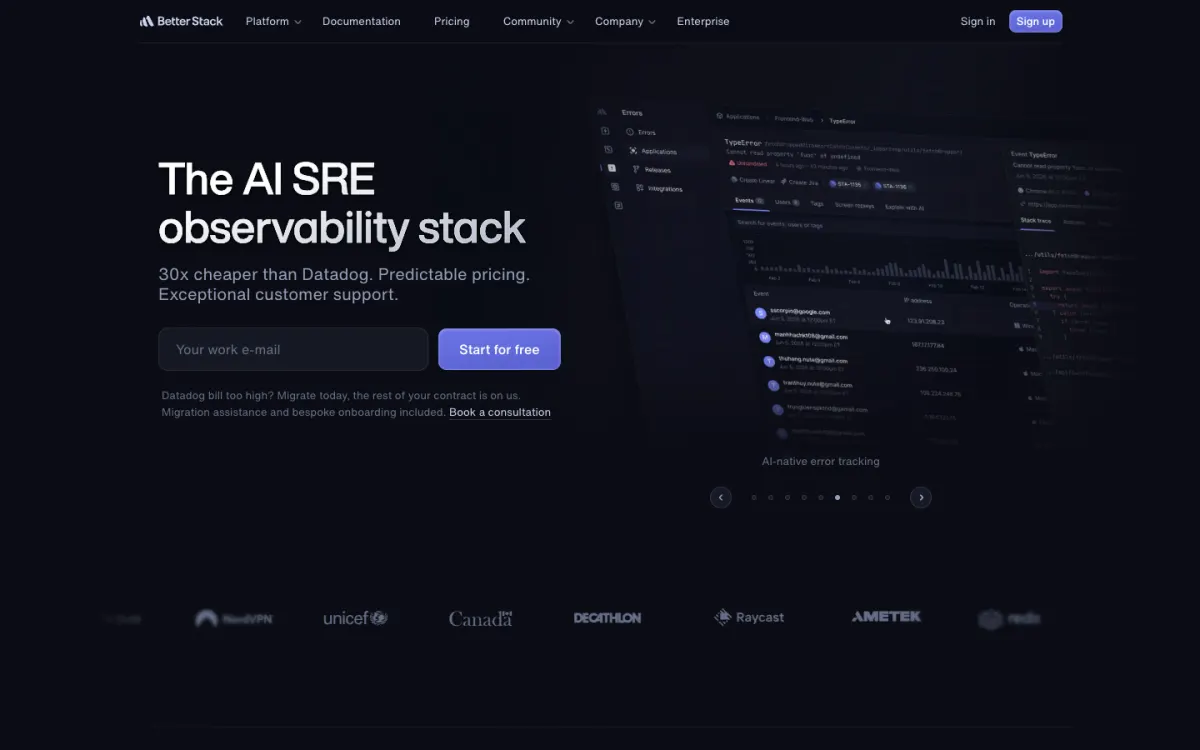
What it is. Uptime monitoring, on-call, incident management, status pages, logs, and an AI SRE in one product.
Vs incident.io. Better Stack detects the outage itself, with HTTP, keyword, port, and cron checks from several locations, then pages the on-call person. incident.io needs a separate tool for that.
Pricing. Free has 10 monitors and heartbeats, 1 status page, and Slack and email alerts. A Responder license is $29 a month billed yearly or $34 monthly, with unlimited phone and SMS and 10 monitors. Team members who do not respond are free. A basic single-channel Slack or Teams integration is included; a channel per incident costs $9 per responder.
Limitations. Extra public status pages are $12 a month each (yearly), password protection $42 per page, and white-labeling $208 per page.
Good for: small engineering teams that want detection and paging on one bill.
5. Pulsetic: best for uptime alerts and a status page at a flat price
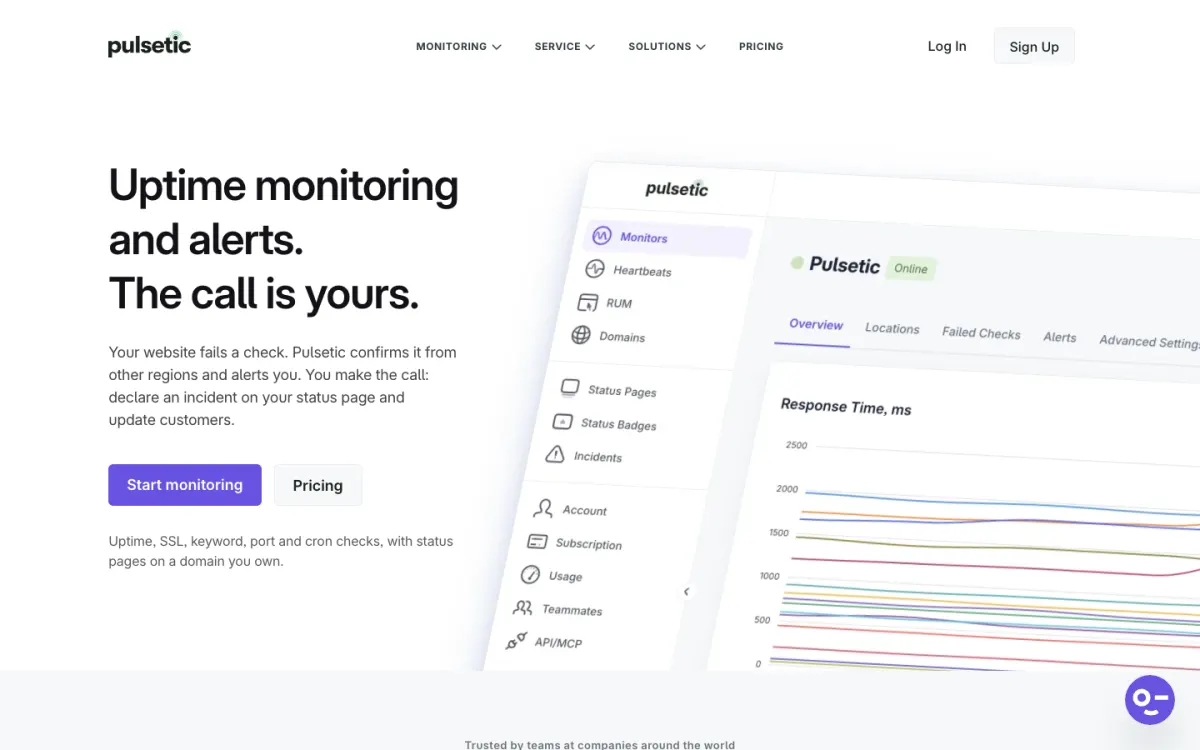
What it is. An uptime monitoring and status page tool. It is not an incident management platform: no incident channels, no on-call schedules, no escalation policies.
Vs incident.io. Some small teams use incident.io mostly for its status page and a call when something breaks. Pulsetic covers that and adds what incident.io lacks: its own checks (HTTP, keyword, SSL, ping, port, cron, domain, and DNS) from up to 15 regions, with a failed check confirmed from another region before anyone is alerted. On paid plans, status pages take custom colors, layouts, and CSS, and Organization adds white-labeling. Its incident.io comparison page lists the feature differences.
Pricing. Plans are flat. Free has 10 monitors at 5-minute checks, 3 status pages, and email alerts. Solo is $9 a month with 60-second checks, 30 SMS or call alerts, Slack, and Teams. Team is $19 a month with 30-second checks, 2 teammates, 3 notify-only seats, and 100 SMS or call alerts. Organization is $49. Extra teammates cost $8 and SMS or calls $0.10.
Limitations. Alerts go to the contacts you set, all at once, with no rotations or “escalate after 10 minutes.” Free alerts are email only (plus 1 webhook).
Good for: small teams and agencies that need to know when a site is down and tell customers, without a formal incident process.
6. Grafana Cloud IRM: best for Grafana users
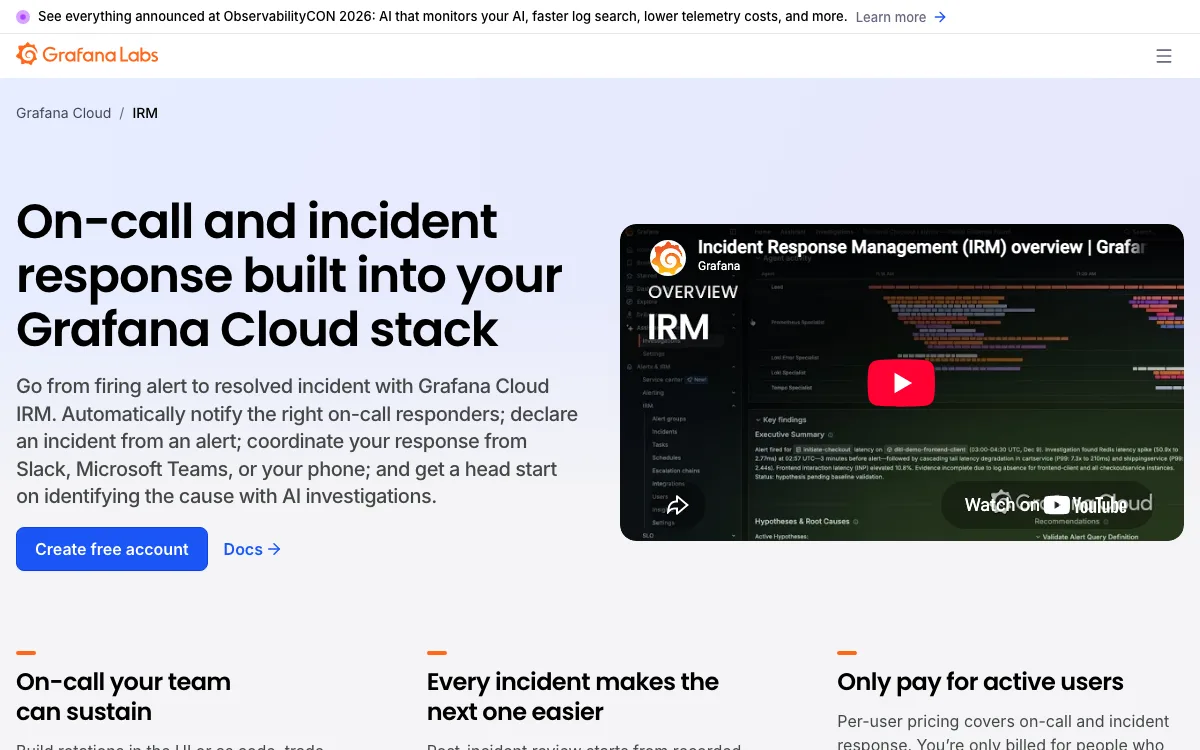
What it is. Grafana’s on-call and incident response add-on, which replaced the open-source Grafana OnCall (archived in March 2026).
Vs incident.io. Alerts already in Grafana become incidents without another integration, and you coordinate from Slack, Teams, or the mobile app. You pay per active user, not per seat.
Pricing. Free covers 3 active IRM users a month. Pro has a $19 monthly platform fee with 3 active users included, then $20 per active user. Grafana’s synthetic API checks have their own free tier of 100,000 executions a month.
Limitations. Status pages are not listed on the IRM page, and it is a weaker fit if your alerts live outside Grafana.
Good for: teams that already run Grafana Cloud.
7. Spike.sh: cheapest on-call with a status page
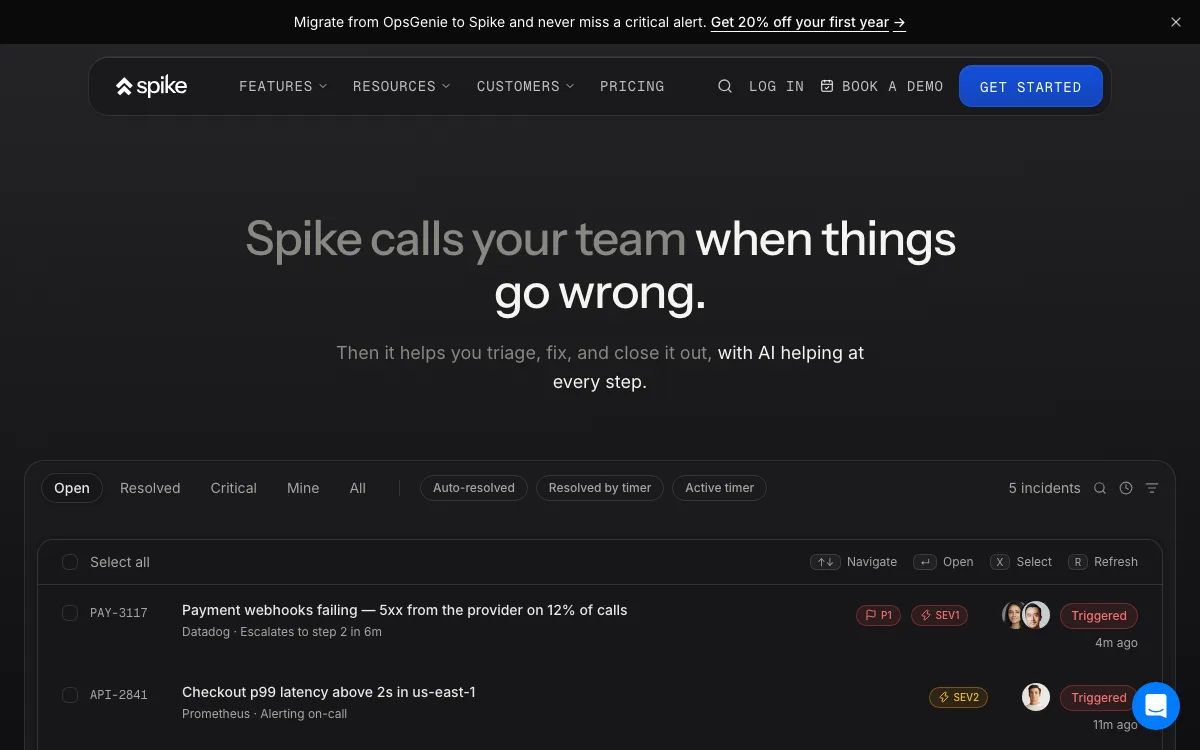
What it is. An alerting and on-call tool with phone, SMS, WhatsApp, and Telegram alerts and Slack and Teams apps.
Vs incident.io. Spike focuses on reaching the right person, not running a structured incident, but a status page is on the entry plan.
Pricing. Standard is $6.40 per user a month billed yearly ($7 monthly), with 1 on-call schedule, 100 phone and SMS alerts a month (shared), and a status page. Business is $12.80 yearly ($14 monthly) with unlimited schedules, phone, and SMS. There is a 14-day trial.
Limitations. One schedule on Standard. Private status pages, war rooms, and Jira or Linear integration need Business, and no monitoring is listed.
Good for: small teams that want real paging for the least money.
8. Zenduty (IMR by Xurrent): budget on-call with Google Chat
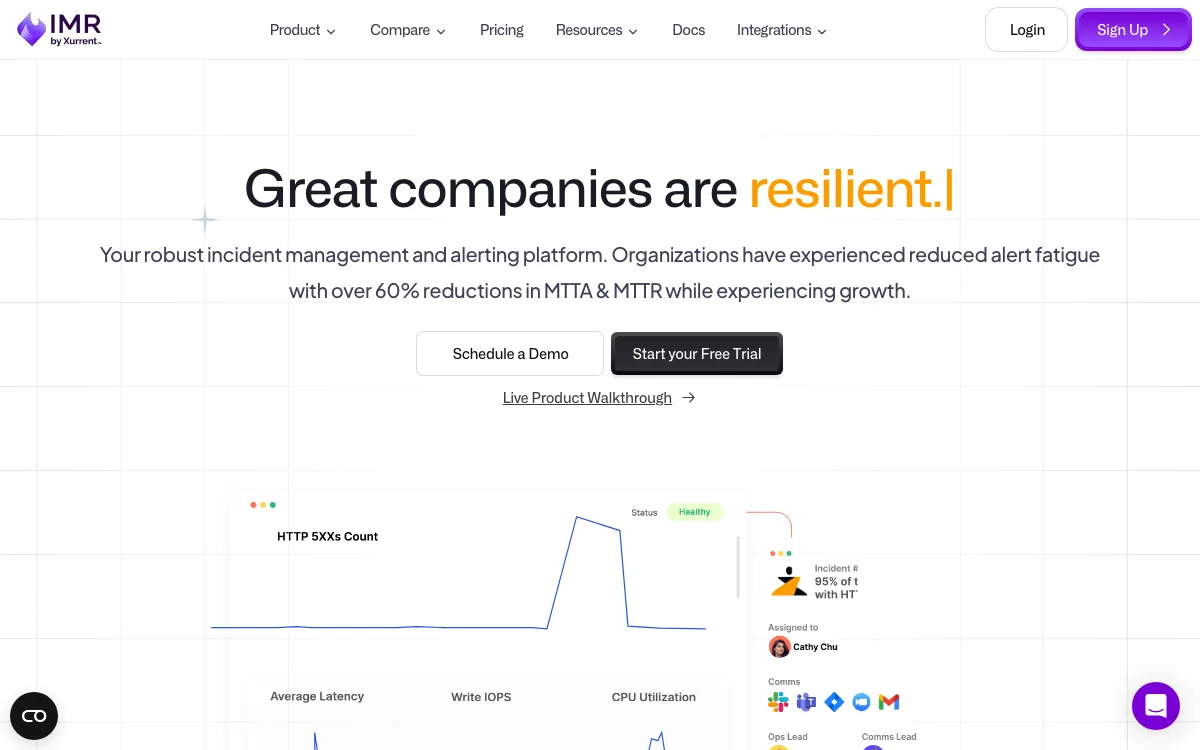
What it is. Zenduty, now sold as IMR by Xurrent. It covers alerting, on-call, playbooks, post-mortems, and an AI SRE assistant.
Vs incident.io. Xurrent says every feature is on every plan, and ChatOps covers Slack, Teams, and Google Chat. Status pages are the main gap.
Pricing. Starter is $5 per user a month billed yearly ($6 monthly) for up to 5 users and 5 integrations. Growth is $14 yearly ($16 monthly) for up to 50 users. Starter includes 100 call or SMS notifications per user a month in the US, Canada, and India. 14-day trial.
Limitations. Status pages are an add-on on Growth and included only on Enterprise.
Good for: teams that want low per-user on-call and use Google Chat.
9. SolarWinds Incident Response (formerly Squadcast): mid-price on-call
What it is. Squadcast, acquired by SolarWinds in 2025. squadcast.com now redirects to SolarWinds.
Vs incident.io. Schedules and escalations come on the entry plan, but status pages need Premium.
Pricing. Pro is $15 per user a month and Premium $24, both billed annually. Pro includes 100 phone or SMS notifications per user in the US, India, and Brazil (25 elsewhere). 14-day trial. We read this page through a fetch tool after our browser was blocked.
Limitations. No free plan or monthly price, and chat features are not named on the pricing page.
Good for: teams that want conventional on-call at a lower price than PagerDuty.
Which incident.io alternative should you choose?
- You want the same Slack-first workflow: Rootly, or FireHydrant if a free tier matters.
- You chat in Google Chat: Rootly or Zenduty.
- On-call paging is the main job: PagerDuty for depth, Spike.sh or Zenduty for price.
- You want monitoring and on-call in one bill: Better Stack.
- Your alerts already live in Grafana: Grafana Cloud IRM.
- You mostly need uptime checks, alerts, and a status page: Pulsetic. Pick an on-call tool instead once you need rotations.
To compare the monitoring side, see our best website monitoring tools and status page tools. To size the budget, start with what website downtime costs.
FAQ
How much does incident.io cost?
Basic is free. Team is $15 per user a month billed annually ($19 monthly), plus $10 per user for on-call. Pro is $25 per user plus $20 for on-call, and Enterprise is custom. On-call alone is $20 per user.
Is there a free incident.io alternative?
FireHydrant Free covers incident response for up to 10 responders, without on-call. PagerDuty Free includes on-call for 5 users, and Grafana Cloud IRM is free for 3 active users. For uptime alerts and status pages, Better Stack and Pulsetic have free plans with 10 monitors.
What is cheaper than incident.io?
For 10 people on call, Spike.sh Standard is $64 a month, Zenduty Growth $140, and SolarWinds Incident Response Pro $150, against $250 for incident.io Team with on-call (annual). Check each one’s status page and schedule limits.
Does incident.io monitor uptime?
No. It ingests alerts from tools like Datadog or Grafana. Team and higher plans include heartbeat monitoring for scheduled jobs, but there are no HTTP, ping, or SSL checks.
Who are incident.io’s main competitors?
Rootly and FireHydrant are the closest, with chat-based incident response and on-call. PagerDuty competes on on-call, and Better Stack on monitoring plus on-call.
Build your Bootstrap theme
Design a custom Bootstrap 5 theme visually with a live preview, then export clean Sass or CSS.
Open the Builder