PagerDuty Alternatives in 2026: 9 Tools Compared by Price
The best PagerDuty alternatives depend on what you actually use it for. If you need on-call rotations, escalations, and incident workflows, incident.io, Better Stack, and Zenduty cover the same ground for less. If your “on-call” is really “call me when the site is down,” a monitoring tool with phone alerts costs a fraction of a per-user license. This guide compares nine options on price per user, free tiers, schedules, phone and SMS, status pages, and built-in monitoring, with prices checked on each vendor’s site in November 2026.
TL;DR
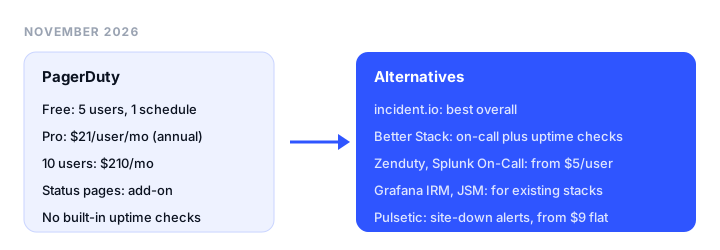
- Best overall PagerDuty alternative: incident.io. Slack and Teams native incidents, a free Basic plan with on-call, and Team at $15 per user a month (annual) plus $10 for on-call.
- Best on-call with built-in uptime checks: Better Stack. $29 per responder a month billed yearly, with unlimited phone and SMS, and non-responders are free.
- Cheapest real on-call: Splunk On-Call from $5 per user a month (annual, up to 10 seats) and Zenduty (IMR by Xurrent) from $5 per user a month (annual, up to 5 users).
- Best for small teams that need alerts more than incident management: Pulsetic. It checks your sites from several regions and calls, texts, or messages you when one goes down, from $9 a month flat. It has no on-call schedules or escalation policies.
- Best inside an existing stack: Jira Service Management for Atlassian shops, Grafana Cloud IRM for teams already on Grafana.
PagerDuty’s plans and pricing
We loaded PagerDuty’s pricing page on November 18, 2026. Our automated browser got a 403, so we read it through a fetch tool instead. Here is what it lists:
| Plan | Price | What’s included |
|---|---|---|
| Free | $0 | Up to 5 users, 1 on-call schedule, 1 escalation policy, 100 SMS or phone notifications a month, 750+ integrations, no external status pages |
| Professional | $21/user/mo billed annually, $25 monthly | Schedules and escalation policies (no cap stated), phone and SMS included, 750+ integrations |
| PD Reliability Platform Starter | $2,800 per year platform fee | 5 seats (30-seat cap), status pages, 1 live call routing line |
| Essential / Plus | $12,000 / $48,000 per year | 25 and 50 seats, more AI actions and event volume |
| Ultimate | Custom | 500 seats |
Two things stand out. First, the Business plan that older comparisons quote is no longer on the page. Above Professional, PagerDuty now sells the PD Reliability Platform with annual platform fees. Second, on Professional, status pages, AIOps, PagerDuty Advance (its AI assistant), runbook automation, and live call routing are add-ons with no public prices. The comparison table shows external status pages with 250 subscribers for Professional, but the plan card lists Status Pages as purchased separately, so ask sales before you count on them.
Why teams look for a PagerDuty alternative
- Per-user pricing adds up. Ten people on Professional cost $210 a month on annual billing, or $250 month to month, before any add-on.
- Add-ons have no list price. Status pages, AI features, and call routing go through sales, which makes budgeting hard for small teams.
- The free plan is narrow. One schedule, one escalation policy, and 100 notifications a month.
- It does not detect outages itself. PagerDuty routes alerts that other tools raise, so you still pay for a separate monitoring service.
- Many teams only need the pager. If nobody runs incident retros or rotations, a per-user incident platform is more tool than the job.
PagerDuty alternatives at a glance
| Tool | Best for | Free plan | Paid from | Key limits |
|---|---|---|---|---|
| incident.io | Slack-native incident management | Basic: single-team on-call, 1 schedule | $15/user annual plus $10 on-call | On-call is an add-on; Team allows 2 schedules |
| Better Stack | On-call plus uptime checks | 10 monitors, 1 status page, Slack and email alerts | $29/responder yearly, $34 monthly | Extra status pages and call routing cost more |
| Pulsetic | Website-down alerts for small teams | 10 monitors, 3 status pages, email alerts | $9/mo flat | No schedules or escalation policies |
| Zenduty (IMR by Xurrent) | Small teams on a budget | 14-day trial | $5/user annual, $6 monthly | Starter: 5 users, 5 integrations |
| SolarWinds Incident Response | Mid-price on-call | 14-day trial | $15/user billed annually | Status pages from Premium ($24) |
| Rootly | AI-assisted incident response | No free plan listed | $20/user (On-Call) | Incident Response is a separate $20 |
| Splunk On-Call | Teams already on Splunk | Free trial | $5/user annual, up to 10 seats | No public price above 10 seats |
| Grafana Cloud IRM | Teams already on Grafana | 3 active IRM users | $19/mo platform fee, then $20/active user | Billed per active user each month |
| Jira Service Management | Atlassian shops | 3 agents, 200 SMS/mo | $26.90/agent at 10 agents, monthly | Status pages on Enterprise |
Features that matter for on-call
| Tool | Schedules and escalations | Phone and SMS | Status pages | Built-in checks |
|---|---|---|---|---|
| PagerDuty | Yes (Free: 1 each) | Free: 100/mo; Professional: included | Add-on on Professional | No |
| incident.io | Yes (Basic 1 schedule, Team 2, Pro unlimited) | Not itemized on pricing page | 1 public page on every plan | Heartbeats |
| Better Stack | Yes | Unlimited per responder | 1 included, extra $12 to $15/mo | Yes, uptime and cron |
| Pulsetic | No | Solo 30, Team 100 a month; $0.10 extra | 3 free, unlimited paid | Yes, uptime, SSL, cron, DNS |
| Zenduty | Yes | 100/user/mo in US, CA, IN (Starter) | Add-on on Growth | No |
| SolarWinds IR | Yes; advanced on Premium | Pro: 100/user in US, IN, BR; Premium unlimited | Premium and up | Not listed |
| Rootly | Yes, 20 on On-Call | SMS and voice included | 1 external with Incident Response | Heartbeats |
| Splunk On-Call | Yes | Not listed on pricing page | Not listed | No |
| Grafana Cloud IRM | Yes | SMS and phone calls | Not listed | Synthetics, separate meter |
| Jira Service Management | Yes; advanced from Standard | Free 200 SMS; Standard adds voice | Enterprise | Heartbeat on Premium |
What 10 people cost per month
| Tool | Setup for 10 people | Price per month |
|---|---|---|
| Splunk On-Call | 10 seats, annual | $50 |
| Zenduty (IMR by Xurrent) | Growth, yearly | $140 |
| SolarWinds Incident Response | Pro, annual | $150 |
| Grafana Cloud IRM | $19 fee + 7 more active users | $159 |
| Rootly | On-Call only (billing period not stated) | $200 |
| PagerDuty | Professional, annual | $210 |
| incident.io | Team + on-call, annual | $250 |
| Jira Service Management | Standard, monthly | $269 |
| Better Stack | 10 responders, yearly | $290 |
| Pulsetic | Team ($19, 2 teammates and 3 notify-only seats) + 5 notify-only seats at $2 | $29 |
Better Stack charges only for responders, so if 3 of the 10 take pages, the bill is $87. Pulsetic’s row is not like for like: those people get alerts, not rotations.
The best PagerDuty alternatives, reviewed
1. incident.io: best overall PagerDuty alternative
What it is. An incident management platform that runs inside Slack or Microsoft Teams, with on-call, status pages, and post-mortems.
Key features. On-call covers alert routing and grouping, schedules with shadow rotations, holiday calendars, cover requests, and overrides. Incidents open as channels, and every plan includes a public status page with unlimited subscribers and a custom domain.
Pricing. Basic is free: single-team on-call, 1 schedule, 2 integrations, and a status page. Team is $15 per user a month billed annually ($19 monthly), plus $10 per user for on-call. Pro is $25 per user plus $20 for on-call. On-call alone is $20 per user.
Limitations. On-call is not in the headline price, so a Team user who takes pages costs $25 a month on annual billing. Team allows only 2 schedules, and root cause analysis is a paid add-on on Pro and up.
Good for: teams that run incidents in Slack or Teams and want PagerDuty’s on-call plus a better incident workflow.
2. Better Stack: best on-call with built-in uptime checks
What it is. Uptime monitoring, on-call, incident management, status pages, and logs in one product.
Key features. Better Stack runs its own HTTP, ping, port, SSL, DNS, and cron checks, so it can detect an outage and page someone without a second vendor. Each Responder license includes on-call scheduling, advanced escalations, iOS and Android apps, and unlimited phone and SMS alerts.
Pricing. The free plan has 10 monitors and heartbeats, 1 status page, and Slack and email alerts. A Responder license is $29 a month billed yearly or $34 monthly. Team members who do not take pages are free. Channel-based Slack and Teams workflows add $9 per responder.
Limitations. Extras add up: more public status pages are $12 to $15 a month each, password protection $42 to $50 per page, and incoming call routing $208 to $250 per number a month. See our Better Stack alternatives if those matter.
Good for: small engineering teams that want monitoring and paging from one bill.
3. Pulsetic: best for small teams that need alerts more than incident management
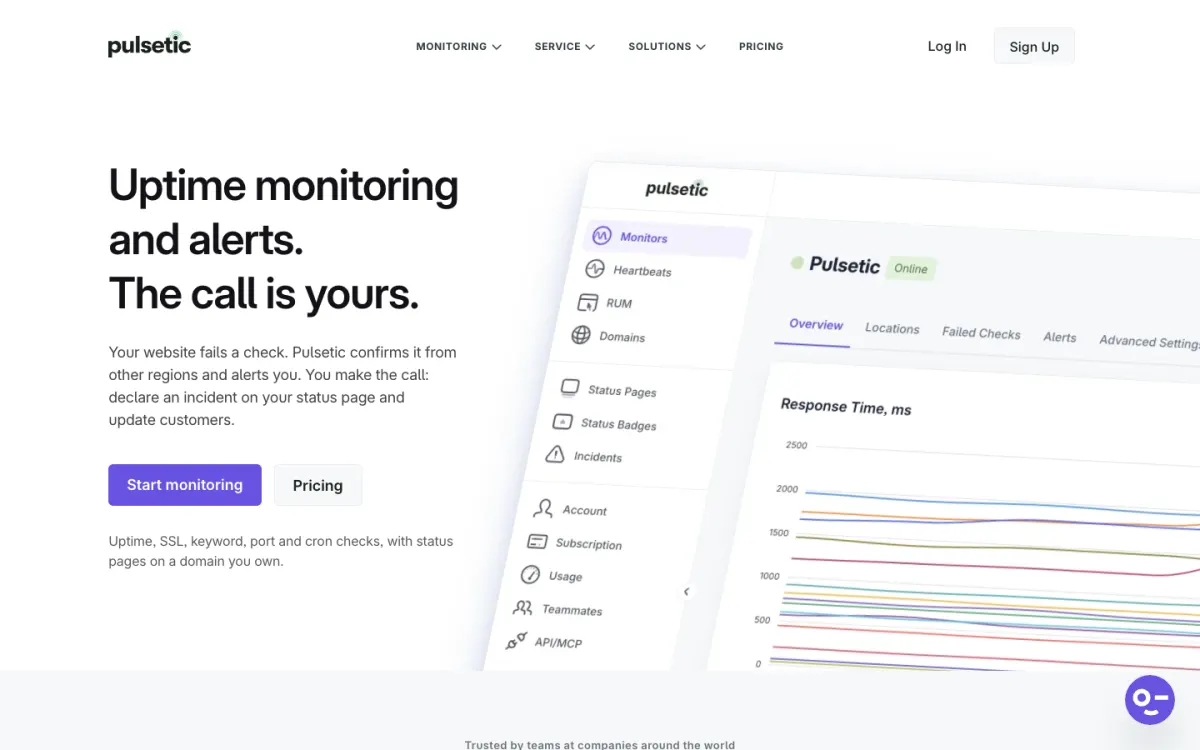
What it is. An uptime monitoring and status page tool. It is not an on-call or incident management platform, and it does not try to be.
Why it can replace PagerDuty. Plenty of small teams pay PagerDuty per user for one job: ring a phone when the website or API goes down. Pulsetic does the checking itself. A failed check is confirmed from other regions before anyone is alerted, which cuts false alarms at 3 a.m. Alerts go out by phone call, SMS, WhatsApp, Slack, Microsoft Teams, and email, and status pages on your own domain are included. Its PagerDuty comparison page lists the feature differences.
Pricing. Plans are flat, not per user. Free has 10 monitors checked every 5 minutes from 3 regions and 3 status pages. Solo is $9 a month with 60-second checks from 5 regions, 30 SMS or call alerts, 15 WhatsApp alerts, and Slack and Teams. Team is $19 a month with 30-second checks from 15 regions, 2 teammates, 3 notify-only seats, and 100 SMS or call alerts. Organization is $49. Extra SMS or calls cost $0.10, extra teammates $8, and notify-only seats $2 each.
Limitations. There are no on-call schedules, rotations, or escalation policies. Alerts go to the contacts you set, all at once. On the free plan, alerts go by email only (plus one webhook), so phone, SMS, WhatsApp, and Slack need Solo or higher.
Good for: small teams, agencies, and solo founders whose PagerDuty setup is really “call me when the site is down.”
4. Zenduty (IMR by Xurrent): cheapest full on-call for small teams
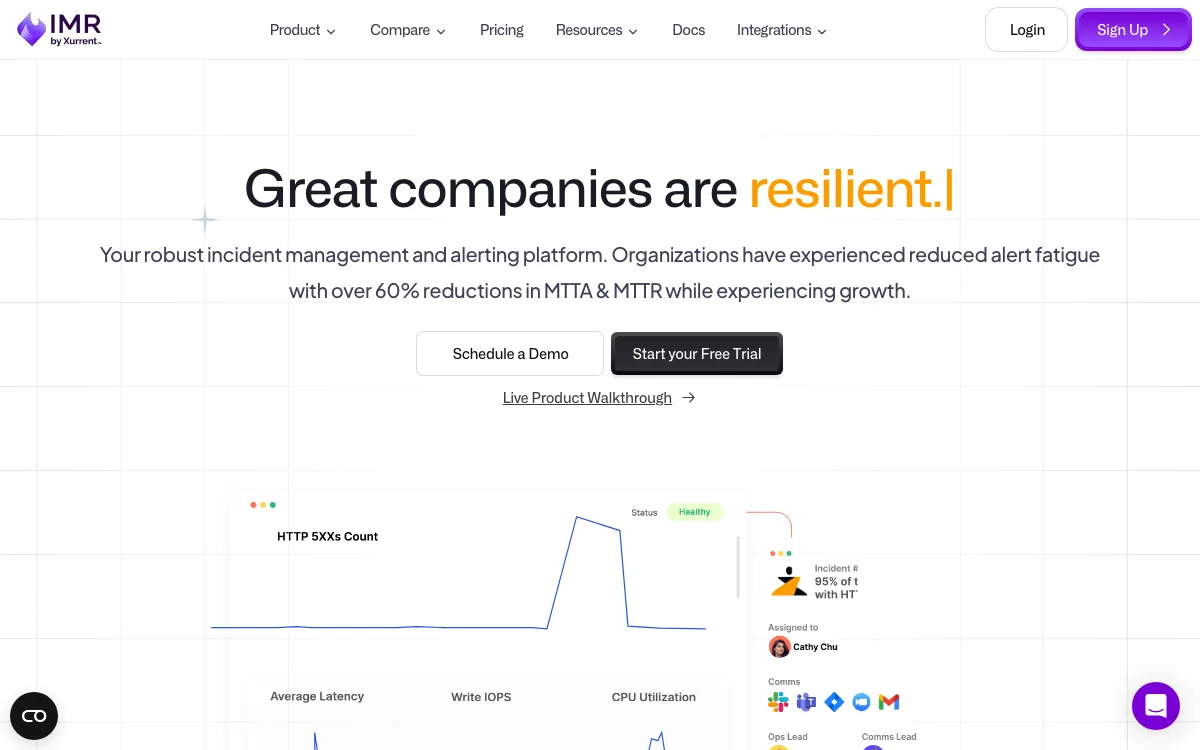
What it is. Zenduty is now sold as IMR by Xurrent, and zenduty.com redirects there. It covers alerting, on-call, escalations, playbooks, and post-mortems.
Key features. Xurrent says every plan has every feature; plans differ only in scale. Starter includes 100 call or SMS notifications per user a month in the US, Canada, and India (25 elsewhere). Growth has unlimited notifications.
Pricing. Starter is $5 per user a month billed yearly ($6 monthly) for up to 5 users, 1 team, and 5 integrations. Growth is $14 yearly ($16 monthly) for up to 50 users and 5 teams. There is a 14-day trial without a card.
Limitations. Five integrations on Starter is tight if alerts come from several tools. Status pages are an add-on on Growth and included only on Enterprise.
Good for: teams of up to 5 that want real rotations and escalations for the least money.
5. SolarWinds Incident Response (formerly Squadcast): mid-price on-call
What it is. Squadcast, bought by SolarWinds in 2025 and renamed.
Key features. Schedules and escalations are on the entry plan. Premium adds advanced escalations, status pages, unlimited notifications, and up to 10 free stakeholders.
Pricing. Pro is $15 per user a month and Premium $24, both billed annually. Pro includes 100 phone or SMS notifications per user in the US, India, and Brazil (25 elsewhere), then $0.10 to $0.35 each. There is a 14-day trial. We read this page through a fetch tool after our browser was blocked.
Limitations. No free plan and no monthly price. Status pages and unlimited notifications need Premium.
Good for: teams that want PagerDuty-style on-call at a lower per-user price.
6. Rootly: AI-assisted incident response
What it is. An incident response and on-call platform for Slack, Teams, and Google Chat, with an AI scribe and AI retrospectives.
Key features. On-Call includes rotations with holidays, PTO, and shadowing, mobile shift swaps, alert grouping, heartbeats, and SMS, voice, and push alerts. Incident Response includes 1 external and 1 internal status page. Rootly says its migration team imports PagerDuty schedules, escalation policies, and users and runs both tools side by side.
Pricing. On-Call is $20 per user a month and Incident Response a separate $20 per user. The page does not say whether that is monthly or annual billing. On-Call includes 20 schedules and escalation policies. A startup program offers up to 50% off.
Limitations. No free plan is listed, and both products together cost $40 per user.
Good for: teams that want AI help during incidents and a hands-on migration.
7. Splunk On-Call: lowest per-user price
What it is. The former VictorOps, now part of Splunk Observability.
Key features. Scheduling, rotations, overrides, and escalation policies, with iOS and Android apps and integrations with hundreds of monitoring and chat tools.
Pricing. Splunk’s observability pricing page lists On-Call from $5 per user a month, billed annually, for up to 10 seats, with a free trial. We read the page through a fetch tool after our browser was blocked.
Limitations. No free plan, no status pages listed, and no public price beyond 10 seats.
Good for: small teams, or teams that already send data to Splunk.
8. Grafana Cloud IRM: on-call for Grafana users
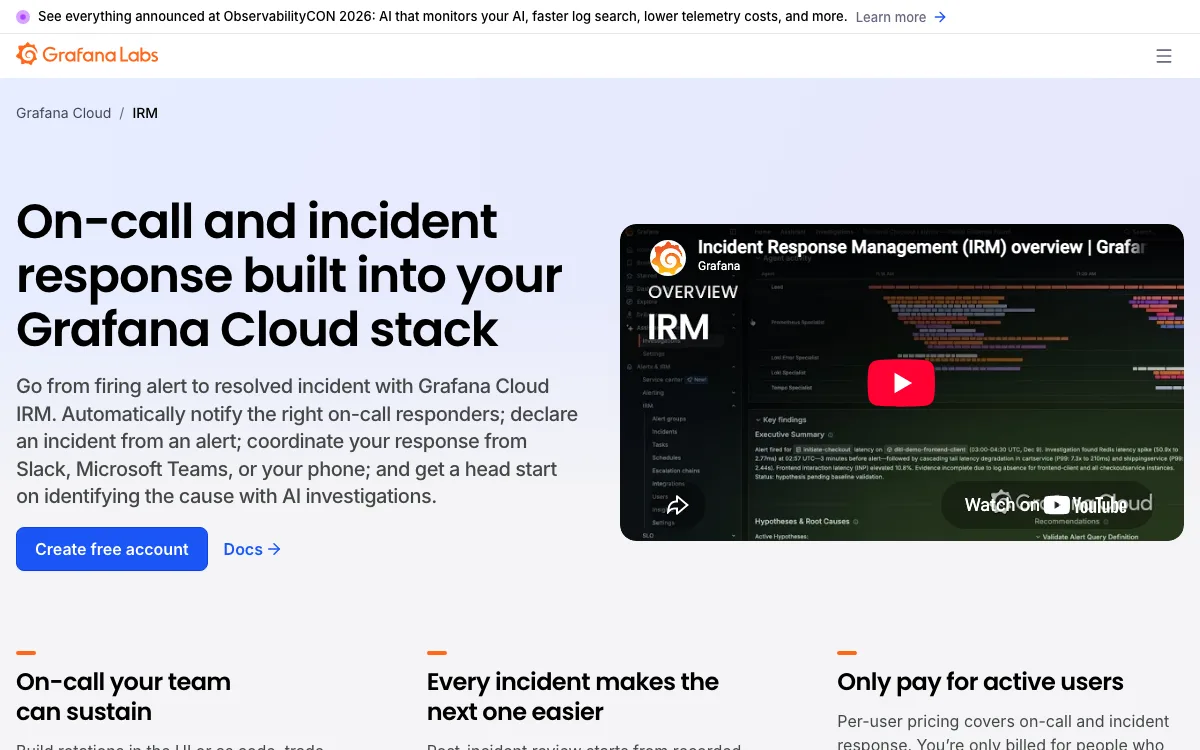
What it is. Grafana’s on-call and incident response add-on for Grafana Cloud.
Key features. Rotations built in the UI or as code, notifications by mobile app, Slack, Teams, SMS, phone call, and email, and incidents declared straight from a Grafana alert. You pay only for users who are on call, get notified, or take action that month.
Pricing. Free covers 3 active IRM users a month. Pro has a $19 monthly platform fee that includes 3 active IRM users, then $20 per active user. Grafana’s synthetic checks are billed separately.
Limitations. Status pages are not listed on the IRM page, and it makes most sense if your alerts already live in Grafana.
Good for: teams already running Grafana Cloud.
9. Jira Service Management: for Atlassian shops
What it is. Atlassian’s service management suite, which now holds the alerting and on-call features from Opsgenie.
Key features. Alerts, on-call schedules, routing rules, and escalation policies on every plan, next to your Jira tickets and change requests.
Pricing. At 10 agents billed monthly, Standard is $26.90 per agent and Premium $61.60. Free covers 3 agents with schedules, an escalation policy, unlimited alerts, and 200 SMS a month. Standard adds voice. Heartbeat monitoring and AI alert grouping are on Premium; status pages on Enterprise.
Limitations. You pay for a full ITSM suite even if you only need paging. Our Opsgenie alternatives guide covers the Opsgenie shutdown and migration in detail.
Good for: teams already working in Jira.
Which PagerDuty alternative should you choose?
- You run incidents in Slack or Teams: incident.io, or Rootly if you want AI help and a guided migration.
- You want monitoring and on-call from one vendor: Better Stack.
- Budget comes first and you need real rotations: Splunk On-Call (up to 10 seats), Zenduty (up to 5 users on Starter), or SolarWinds Incident Response.
- Your stack is Grafana or Jira: Grafana Cloud IRM or Jira Service Management.
- You only need a call when the site goes down: Pulsetic. Choose an on-call tool instead if you need rotations or escalation steps.
Before you pick, work out what an outage costs with our website downtime cost guide, and compare status page tools and free uptime monitoring options.
FAQ
How much does PagerDuty cost?
PagerDuty Free covers up to 5 users with 1 schedule and 1 escalation policy. Professional is $21 per user a month billed annually or $25 monthly. Larger teams buy the PD Reliability Platform, from $2,800 a year for Starter. Status pages, AIOps, and AI features are add-ons on Professional.
Is there a free PagerDuty alternative?
Yes. incident.io Basic includes single-team on-call with 1 schedule, Jira Service Management Free covers 3 agents with 200 SMS a month, and Grafana Cloud IRM is free for 3 active users. For simple uptime alerts, Better Stack and Pulsetic both have free plans with 10 monitors.
What is cheaper than PagerDuty?
Splunk On-Call and Zenduty start at $5 per user a month on annual billing, and SolarWinds Incident Response at $15. At 10 users, they cost $50, $140, and $150 a month against $210 for PagerDuty Professional. Flat-priced monitoring tools like Pulsetic cost less still, but without rotations.
Who are PagerDuty’s main competitors?
For full incident management: incident.io, Rootly, and Jira Service Management. For on-call at a lower price: Zenduty, SolarWinds Incident Response, Splunk On-Call, and Grafana Cloud IRM. Better Stack competes on monitoring plus on-call.
Do I need PagerDuty if I only want downtime alerts?
Probably not. PagerDuty does not check your site itself, so you would pay for monitoring and per-user paging. An uptime tool with phone and SMS alerts covers that job for a flat monthly price.
Build your Bootstrap theme
Design a custom Bootstrap 5 theme visually with a live preview, then export clean Sass or CSS.
Open the Builder