Better Stack Alternatives: 7 Tools Compared (2026)
Better Stack, known as Better Uptime before it added logs and other products, bundles a lot into one platform: uptime monitoring, cron heartbeats, status pages, on-call scheduling with phone and SMS alerts, incident management in Slack, and logs, metrics, traces, and error tracking. That’s its appeal, and also why teams look elsewhere. Many only use the uptime checks and status page, yet incident features are priced per responder license, status page extras add up, and the free plan is meant for personal projects. This guide covers seven alternatives, grouped by the part of Better Stack they replace, with pricing checked on each vendor’s site in November 2026.
TL;DR
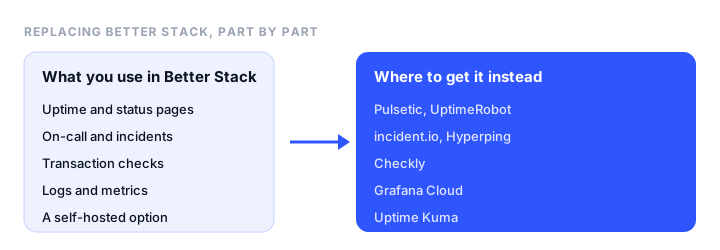
- Best overall: Pulsetic. Uptime, SSL, domain, cron, and AI browser monitors, status pages on your own domain, and real-user monitoring, with SMS, call, Slack, and Teams alerts from $9 a month and a free plan that allows business use.
- Most free monitors: UptimeRobot, with 50 monitors free and paid plans from €9 a month.
- Best for on-call and incidents: incident.io, Slack- and Teams-native incident response with a free Basic plan.
- Best for synthetic and API checks: Checkly, monitoring as code with Playwright.
- Best for logs and metrics: Grafana Cloud, with a free tier of 50 GB of logs a month.
- Best self-hosted: Uptime Kuma, free and open source.
What Better Stack does well
- One platform for everything. Monitors, on-call, incidents, status pages, and telemetry share one account, so an alert can open an incident, page the on-call person, and update the status page.
- Fast checks. Paid monitors check as often as every 30 seconds, from several locations, with screenshots of errors.
- Unlimited phone and SMS alerts for each responder license.
- Generous telemetry. The free plan includes 3 GB of logs, 100,000 exceptions, and 5,000 session replays, and log ingestion is $0.10 per GB.
Why teams look for Better Stack alternatives
- Per-responder pricing. On-call, phone alerts, and incident management need a Responder license at $29 a month per responder billed yearly, or $34 monthly. A team of five on-call engineers pays $145 to $170 a month before any add-ons.
- Status page extras cost more. One status page and 1,000 subscribers are included. Each additional page is $12 to $15 a month, password protection $42 to $50 per page, and removing the “Powered by Better Stack” footer $208 to $250 per page.
- The free plan is for personal projects. It includes 10 monitors and heartbeats combined, checked every 3 minutes, with one status page and Slack and email alerts.
- It’s more than many teams need. If you only want to know when a site goes down and tell customers about it, a monitoring and status page tool is simpler and cheaper.
Better Stack alternatives at a glance
| Tool | Replaces | Free plan | Paid from | Status pages | Best for |
|---|---|---|---|---|---|
| Pulsetic | Uptime, heartbeats, status pages, RUM | 10 monitors, 3 status pages, business use allowed | $9/mo | 3 free, unlimited on paid, custom domain | Best overall |
| UptimeRobot | Uptime, status pages | 50 monitors, 5-min checks | €9/mo annual | 1 free; 3 on Solo, own domain | Most free monitors |
| Hyperping | Uptime, status pages, on-call | 20 monitors | €24/mo annual | 1 with custom domain on Essentials | Monitoring plus on-call in one |
| incident.io | On-call, incident management | Basic: single-team on-call, status page | $15/user/mo annual | Yes | Slack and Teams incident response |
| Checkly | Synthetic and API checks | 10 uptime monitors, API and browser runs | $24/mo annual | Yes | Monitoring as code |
| Grafana Cloud | Logs, metrics, traces | 50 GB logs, 50 GB traces, 10k metric series | $19/mo + usage | No | Observability |
| Uptime Kuma | Uptime, status pages | Free, self-hosted | Free | Yes, custom domain | Self-hosting |
The best Better Stack alternatives, reviewed
1. Pulsetic: best overall Better Stack alternative
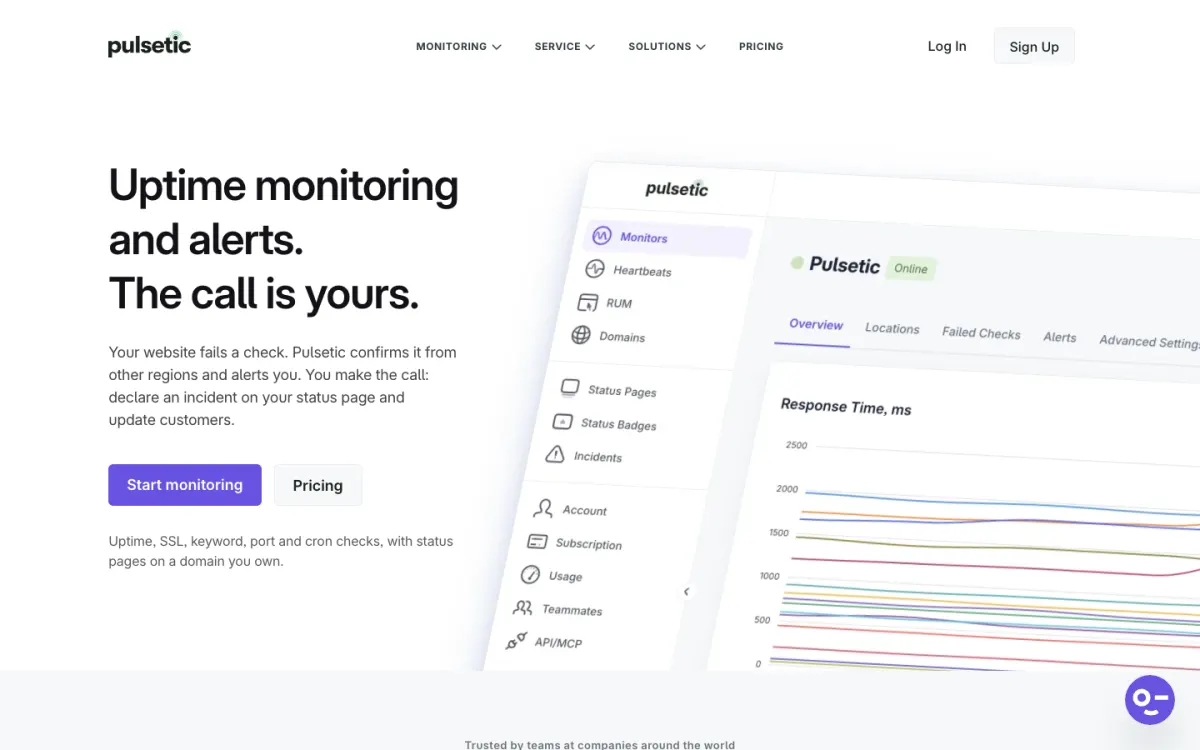
What it is. A monitoring and status page platform: uptime, keyword, SSL, port, ping, cron heartbeat, and domain expiry monitors, dependency monitors for the third-party services you rely on, AI monitors that follow a plain-English instruction in a real browser, real-user monitoring, and branded status pages.
Why it replaces Better Stack. For teams that use Better Stack for monitoring and status pages, Pulsetic covers both at a flat plan price instead of per responder. Each failure is confirmed from a second location before an alert goes out, which keeps false alarms down. Status pages include incident updates, scheduled maintenance, subscriber notifications, password protection, translations, and your own domain, without per-page add-ons.
Pricing.
| Plan | Price | Monitors | Check interval | Status pages | Alerts included |
|---|---|---|---|---|---|
| Free | $0 | 10 | 5 min, 3 regions | 3, custom domain | Email, webhooks |
| Solo | $9/mo | 10+ | 60 sec, 5 regions | Unlimited, 1,000+ subscribers | 30 SMS or calls, 15 WhatsApp, Slack, Teams, Discord, Telegram |
| Team | $19/mo | 50+ | 30 sec, 15 regions | Unlimited, white label, 5,000+ subscribers | 100 SMS or calls, 50 WhatsApp |
| Organization | $49/mo | 300+ | 30 sec, 15 regions | Unlimited, 10,000+ subscribers | 200 SMS or calls, 100 WhatsApp |
Extra monitors are $0.20 each, extra SMS or call alerts $0.10, and extra teammates $8 a month. Yearly billing gives 2 months free.
The catch. It doesn’t include on-call rotations or log management. Pair it with a dedicated on-call tool or Grafana Cloud if you need those.
2. UptimeRobot: most free monitors
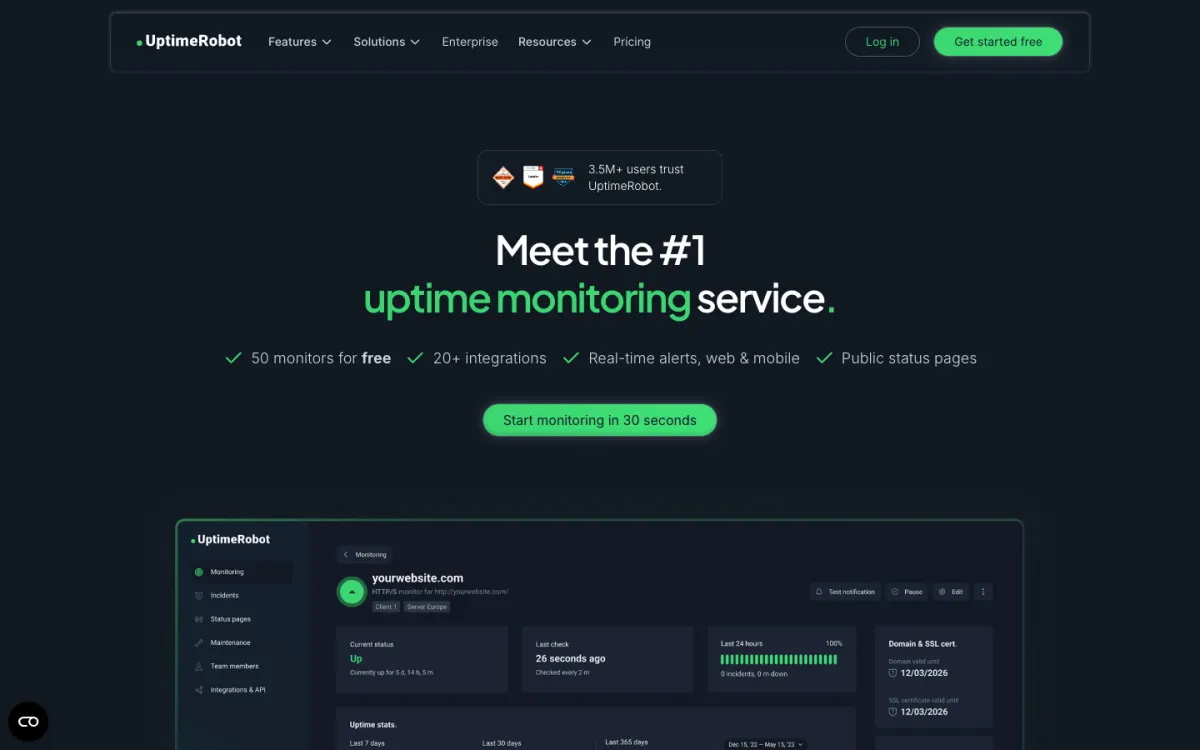
What it is. The most widely used uptime monitor, with HTTP, keyword, ping, port, SSL, DNS, and cron checks and status pages.
Why it replaces Better Stack. The free plan has 50 monitors checked every 5 minutes, five times Better Stack’s free monitor count, and allows commercial use. Paid plans are priced per account rather than per responder.
Pricing. Solo is €9 a month billed annually (€10 monthly) for 10 monitors at 60-second checks, with 3 status pages on your own domain. Team is €35 a month annually for 100 monitors at 30-second checks, 3 seats, and 100 white-label status pages.
The catch. SSL, domain, and DNS checks are paid features, and SMS and voice alerts need purchased credits. See our UptimeRobot alternatives for its trade-offs.
3. Hyperping: monitoring and on-call together
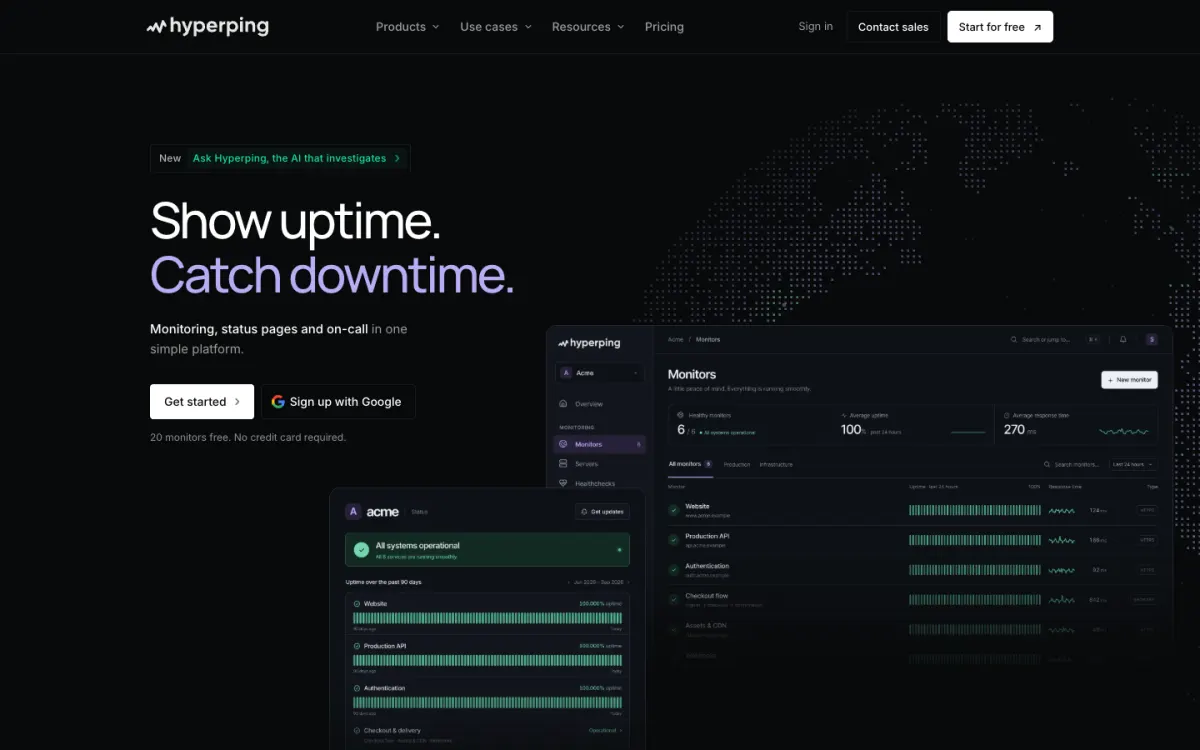
What it is. Uptime monitoring, browser checks, server monitoring, status pages, and on-call with escalation policies.
Why it replaces Better Stack. It’s the closest match for teams that want on-call scheduling and phone alerts alongside monitoring, with seats included in the plan rather than priced per responder.
Pricing. Free for 20 monitors with a basic status page. Essentials is €24 a month billed yearly, with 3 seats, 50 monitors, 3 browser checks, 5 GB of logs, on-call and escalation policies, phone call alerts, and a status page on your own domain with 100 subscribers. Pro is €74 a month with 10 seats and 250 monitors.
The catch. Essentials includes only one status page, and extra seats cost €7 a month on Essentials and €9 on Pro.
4. incident.io: best for on-call and incidents
What it is. An incident management platform that runs inside Slack or Microsoft Teams, with on-call scheduling, alerting, workflows, status pages, and post-mortems.
Why it replaces Better Stack. If your team uses Better Stack mainly for on-call and incident response, incident.io is a more complete incident tool, and it takes alerts from any monitoring tool, so you can pair it with Pulsetic or UptimeRobot for the checks.
Pricing. The Basic plan is free, with single-team on-call, a status page, and essential automation. Team is $15 per user a month billed yearly ($19 monthly), with multi-team on-call as a $10-per-user add-on.
The catch. It doesn’t monitor anything itself, so you need a separate monitoring tool.
5. Checkly: best for synthetic and API checks
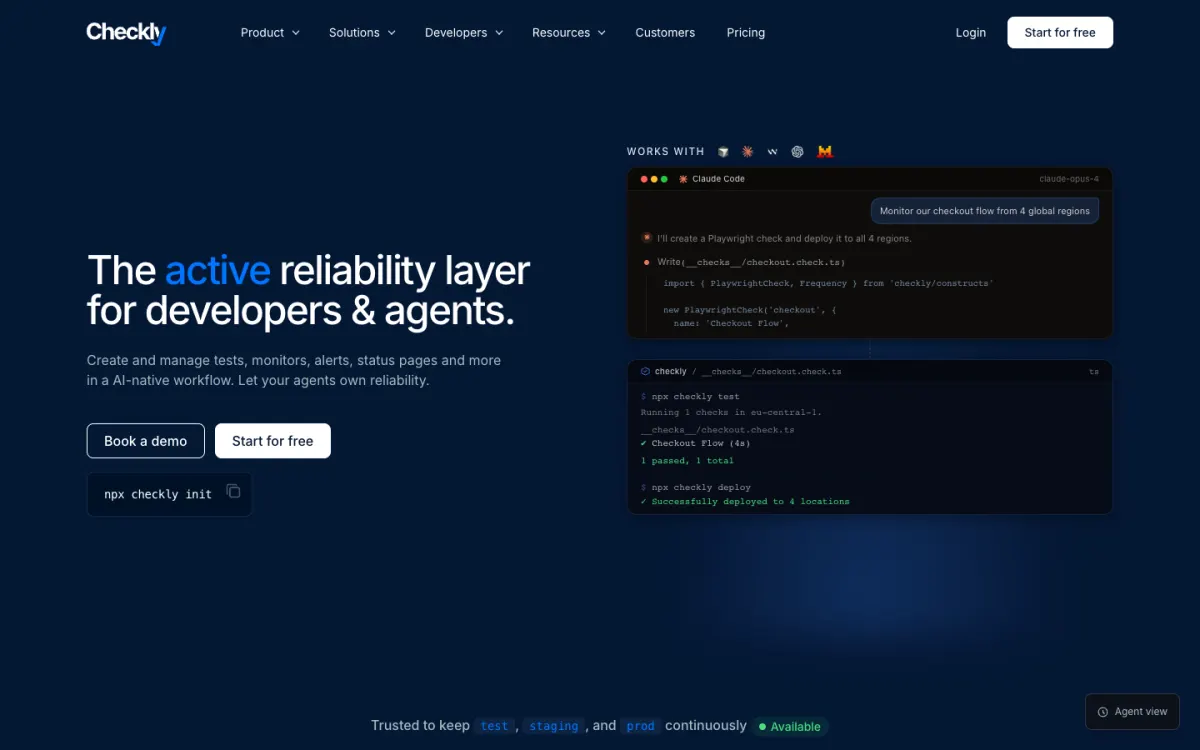
What it is. A monitoring platform for developers: uptime monitors, API checks, and Playwright browser checks that log in, search, or check out, defined as code and deployed from your repository.
Why it replaces Better Stack. Better Stack’s transaction monitoring is billed by Playwright minutes. Checkly is built around those checks, with monitoring as code, so tests live next to your application and run in CI.
Pricing. The free Hobby plan includes 10 uptime monitors checked every 2 minutes, 10,000 API check runs, and 1,000 browser check runs a month. Starter is $24 a month billed annually.
The catch. It’s a developer tool. Non-technical teams may find a dashboard-first monitor easier.
6. Grafana Cloud: best for logs and metrics
What it is. Hosted Grafana with logs (Loki), metrics (Prometheus and Mimir), traces (Tempo), synthetic monitoring, and on-call.
Why it replaces Better Stack. If you send logs and metrics to Better Stack Telemetry, Grafana Cloud is the standard open-source-based alternative, and its free tier is large.
Pricing. The free tier includes 10,000 active metric series, 50 GB of logs, and 50 GB of traces a month with 14 days of retention, 3 users, and 100,000 synthetic API test runs. Pro starts with a $19 monthly platform fee plus usage.
The catch. Dashboards and queries take setup and learning, and status pages aren’t included.
7. Uptime Kuma: best self-hosted alternative
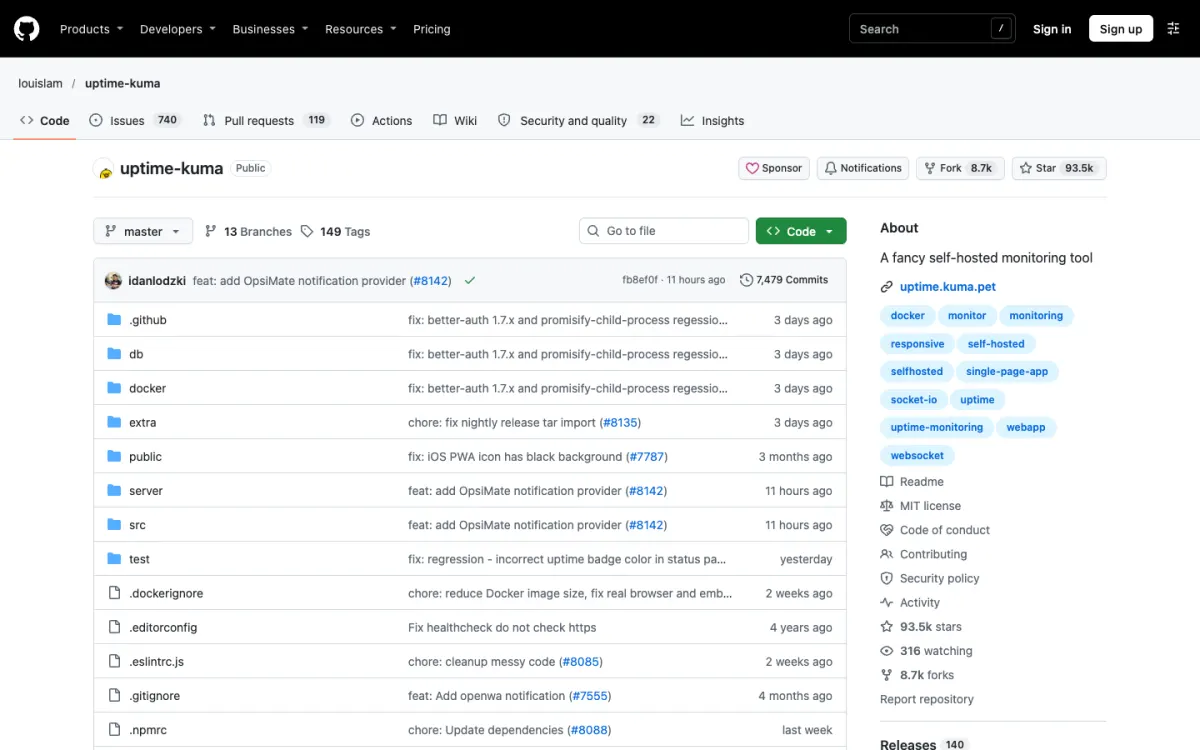
What it is. An open-source monitoring tool you run on your own server, with HTTP, keyword, ping, port, DNS, Docker, and push (cron) monitors, more than 90 notification services, and status pages.
Why it replaces Better Stack. Unlimited monitors and status pages on your own domain, with checks as often as every 20 seconds, for the cost of a small server.
Pricing. Free.
The catch. If the server running it goes down, so does your monitoring, and there’s no on-call scheduling. Run it somewhere other than the sites it watches.
Which Better Stack alternative should you choose?
- You use Better Stack for uptime and status pages: Pulsetic.
- You want as many free monitors as possible: UptimeRobot.
- You want monitoring and on-call in one tool: Hyperping.
- On-call and incident response matter most: incident.io, paired with a monitoring tool.
- You test logins and checkouts in a real browser: Checkly.
- You need logs and metrics: Grafana Cloud.
- You’d rather self-host: Uptime Kuma.
For more options, see our best website monitoring tools, free uptime monitoring, and status page tools guides.
FAQ
What is the best alternative to Better Stack?
Pulsetic is the best overall alternative for uptime monitoring and status pages, with SSL, domain, cron, and AI browser monitors, status pages on your own domain, and SMS and call alerts from $9 a month. incident.io is better for on-call and incident management, and Grafana Cloud for logs and metrics.
Is Better Stack free?
Better Stack has a free plan for personal projects with 10 monitors and heartbeats combined, checked every 3 minutes, one status page, Slack and email alerts, and small allowances for logs, errors, and session replays. On-call and phone alerts need a Responder license from $29 a month billed yearly.
How much does Better Stack cost?
A Responder license is $29 a month billed yearly or $34 monthly, per responder, and includes on-call, monitoring, status pages, and unlimited phone and SMS alerts. Extra status pages are $12 to $15 a month each, and 50 extra monitors $21 to $25 a month.
Is there a cheaper alternative to Better Stack for status pages?
Yes. Pulsetic includes 3 status pages on your own domain for free, and unlimited status pages with subscriber notifications from $9 a month. UptimeRobot’s Solo plan includes 3 status pages on your own domain from €9 a month billed annually.
Is Better Uptime the same as Better Stack?
Yes. Better Uptime was the original name of the uptime monitoring and status page product. It became part of Better Stack, which also covers logs, metrics, and error tracking, so Better Uptime alternatives and Better Stack alternatives are the same list: Pulsetic, UptimeRobot, Hyperping, and the others above.
Can I self-host an alternative to Better Stack?
Yes. Uptime Kuma is a free, open-source monitor with status pages that you run on your own server. For logs and metrics, Grafana, Loki, and Prometheus are open source and can be self-hosted too.
Build your Bootstrap theme
Design a custom Bootstrap 5 theme visually with a live preview, then export clean Sass or CSS.
Open the Builder