Site24x7 Alternatives: 8 Tools for Uptime and APM (2026)
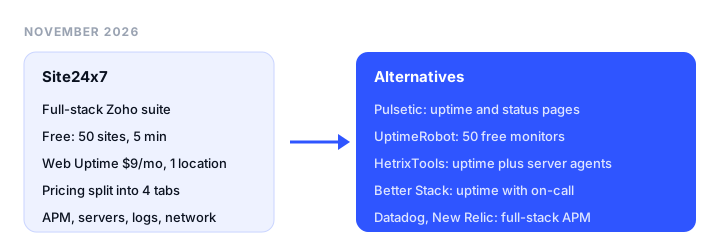
Site24x7 is Zoho’s full-stack monitoring suite, and it is a lot of tool if all you need is to know when your website goes down. Teams look for Site24x7 alternatives when the pricing (four plan families, license packs, and add-ons) gets hard to follow, when the $9 website plan is listed with a single monitoring location, or when they need something simpler for uptime and status pages. This guide covers eight alternatives, split into focused uptime tools and full-stack suites for teams that also need APM, with pricing checked on each vendor’s site in November 2026.
TL;DR
- Best for website and uptime monitoring: Pulsetic. 10 free monitors checked from 3 regions, 3 free status pages on your own domain, and paid plans from $9 a month with 60-second checks from 5 regions and SMS, call, Slack, and Teams alerts. It does not do APM or server monitoring.
- Most free monitors: UptimeRobot, 50 monitors on a free plan that allows commercial use.
- Uptime plus basic server monitoring: HetrixTools, with a server agent for every uptime monitor and 1-minute checks on every plan, including free.
- Uptime with on-call and logs: Better Stack.
- Full-stack replacement for Site24x7: Datadog if you want the broadest platform, New Relic if you want a large free tier and usage-based pricing.
What Site24x7 does well
Site24x7 covers far more than websites. One account can watch:
- Websites and APIs: HTTP, DNS, port, ping, SSL and domain expiry checks, content checks, and website defacement monitoring.
- Infrastructure: servers, Kubernetes, VMware, databases, and AWS, Azure, GCP, and OCI resources.
- Applications: APM for Java, .NET, Python, Node.js, and mobile apps, plus log management.
- Users: real user monitoring (RUM) and synthetic browser transactions.
- Networks: network performance, traffic, and configuration management.
It also has a real free plan. Site24x7’s free website monitoring page lists 50 website monitors checked every 5 minutes from one location, email alerts, and one public status page, with no expiry. For an IT team that wants servers, apps, and websites under one login, that breadth is the main reason to stay.
Why teams look for Site24x7 alternatives
- Pricing is hard to read. The pricing page splits plans into four tabs (Website Monitoring, Infrastructure, All-in-one, MSP), each with its own plans, license packs, and add-on rates. APM, for example, consumes advanced and basic monitor licenses rather than having a single price.
- The cheapest website plan checks from one place. Web Uptime at $9 a month (billed annually) includes 25 websites at 1-minute intervals, and Site24x7’s pricing page lists one monitoring location for it, with a feature-table note that notification profiles on that plan support email alerts only. Its free website monitoring page describes the paid Uptime plan with 8 locations, so check the current plan details with Site24x7 before you buy.
- Multi-location checks cost more. Web Perf adds 8 locations, but at $36 a month billed annually, and secondary locations are polled once an hour, not every minute.
- Limits on the entry all-in-one plan. Lite allows 10 alerts per resource per day and 6 months of data retention.
- More tool than the job needs. If you only watch websites, SSL certificates, and cron jobs, a full observability console adds setup and navigation you will not use.
Site24x7’s plans and pricing
We loaded site24x7.com/site24x7-pricing.html in USD on November 18, 2026. The struck-through price on each card is the month-to-month rate; the larger number is the price per month when paid annually.
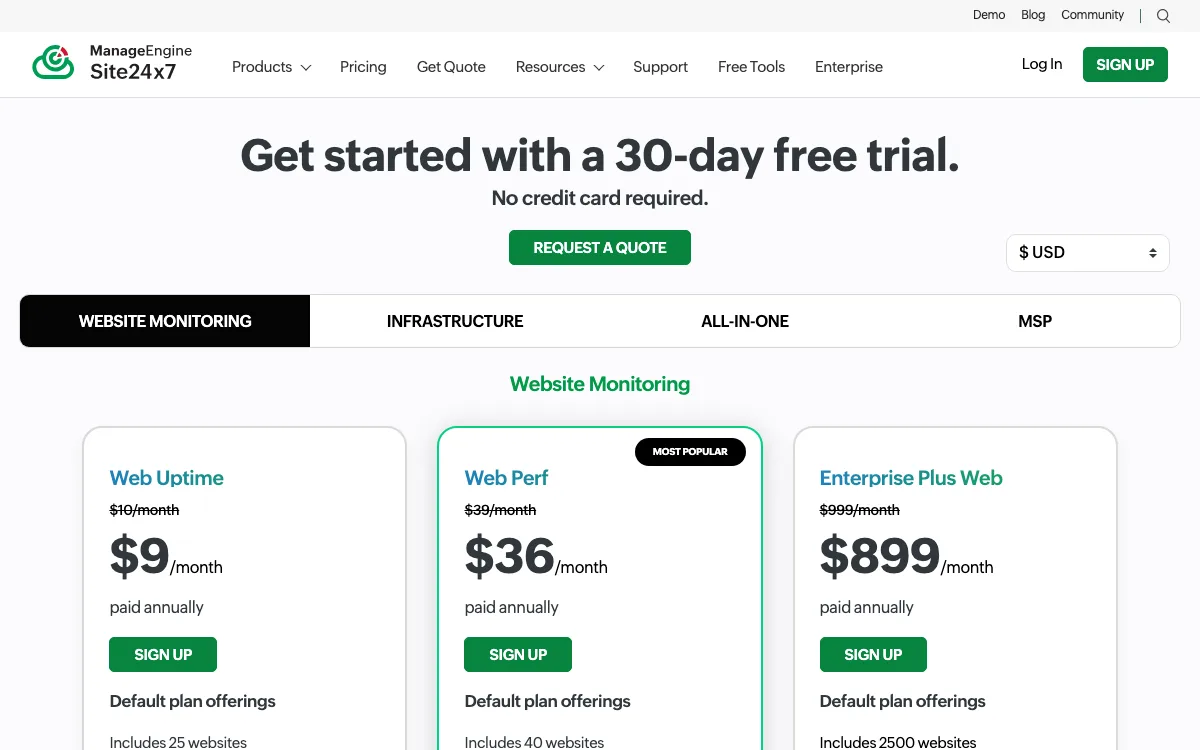
| Plan | Monthly | Paid annually | What’s included |
|---|---|---|---|
| Free | $0 | $0 | 50 website monitors, 5-min checks, 1 location, email alerts, 1 status page |
| Web Uptime | $10/mo | $9/mo | 25 websites, 1-min checks, 1 location, 3 status pages, no transaction monitors or RUM |
| Web Perf | $39/mo | $36/mo | 40 websites, 8 transaction monitors, 8 locations, 100K RUM page views, 10 status pages |
| Enterprise Plus Web | $999/mo | $899/mo | 2,500 websites, 100 transaction monitors, 30-sec checks, 16 locations |
| All-in-one Lite | $10/mo | $9/mo | 2 servers, 5 websites |
| All-in-one Professional | $49/mo | $42/mo | 5 servers, 1 application, 20 websites, 4 GB logs, 10 network components, 100K page views |
| All-in-one Enterprise | Quote | From $625/mo | Professional plus anomaly detection and event correlation |
Extra capacity is sold in packs. On Web Uptime, 50 more uptime monitors cost $18 a month. Every paid plan starts with a 30-day free trial without a card.
Site24x7 alternatives at a glance
| Tool | Type | Best for | Free plan | Paid from | Key limits |
|---|---|---|---|---|---|
| Pulsetic | Uptime and status pages | Website and uptime monitoring | 10 monitors, 5 min, 3 regions | $9/mo | No APM or server agents; free alerts are email and webhook only |
| UptimeRobot | Uptime and status pages | Most free monitors | 50 monitors, 5 min | €9/mo annual | Prices shown in EUR; SSL and DNS checks listed from Solo |
| HetrixTools | Uptime and server agents | Uptime plus basic server metrics | 15 monitors, 1 min | $9.95/mo | Free accounts must log in every 90 days |
| Better Stack | Uptime, on-call, logs | Monitoring with on-call | 10 monitors and heartbeats | $29/mo per responder (yearly) | Per-responder pricing; extra status pages cost extra |
| Uptrends | Synthetic monitoring | Many checkpoint locations | 30-day trial | $42/mo (annual billing) | Credit-based pricing; 2-min checks on Core |
| Pingdom | Synthetic and RUM | Uptime plus real-user data | Free trial | €14.33/mo annual | Prices shown in EUR; no free plan |
| Datadog | Full-stack suite | Broadest observability platform | Free trial | $15/host/mo (infra, annual) | Usage pricing across many products |
| New Relic | Full-stack suite | Large free tier, usage pricing | 100 GB/mo ingest, 1 full user | $10 first user (Standard) | Costs grow with data and full users |
The best Site24x7 alternatives, reviewed
Focused website and uptime tools (1 to 6). These replace Site24x7’s website monitoring, SSL checks, and status pages, usually for less money and with less setup. None of them is an APM tool.
1. Pulsetic: best for website and uptime monitoring
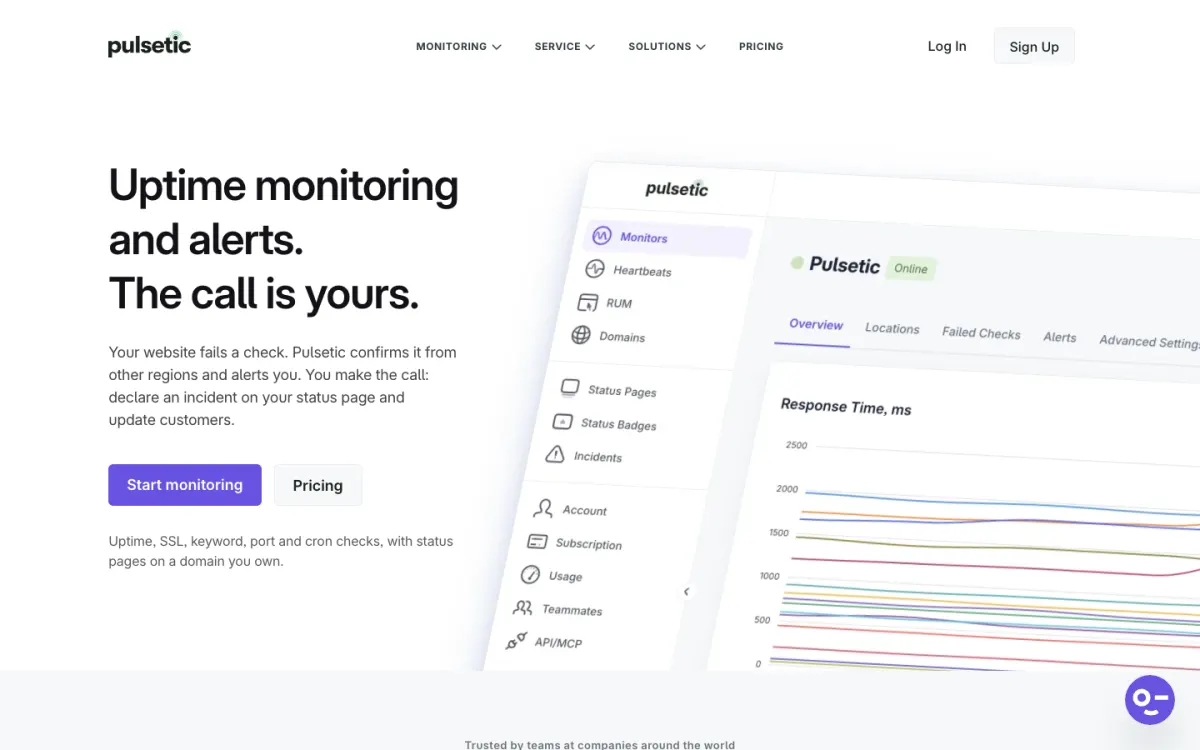
What it is. A monitoring and status page tool with website, keyword, SSL, port, ping, TCP, API, cron heartbeat, domain expiry, and DNS monitors, plus dependency monitoring for third-party services, AI browser monitors, real-user monitoring of Core Web Vitals, and branded status pages.
Why it replaces Site24x7. Pulsetic publishes its check regions per plan: 3 on the free plan, 5 on Solo, and 15 on Team, and it confirms a failure from other regions before it alerts you, which cuts false alarms. Status pages are unlimited on every paid plan and use your own domain on every plan, including free.
Pricing.
| Plan | Price | Monitors | Check interval | Status pages | Alerts included |
|---|---|---|---|---|---|
| Free | $0 | 10 | 5 min, 3 regions | 3, custom domain | Email, 1 webhook |
| Solo | $9/mo ($90/yr) | 10+ | 60 sec, 5 regions | Unlimited | 30 SMS or calls, 15 WhatsApp, Slack, Teams, Discord, Telegram |
| Team | $19/mo ($190/yr) | 50+ | 30 sec, 15 regions | Unlimited, white label | 100 SMS or calls, 50 WhatsApp |
| Organization | $49/mo ($490/yr) | 300+ | 30 sec, 15 regions | Unlimited, SSO-protected | 200 SMS or calls, 100 WhatsApp |
Extra monitors cost $0.20 each a month. To match Web Uptime’s 25 websites, Solo plus 15 extra monitors comes to $12 a month, about $3 more than Site24x7’s annual price, with 5 check regions instead of one.
Limitations. Pulsetic is not an APM, server, log, or network monitoring tool, so it cannot replace Site24x7’s infrastructure side. Free plan alerts are email and one webhook only, and there is no on-call scheduling. One Trustpilot reviewer called it the “Best UI/UX out of a dozen competing offerings that I looked at” (Trustpilot, January 2024).
Good for: small teams, agencies, and SaaS products that used Site24x7 mainly for uptime, SSL, cron, and status pages.
2. UptimeRobot: most free monitors
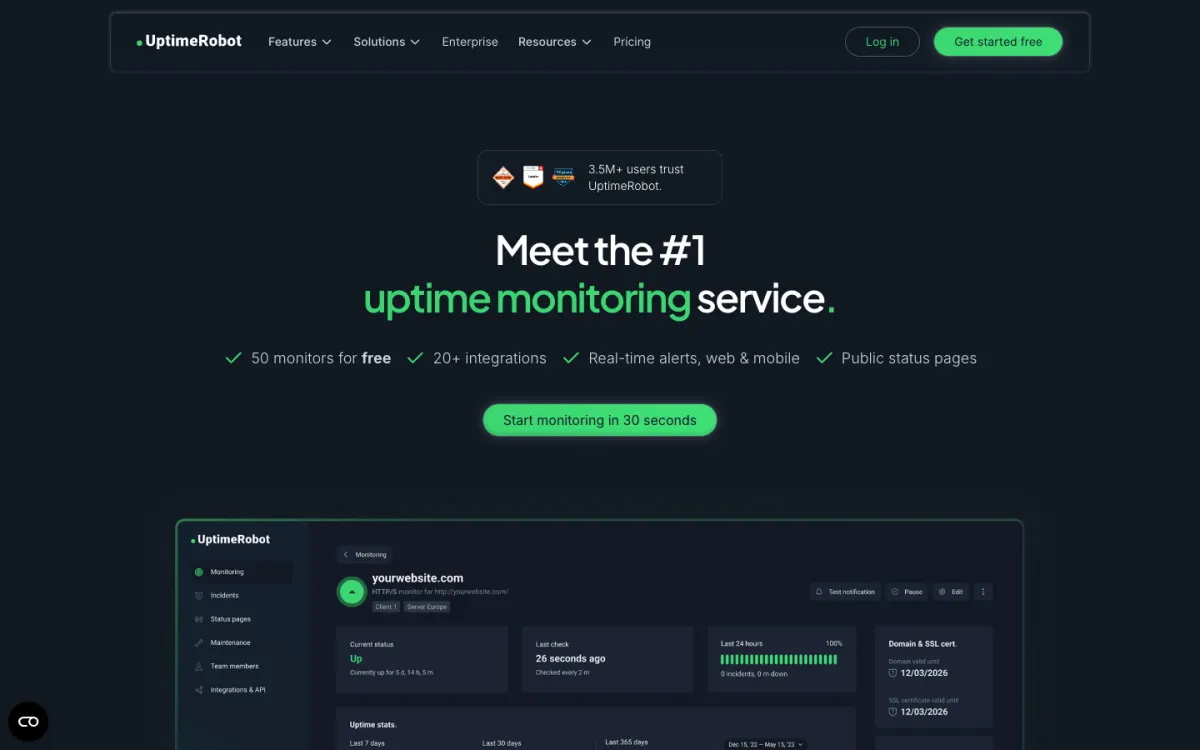
What it is. A widely used uptime monitor with HTTP, keyword, ping, port, API, DNS, SSL, domain, and heartbeat checks.
Why it replaces Site24x7. Its free plan matches Site24x7’s 50 monitors at 5-minute intervals, and the pricing page says the free plan is for personal and commercial projects. Paid plans re-check a failure from a second data center.
Pricing. Our pricing page load showed EUR only. Solo is €9 a month billed annually (€10 monthly) for 10 monitors at 60-second intervals and 3 status pages on your own domain. Team is €30 a month annually (€35 monthly) for 100 monitors at 30-second intervals and 3 seats. Scale starts at €55 a month annually for 200 monitors at 15-second intervals.
Limitations. The free plan is limited to 5 integrations with no notify-only seats, and SSL and DNS monitoring are listed as Solo features. Solo includes only 10 to 20 SMS or voice credits. More in our UptimeRobot alternatives guide.
Good for: watching many sites for free.
3. HetrixTools: uptime plus basic server monitoring
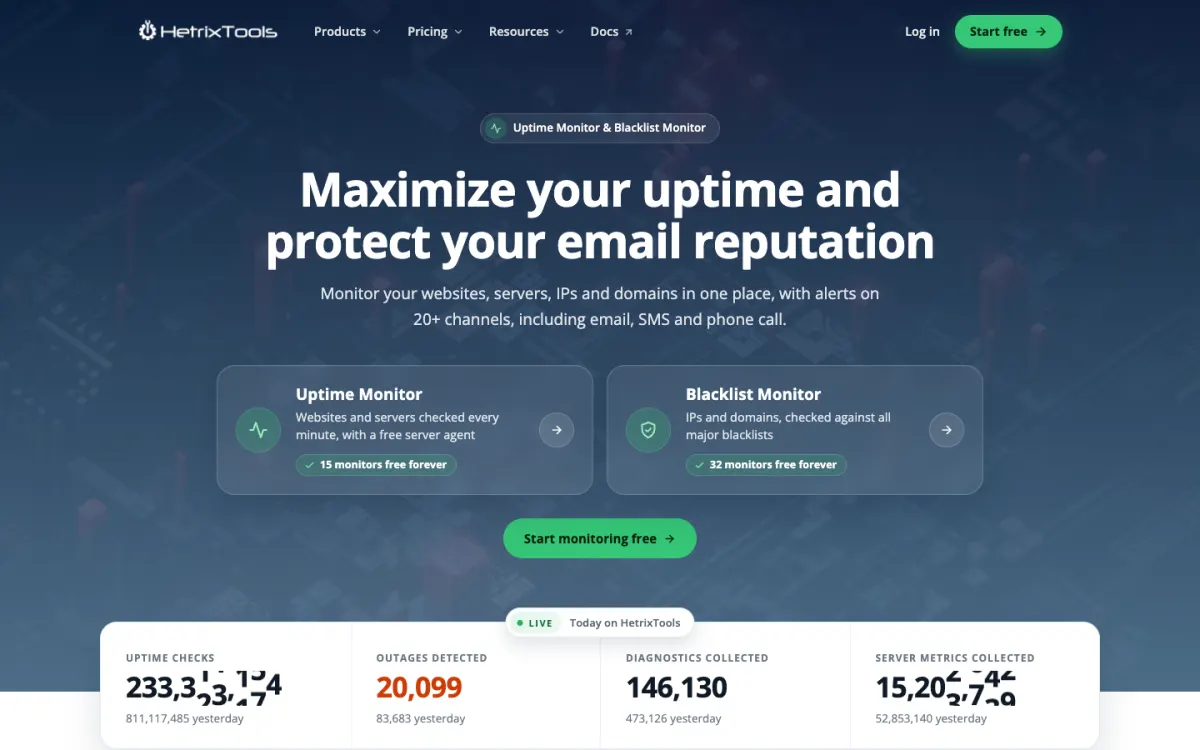
What it is. Uptime monitoring with a server agent for CPU, RAM, disk, network, RAID, and drive health, plus status pages and uptime reports.
Why it replaces Site24x7. If you used Site24x7 for a handful of websites and servers, HetrixTools covers both. Every plan, including free, checks every minute and includes one server agent per uptime monitor.
Pricing. Free has 15 uptime monitors and 15 server monitors from 4 of 12 locations. Professional is $9.95 a month ($99.95 a year) for 30 of each with 25 SMS a month. Business is $19.95 for 60, and Enterprise $49.95 for 200.
Limitations. Free accounts must log in at least once every 90 days. Server monitoring is host metrics, not application tracing.
Good for: small teams with a few servers who want uptime and host alerts without a full suite.
4. Better Stack: uptime with on-call and logs
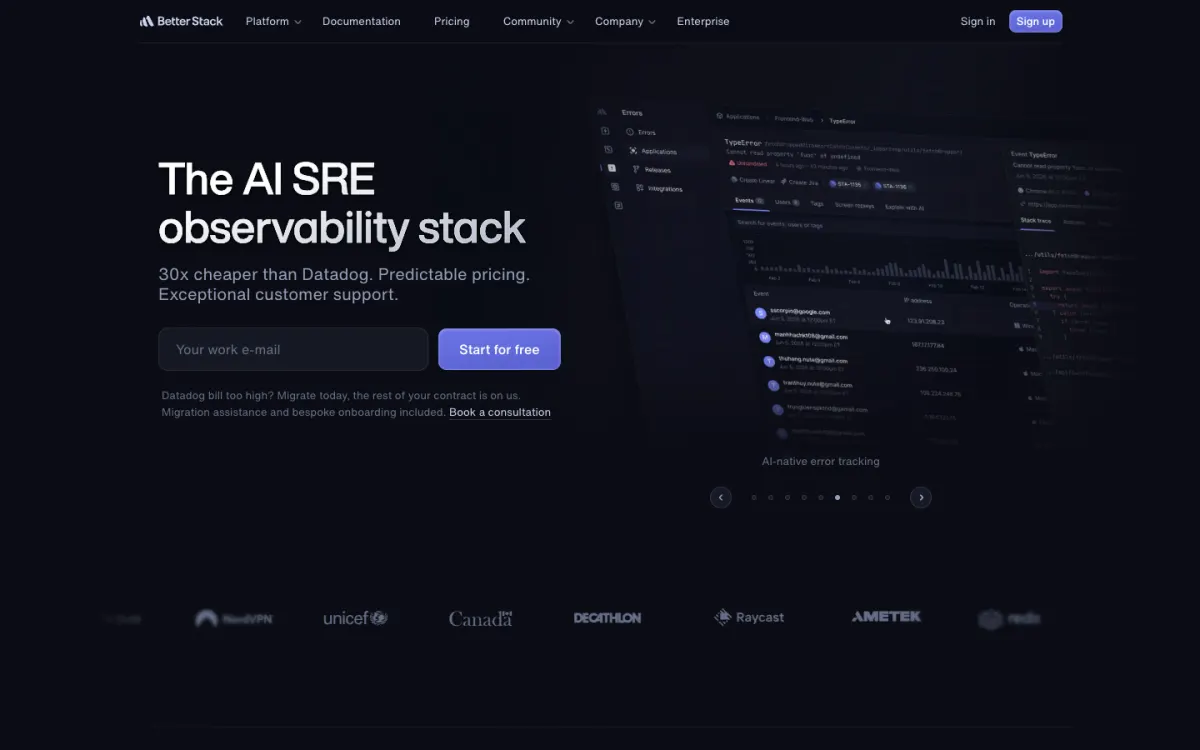
What it is. A platform with uptime monitoring, heartbeats, status pages, on-call scheduling, incident management, and logs, traces, and metrics.
Why it replaces Site24x7. It sits between the two groups: uptime checks as often as every 30 seconds with unlimited phone and SMS alerts per responder, plus telemetry bundles if you also want logs and traces.
Pricing. The free plan, for personal projects, includes 10 monitors and heartbeats and one status page. A Responder license is $29 a month billed yearly or $34 monthly. Extra status pages are $12 a month yearly. Telemetry bundles start at $25 a month billed yearly for 40 GB each of logs, traces, and metrics.
Limitations. Costs grow with each responder and each extra status page. See our Better Stack alternatives.
Good for: teams that need on-call rotations with their uptime checks.
5. Uptrends: many checkpoint locations
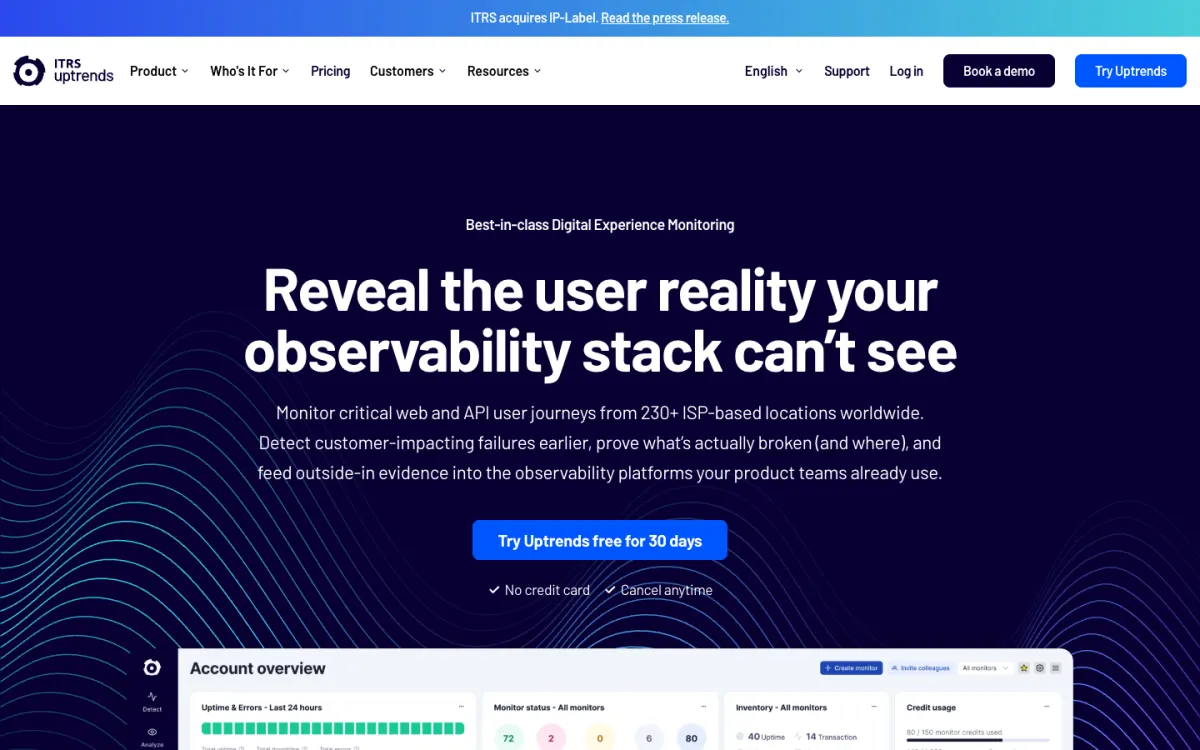
What it is. A synthetic monitoring service with uptime, browser, transaction, and API checks, with RUM as an add-on.
Why it replaces Site24x7. If you want Web Perf style transaction monitoring from many locations, Uptrends Pro lets you pick from 230+ checkpoints.
Pricing. Core is from $42 a month on annual billing with 10 users, 2-minute uptime checks, 10 public status pages, and 240 SMS credits. Pro is from $60 a month with 1-minute uptime checks, 5-minute transaction checks, and unlimited status pages. A 30-day trial needs no card.
Limitations. Pricing is credit-based on an annual term, and there is no free plan.
Good for: teams that need transaction monitoring from specific cities.
6. Pingdom: uptime plus real-user monitoring
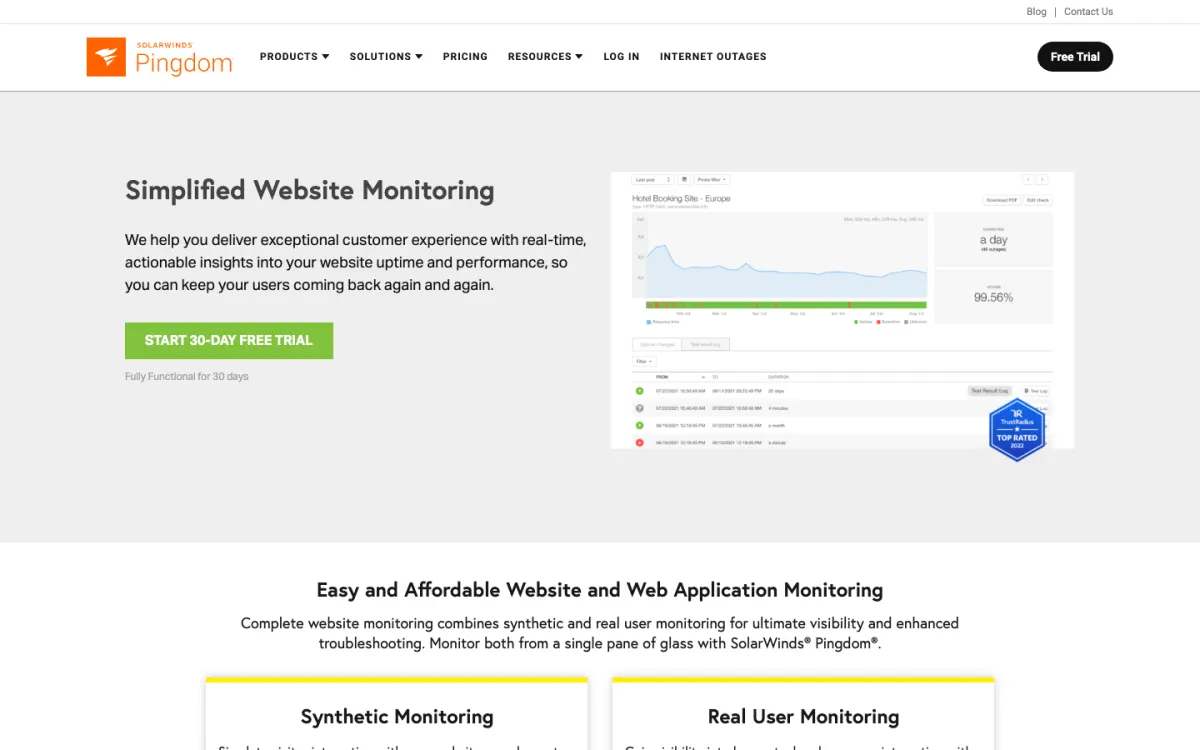
What it is. SolarWinds’ website monitoring service with uptime, page speed, and transaction checks, plus real-user monitoring.
Why it replaces Site24x7. It is a well-known name for synthetic plus RUM without Site24x7’s infrastructure layers, and every plan includes unlimited users and public status pages.
Pricing. Our pricing page load showed EUR only. Synthetic Monitoring starts at €16 a month, or €14.33 a month billed annually, for 10 uptime checks, 1 advanced check, and 50 SMS. RUM is priced separately.
Limitations. No free plan, only a trial, and 10 checks is a low entry allowance. Compare it further in our Pingdom alternatives.
Good for: teams that want synthetic and RUM from one established vendor.
Full-stack suites (7 and 8). Pick one of these if you need what Site24x7 does beyond websites: APM, traces, infrastructure, and logs.
7. Datadog: broadest observability platform
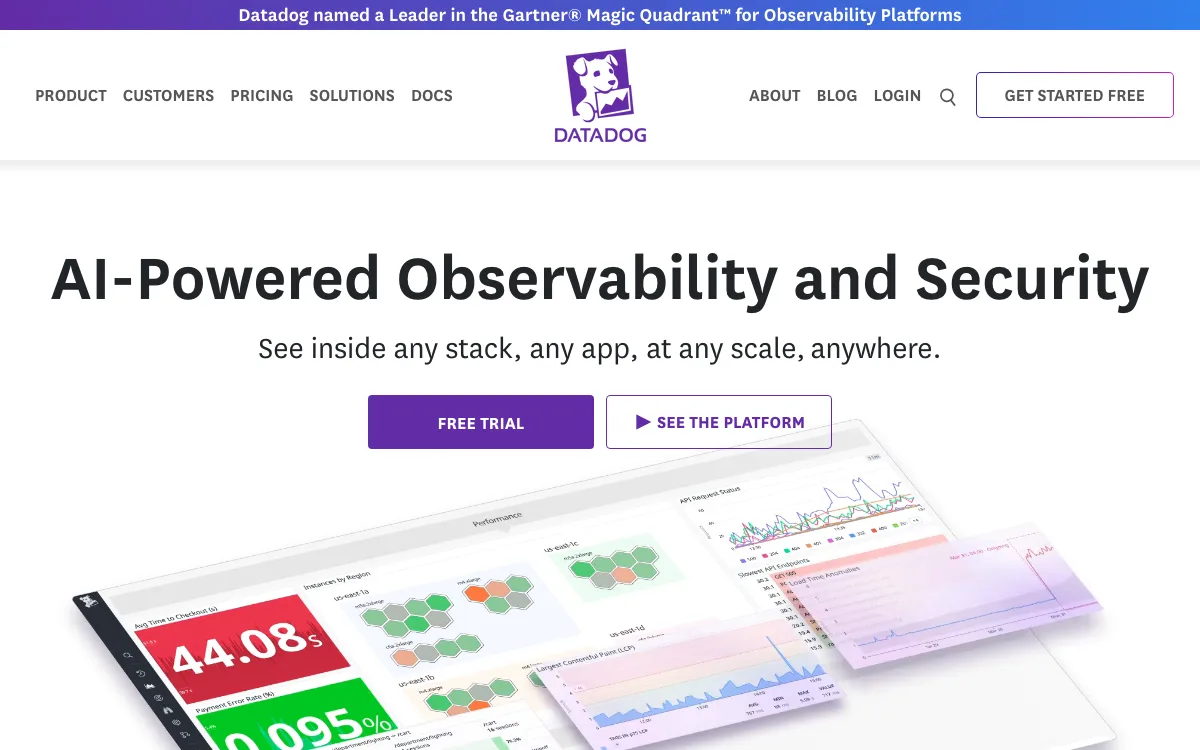
What it is. An observability and security platform covering infrastructure, APM, logs, RUM, synthetic tests, databases, and incident response.
Why it replaces Site24x7. It covers everything Site24x7 does and more, with 1,000+ integrations on its Pro infrastructure tier.
Pricing. Infrastructure Pro starts at $15 per host a month billed annually ($18 on-demand). APM starts at $31 per host a month with infrastructure attached, billed annually ($36 on-demand). API synthetic tests are $5 per 10,000 runs billed annually ($7.20 on-demand). By Datadog’s own counting, one API test from 3 locations every minute is 180 runs an hour, about 129,600 a month, which works out to roughly $65 a month for that one check at the annual rate (our calculation).
Limitations. Each product is priced separately, so bills are hard to predict, and it is far more than a website-only team needs.
Good for: engineering teams that want one platform for every layer.
8. New Relic: large free tier with usage pricing
What it is. A full-stack observability platform with APM, infrastructure, logs, browser and mobile monitoring, and synthetics.
Why it replaces Site24x7. You pay for data and users instead of per-host licenses, and the free tier is large enough to try APM properly.
Pricing. Free includes 100 GB of data ingest a month and one full platform user. Beyond that, data is $0.40 per GB. Standard charges $10 for the first full platform user and $99 for each additional one (up to 5). Pro full platform users are $349 a month on annual commitments.
Limitations. Costs climb quickly as you add engineers who need full access, and uptime checks are only one small part of the product.
Good for: teams that want APM and can predict their data volume.
Which Site24x7 alternative should you choose?
- You mainly watched websites, SSL, and status pages: Pulsetic.
- You need as many free monitors as Site24x7’s 50: UptimeRobot.
- You also watch a few servers: HetrixTools.
- Your team needs on-call and escalation: Better Stack.
- You need transaction checks from specific cities: Uptrends.
- You want synthetic plus real-user data from one vendor: Pingdom.
- You rely on Site24x7’s APM, servers, and logs: Datadog or New Relic, or stay on Site24x7 and add a focused uptime tool for public status pages.
For more options, see our best website monitoring tools, synthetic monitoring tools, and free uptime monitoring guides.
FAQ
What is the best alternative to Site24x7?
For website and uptime monitoring, Pulsetic: 10 free monitors from 3 regions, 3 free status pages on your own domain, and paid plans from $9 a month. If you need APM, servers, and logs too, Datadog and New Relic are the closest full-stack replacements.
Is Site24x7 free?
Yes. Site24x7’s free plan monitors up to 50 websites every 5 minutes from one location, with email alerts and one public status page. Server, APM, and log monitoring need a paid plan, and every paid plan has a 30-day trial.
How much does Site24x7 cost?
Web Uptime is $10 a month, or $9 a month paid annually, for 25 websites. Web Perf is $39 ($36 annually), All-in-one Lite $10 ($9 annually), and All-in-one Professional $49 ($42 annually). All-in-one Enterprise starts at $625 a month paid annually.
Does Site24x7’s cheapest plan check from multiple locations?
No. The Web Uptime plan lists one monitoring location. Web Perf adds 8 locations, with secondary locations polled every hour.
Is Pulsetic a replacement for Site24x7 APM?
No. Pulsetic monitors websites, APIs, SSL, domains, DNS, cron jobs, and real-user page performance, and runs status pages. It does not trace application code or collect server metrics, so keep an APM tool if you rely on that part of Site24x7.
Build your Bootstrap theme
Design a custom Bootstrap 5 theme visually with a live preview, then export clean Sass or CSS.
Open the Builder