Pingdom Alternatives: 9 Better Monitoring Tools in 2026
Pingdom was one of the first website monitoring services, and it still does the core job well: it checks your site from around the world, alerts you when it goes down, and adds transaction checks, page speed reports, and real-user monitoring on top. But it has no free plan, its mobile apps are gone, and newer tools now match it for less money, often with features Pingdom never added. This guide covers why teams switch, which Pingdom features you need to replace, nine alternatives with current pricing, and how to move your checks over.
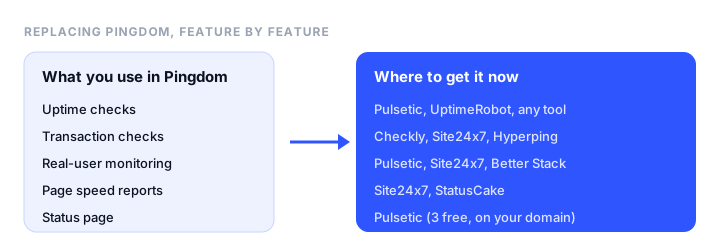
TL;DR
- Best overall: Pulsetic. Uptime, SSL, domain, cron and DNS monitoring, real-user monitoring, and polished status pages, with a free plan and paid plans from $9 a month.
- Best free plan by monitor count: UptimeRobot, with 50 free monitors.
- Closest like-for-like replacement: Site24x7, which also bundles transaction checks, RUM, and page speed, from $9 a month.
- Best for scripted transaction checks: Checkly, which runs real Playwright browser tests.
- Best free self-hosted option: Uptime Kuma.
Why teams leave Pingdom
Pingdom is mature and reliable, so most people leave over price and gaps rather than problems with the checks themselves:
- No free plan. There is a trial, then you pay. Most alternatives have a permanent free tier, so a side project or a small business site can be monitored for nothing.
- Pricing climbs quickly. Synthetic monitoring (uptime and transaction checks) and real-user monitoring are billed as two separate products, each sized on a slider. A setup with uptime checks, a few transaction checks, and RUM adds up faster than a single plan elsewhere.
- No mobile apps. Pingdom’s iOS and Android apps were discontinued in 2021.
- Limited alert channels. There are no native phone-call alerts, and SMS alerts are a credit allowance that doesn’t refill like an unlimited plan.
- Basic status pages. Pingdom’s public status page is simple, with roughly one page per account, while dedicated status pages with subscribers, incident updates, and custom branding are standard in newer tools.
- 1-minute checks at best. Several alternatives check every 30 seconds or faster.
Pingdom’s pricing page shows prices in euros on a quantity slider. When we checked in November 2026, synthetic monitoring started at €16 a month (€14.33 billed annually) for 10 uptime checks and 1 advanced check, rising to €66 for 50 checks and €120 for 100. RUM started at €16 a month for 100,000 page views.
What Pingdom does well
Before you switch, list which of these you actually use, because not every alternative replaces all of them:
| Pingdom feature | What it does | Alternatives that replace it |
|---|---|---|
| Uptime checks | HTTP, ping, port, and keyword checks from 100+ locations | All of them |
| Transaction checks | Scripted multi-step flows such as login or checkout | Checkly, Uptime.com, Site24x7, Hyperping |
| Real-user monitoring | Load times from real visitors’ browsers | Pulsetic, Site24x7, Uptime.com, Better Stack |
| Page speed | Waterfall reports of what slows a page down | Site24x7, StatusCake |
| Status page | A public page showing your uptime | All except Checkly’s basic pages; strongest in Pulsetic |
| Integrations | Slack, PagerDuty, Opsgenie, webhooks | All, with PagerDuty and Opsgenie native in most |
If you only use uptime checks and alerts, which is true for most small sites, any tool on this list replaces Pingdom and most cost less. If you rely on transaction checks or RUM, look at the tools marked for those.
Pingdom alternatives at a glance
| Tool | Free plan | Paid from | Fastest checks | RUM | Transaction checks | Status pages |
|---|---|---|---|---|---|---|
| Pulsetic | 10 monitors | $9/mo | 30 sec | Yes | AI browser monitors | Unlimited on paid |
| UptimeRobot | 50 monitors | €9/mo | 15 sec | No | No | Yes |
| Better Stack | 10 monitors | $29/mo per seat | 30 sec | Yes | Playwright checks | Yes |
| StatusCake | 10 monitors | €16.66/mo | 30 sec | No | No | Paid plans |
| Site24x7 | 50 monitors | $9/mo | 1 min (sub-minute on top tier) | Yes | Yes | Yes |
| Uptime.com | No | $9/mo | 1 min | Add-on | Yes | Add-on |
| Checkly | 10 monitors | $24/mo | 30 sec (Team) | No | Yes, Playwright | Yes |
| Hyperping | 20 monitors | $24/mo | 30 sec | No | Yes, Playwright | Yes |
| Uptime Kuma | Free, self-hosted | $0 | 20 sec | No | No | Yes |
| Pingdom | Trial only | €14.33/mo | 1 min | Separate product | Yes | Basic |
Paid prices are the lowest plan billed annually, as listed in November 2026.
The best Pingdom alternatives, reviewed
1. Pulsetic: best overall Pingdom alternative
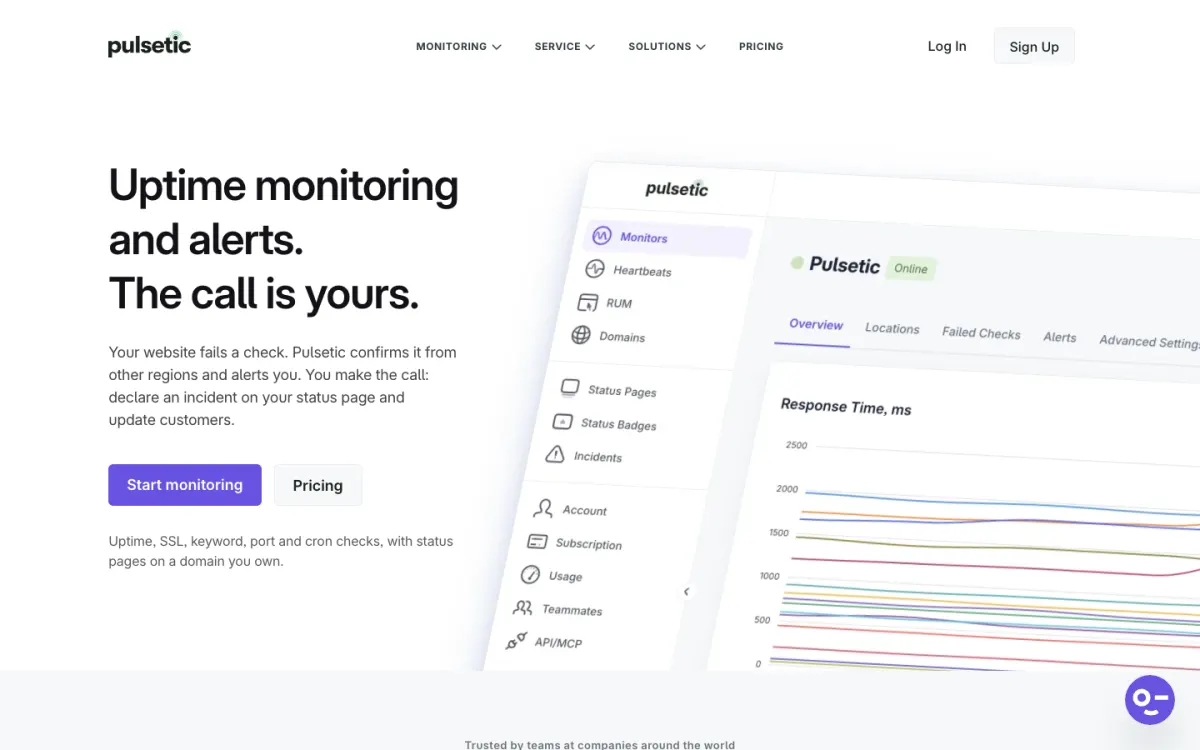
Pulsetic covers what most Pingdom customers use, uptime checks, alerts, RUM, and a status page, and adds the monitoring Pingdom doesn’t have: domain expiry and DNS record change alerts, heartbeat monitors for cron jobs, and dependency monitors for the third-party services your site relies on. Checks include HTTP and keyword, SSL, port, TCP, and ICMP, every 5 minutes from 3 regions on the free plan, every 60 seconds from 5 regions on Solo, and every 30 seconds from 15 regions on Team and Organization.
Status pages are where the gap with Pingdom is widest. The free plan includes 3 status pages on your own domain, translated into 50 languages, and paid plans add unlimited pages, your logo and colors, incident updates, subscriber notifications, password protection, and scheduled maintenance. Alerts go by email and webhook on every plan, and by SMS, phone call, WhatsApp, Slack, Teams, Discord, and Telegram from Solo, with SMS and call credits included.
For journeys like a login or checkout, Pulsetic’s AI monitors follow a plain-English instruction in a real browser and keep a screenshot of every run. They run on a monthly allowance (as often as hourly on Team), so they suit spot-checking key flows rather than replacing Pingdom’s every-minute transaction checks.
The catch. PagerDuty and Opsgenie connect through a webhook rather than a native integration, and Pingdom keeps uptime history indefinitely, while Pulsetic keeps it for 3 months on Free, 1 year on Solo, and up to 5 years on Organization.
Pricing. Free (10 monitors, 5-minute checks, 3 status pages); Solo $9/mo (60-second checks, unlimited status pages); Team $19/mo (50 monitors, 30-second checks, 15 regions); Organization $49/mo (300 monitors). Annual billing gives two months free.
2. UptimeRobot: best free plan
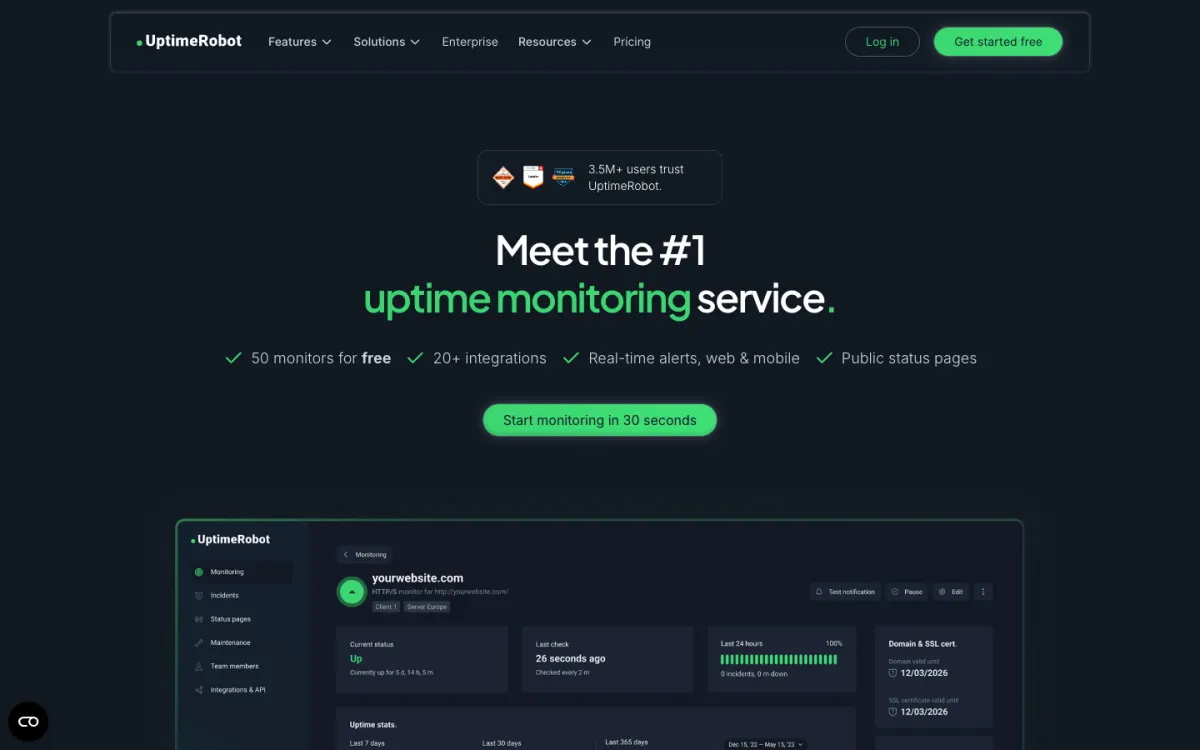
UptimeRobot is the budget pick. Its free plan covers 50 monitors at 5-minute intervals, for personal and commercial sites, which is more than Pingdom’s entry paid plan. Monitor types include HTTP, keyword, ping, port, SSL and domain expiry, heartbeat, and DNS, with a status page and a well-known mobile app.
The catch. No RUM, no transaction checks, and no page speed reports, so it replaces Pingdom’s uptime checks only. SMS and voice alerts are paid credits, and the cheapest paid plan (Solo) covers 10 monitors unless you pay for the 50-monitor option.
Pricing. Free (50 monitors); Solo €9/mo annual; Team €35/mo annual (100 monitors, 30-second checks); Scale €65/mo annual (15-second checks).
3. Better Stack: best for DevOps teams
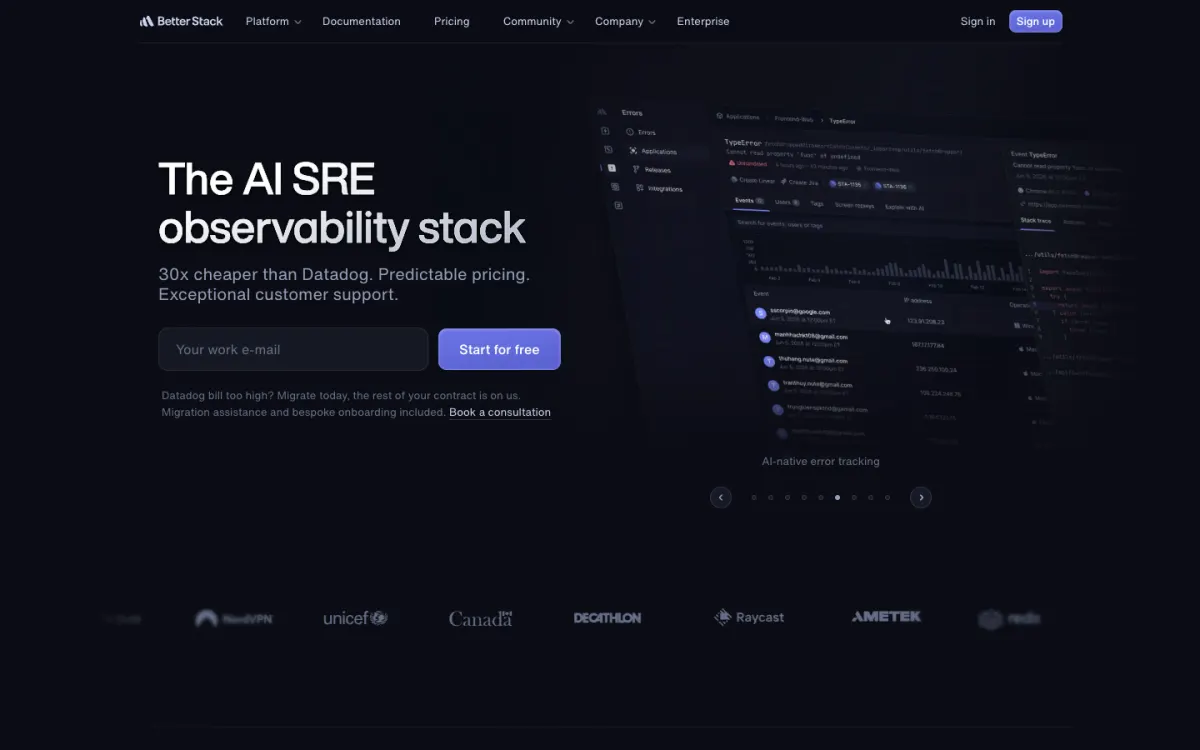
Better Stack combines uptime monitoring with on-call scheduling, phone and SMS alerts, status pages, and a full observability suite: logs, metrics, traces, error tracking, and RUM with session replay. For a team that also wants to replace PagerDuty and a logging tool, it covers more than Pingdom ever did.
The catch. Pricing is per responder seat plus add-ons for extra monitors and telemetry, so the monthly bill is harder to predict than Pingdom’s slider, and the free plan checks only every 3 minutes.
Pricing. Free (10 monitors and 10 heartbeats); Responder seats $29/mo annual, with unlimited phone and SMS alerts; telemetry bundles from $25/mo.
4. StatusCake: best budget all-rounder
StatusCake covers uptime, page speed, SSL and domain expiry, DNS, and Linux server monitoring, with confirmation servers that cut false alarms. Its page speed tests are the closest match to Pingdom’s page speed reports in this price range.
The catch. No RUM and no transaction checks, a UI reviewers call dated, and a big jump from the free plan to the first paid plan. Public status pages and 30-second checks need higher plans.
Pricing. Free (10 monitors); Superior €16.66/mo annual; Business €58.33/mo annual (30-second checks).
5. Site24x7: closest like-for-like replacement
Site24x7, from ManageEngine (Zoho), has every Pingdom feature in one place: uptime checks from 130+ locations, scripted transaction checks, RUM, page speed, and status pages, and it reaches further into server, network, and application monitoring. If you want to drop Pingdom without losing anything, this is the safest swap.
The catch. Many overlapping plans and credit-based add-ons make the true cost hard to work out, and the interface is busier than focused uptime tools. The free plan checks every 5 minutes from one location.
Pricing. Free (50 website monitors); Web Uptime $9/mo annual (25 sites, 1-minute checks); Web Perf $36/mo annual (40 sites, 8 locations).
6. Uptime.com: best for SLA reporting
Uptime.com is the closest match to Pingdom’s enterprise feel: uptime, transaction, and API checks from 100+ probe servers, RUM, and polished public and private status pages, with SLA reports for teams that answer to customers or management.
The catch. No free plan, and status pages, RUM, and extra locations are add-ons, so a complete setup costs more than the entry price suggests.
Pricing. From $9/mo or $84/yr (10 basic checks, 1 advanced check); status pages $13/mo each.
7. Checkly: best for transaction checks
Checkly replaces Pingdom’s transaction checks with something more capable: real Playwright browser tests and API checks written as code, stored in your repository, and deployed from CI. If your Pingdom transaction checks keep breaking when the page changes, scripts you can debug locally are a big step up.
The catch. It’s built for developers, so non-technical teams will struggle, and it has no RUM.
Pricing. Hobby free (10 uptime monitors, 1,000 browser runs a month); Starter $24/mo; Team $64/mo (30-second checks, 21 locations).
8. Hyperping: simple, with on-call built in
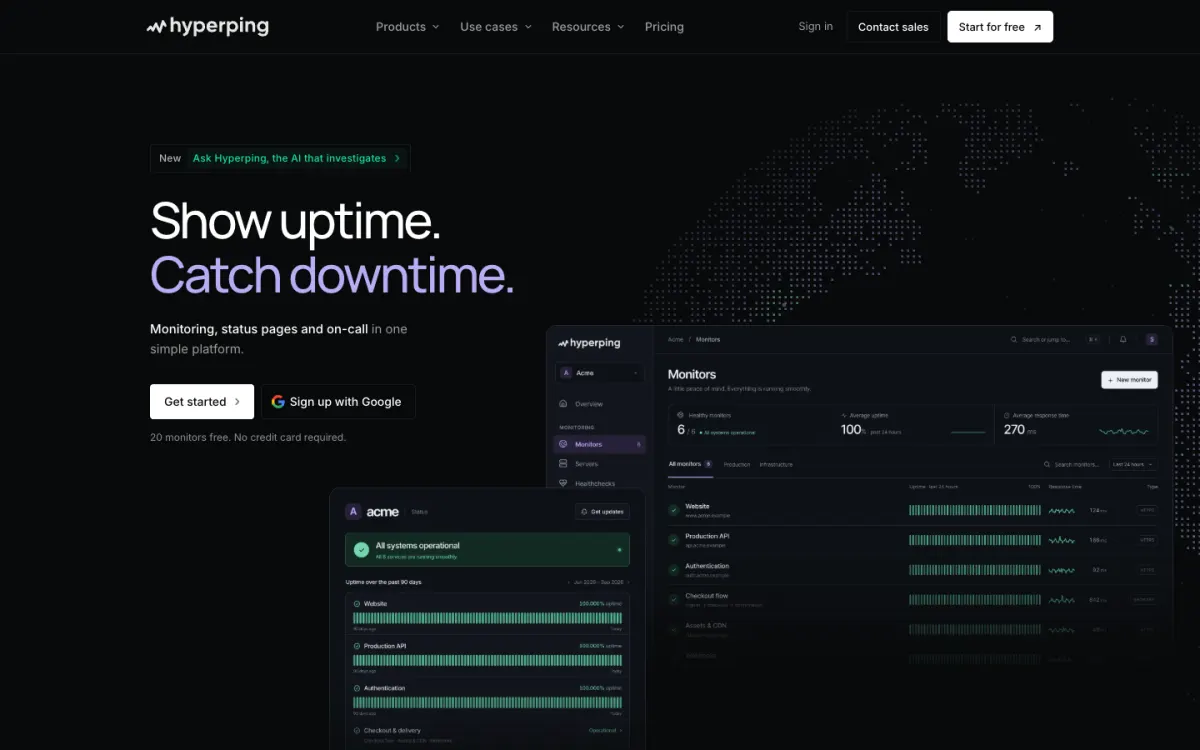
Hyperping combines uptime checks, Playwright browser checks for logins and checkouts, status pages, and on-call schedules with escalation, so a small team gets transaction checks and incident routing without a second tool.
The catch. The free plan is basic, and the step from Essentials to Pro is large.
Pricing. Free (20 monitors, 5-minute checks); Essentials $24/mo annual (50 monitors, 30-second checks, phone alerts, browser checks); Pro $74/mo annual.
9. Uptime Kuma: best free self-hosted alternative
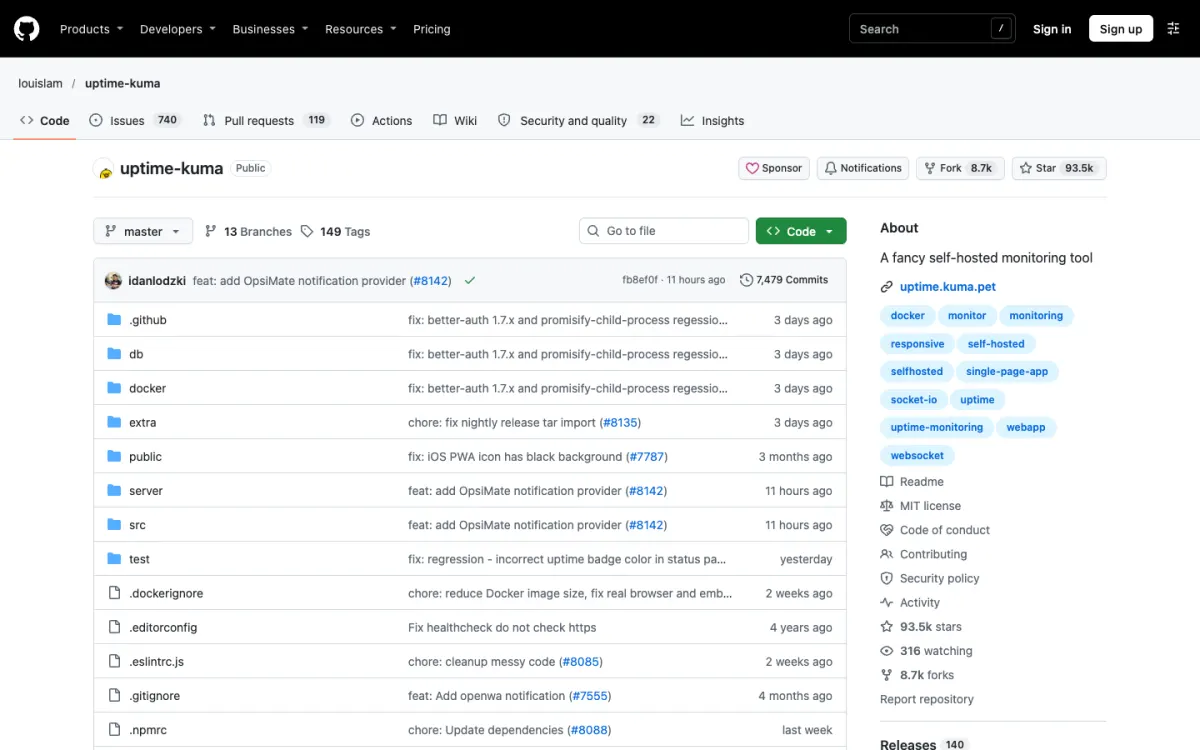
Uptime Kuma is free, open-source software you run on your own server. It monitors HTTP, keyword, ping, port, DNS, and push heartbeats down to 20-second intervals, and sends alerts to 90+ services, with status pages included.
The catch. It checks from wherever you install it, so a single instance can’t tell a regional outage from a problem with its own server, and if that server goes down, your monitoring goes with it. You handle updates and backups.
Pricing. Free (MIT license); you pay only for the server.
Which Pingdom alternative should you choose?
- You only use uptime checks and alerts: Pulsetic or UptimeRobot, both with free plans.
- You want better status pages: Pulsetic.
- You need everything Pingdom has, in one tool: Site24x7 or Uptime.com.
- Your transaction checks matter most: Checkly, or Hyperping for a simpler setup.
- You also want on-call and logs: Better Stack.
- You want no subscription at all: Uptime Kuma on your own server.
More options, including open-source monitors and how free plans compare, are in our roundup of the best website monitoring tools. If you’re comparing against UptimeRobot instead, see UptimeRobot alternatives.
How to move from Pingdom
- List your checks. In Pingdom, note each check’s URL, type, interval, and alert contacts. With many checks, the Pingdom API lists them all:
curl -H "Authorization: Bearer YOUR_API_TOKEN" https://api.pingdom.com/api/3.1/checks. - Recreate them in the new tool. Most alternatives import a list of URLs through their API or a bulk-add form. Recreate transaction checks by hand, which is a good moment to drop flows nobody watches.
- Set up alerts again. Alert contacts and integrations don’t carry over. Send a test alert to every channel.
- Run both tools for a week or two. A free plan or trial makes this cheap. Compare which tool catches each incident first and check for false alarms.
- Move your status page. If your status page lives on a subdomain such as
status.example.com, point that DNS record at the new provider. - Cancel Pingdom. Export any uptime reports you need first, since history doesn’t transfer.
FAQ
What is the best alternative to Pingdom?
For most websites, Pulsetic: it covers uptime checks, alerts, real-user monitoring, and status pages, adds domain and cron monitoring, has a free plan, and starts at $9 a month. Site24x7 is the closest feature-for-feature replacement, and Checkly is best for scripted transaction checks.
Is there a free alternative to Pingdom?
Yes. Pulsetic (10 monitors), UptimeRobot (50 monitors), Site24x7 (50 monitors), StatusCake (10 monitors), Hyperping (20 monitors), and Better Stack (10 monitors) all have permanent free plans. Uptime Kuma is free open-source software you host yourself. Pingdom only offers a trial.
Does Pingdom have a free plan?
No. Pingdom offers a free trial that includes synthetic monitoring and RUM, then requires a paid plan. When we checked in November 2026, the lowest synthetic plan was €16 a month, or €14.33 a month billed annually, for 10 uptime checks and 1 transaction check.
Is Pingdom still owned by SolarWinds?
Yes. Pingdom is part of SolarWinds, which bought it in 2014, and is sold as SolarWinds Pingdom with separate synthetic monitoring and real-user monitoring products.
Which Pingdom alternatives have real-user monitoring?
Pulsetic, Site24x7, Uptime.com, and Better Stack all offer RUM. Pulsetic includes 1,000 page views a month on its free plan, while Site24x7 and Uptime.com sell RUM as part of larger plans or as an add-on.
Build your Bootstrap theme
Design a custom Bootstrap 5 theme visually with a live preview, then export clean Sass or CSS.
Open the Builder