Best Website Builders for Small Business in 2026 (Compared)
The best website builder for a small business is the one that does the job your website has to do, and that job is different for a plumber, a bakery, and a shop that ships across the country. A plumber needs a phone number, a list of services, and a way to ask for a quote. A bakery wants orders for pickup. An online shop needs a cart, payments, and stock. Pick a builder for the wrong job and you either pay for tools you never open or find out after launch that the one thing you need is missing.
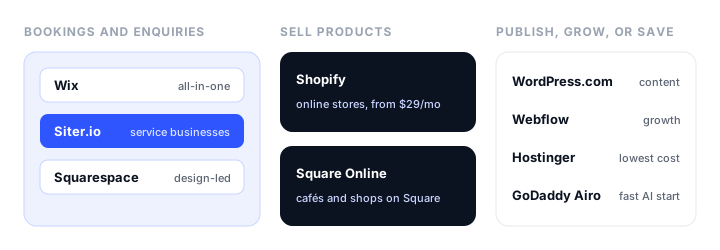
This guide compares nine website builders for small businesses in November 2026, sorted by what your website needs to do. For each one it covers who it suits, what the cheapest useful plan costs, when you can take payments, and what the catch is. Prices are the US prices on each vendor’s own pricing page in November 2026, billed yearly unless we say otherwise; some vendors show prices in your local currency, so the figures you see may differ slightly.
The short version:
- Best overall for most small businesses: Wix. Bookings, a store, invoices, and marketing tools in one place, from $17 a month billed yearly.
- Best for a service business that takes enquiries, not payments: Siter.io. A site that looks designed, booking requests and order forms built from a description, and your own domain for $7 a month.
- Best for design, with invoicing and POS included: Squarespace, from $19 a month.
- Best for selling products online: Shopify, from $29 a month.
- Best for restaurants and shops already on Square: Square Online, with a free plan that sells.
- Best for publishing a lot of content: WordPress.com.
- Lowest cost over several years: Hostinger, if you commit to 48 months.
The best website builders for small business at a glance
| Builder | Best for | Cheapest plan with your domain | Take payments from | Free plan or trial | Main catch |
|---|---|---|---|---|---|
| Wix | Most small businesses | Light, $17/mo | Core, $29/mo | Free plan (Wix ads) | No way to move the site off Wix |
| Siter.io | Service businesses | Solo, $7/mo ($8 monthly) | No payments | Free plan (3 pages) | No store, no blog |
| Squarespace | Design-led brands | Basic, $19/mo ($25 monthly) | Basic, with a 2% fee | 14-day trial | No free plan, 2% fee on Basic sales |
| Shopify | Selling products | Basic, $29/mo ($39 monthly) | Basic | 3-day trial, then $1/mo for 3 months | Expensive if you don’t sell much |
| GoDaddy Airo | A fast AI start | Starter, $9.99/mo | Professional, $24.99/mo | Free plan (build and preview only) | Credits limit AI changes |
| Square Online | Restaurants and retail | Free | Free, at 3.3% + 30¢ | Free plan | Built around Square payments |
| WordPress.com | Content and blogs | Personal, $4/mo ($9 monthly) | Premium, $8/mo, with a 4% fee | Free plan | More to learn and manage |
| Webflow | A marketing site that grows | Basic, $15/mo ($25 monthly) | Ecommerce Standard, $29/mo | Free plan (2 pages) | Steepest learning curve |
| Hostinger | Lowest long-term cost | Premium, $1.99/mo on 48 months | Higher plans | 14-day trial | Renews at $10.99/mo |
What does your small business website need to do?
Most comparisons rank builders on templates and editors. For a small business the better question is what the site has to do once it is live, because that decides the plan you will end up paying for.
Tell people who you are and how to reach you. Services, prices, opening hours, a map, reviews, and a contact form. Every builder here does this, and it is where the cheapest plans are honest value. If this is all you need, don’t pay for a store.
Take bookings or enquiries. A salon, a tutor, a cleaner, or a consultant needs visitors to ask for a time. There are two levels: a booking request that you confirm yourself, and a full booking system with a calendar, reminders, and deposits. Wix and GoDaddy’s Professional plan do the second; Squarespace sells it separately as an add-on.
Sell products. A cart, a checkout, shipping, tax, and stock. Shopify is built for this; Wix, Squarespace, Square Online, and Webflow do it too, usually from their second plan up. Payment fees matter more here than the monthly price.
Publish regularly. A blog, news, recipes, or case studies, posted every week. That needs a real content system, which is where WordPress.com and Webflow lead.
Be found locally. For most small businesses the visitors who matter search for a service near them. Every builder here lets you set page titles and descriptions; what matters more is a Google Business Profile, your own domain, and pages that say what you do and where.
The best website builders for small business, reviewed
1. Wix: best overall for most small businesses
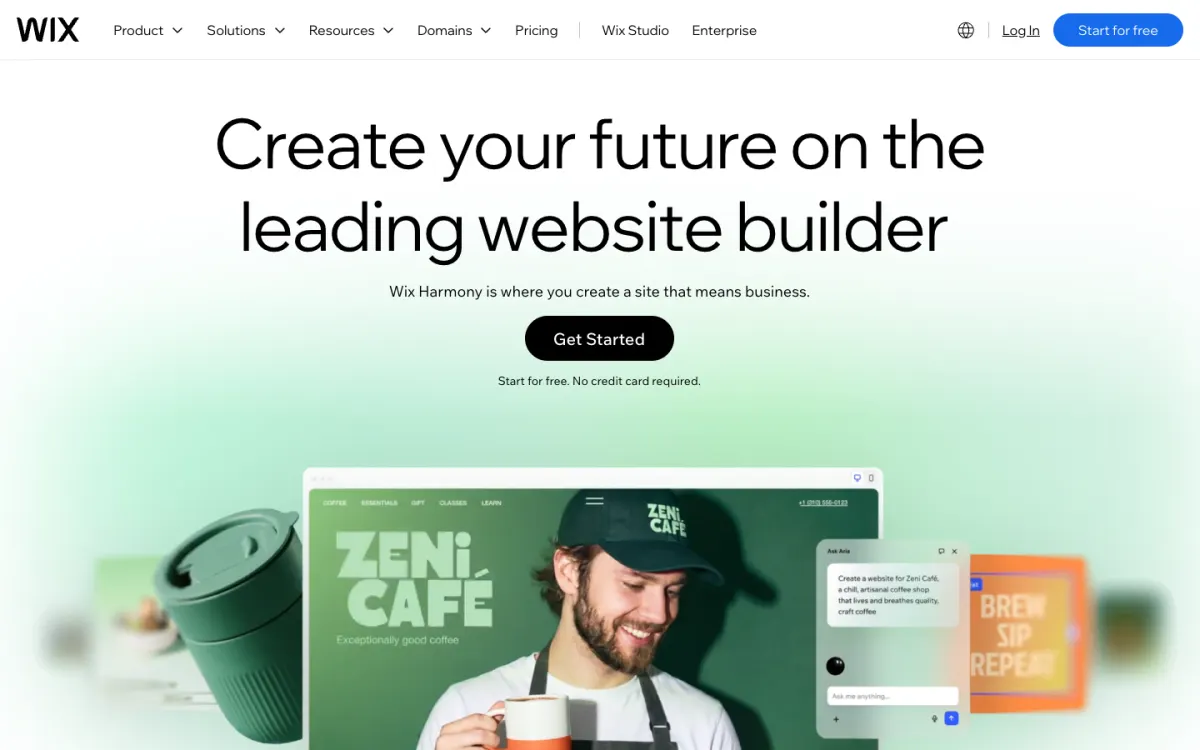
What it is. Wix is the biggest all-in-one website builder, with a drag-and-drop editor, an AI website builder that generates a whole site from a description, and business tools for bookings, stores, events, and email marketing in the same dashboard.
Why it suits small businesses. Wix covers more small business jobs in one product than anything else here. Scheduling, a store, and online payments start on the Core plan, so a service business can take bookings and payments without adding other tools, and a shop can sell from the same site. There is a large app market for anything Wix doesn’t build in.
The catch. You cannot export a Wix site to host it elsewhere: if you leave, you rebuild. The free plan shows Wix ads on every page, so it is a place to try the editor rather than to run a business. Wix lists its US prices for reference and charges in your local currency, so check the final price at checkout.
Pricing. Free $0. Light $17/mo billed yearly adds your own domain (with a free domain voucher for a year). Core $29/mo adds payments, basic ecommerce, and scheduling. Business $39/mo and Business Elite $159/mo add more store and marketing features. Premium plans come with a 14-day full refund.
Best for. Service businesses and small shops that want bookings, payments, and marketing in one place and are happy to stay on Wix for good. If you are already on Wix and want out, see our Wix alternatives.
2. Siter.io: best for a service business that takes enquiries
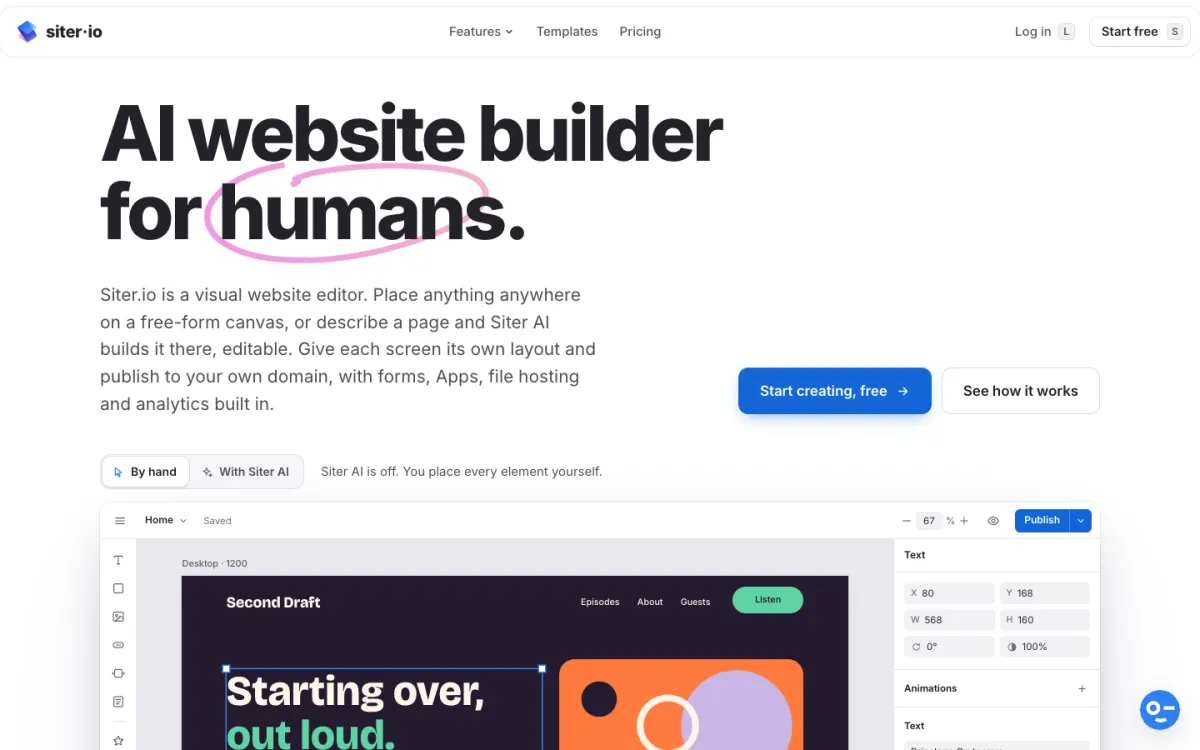
What it is. Siter.io is a visual website builder with a free-form canvas: you place and size everything yourself, on separate desktop, tablet, and phone layouts, so the site looks designed rather than assembled from fixed blocks. Siter AI can draft a page from a description, and every part of the result stays editable on the canvas.
Why it suits small businesses. Siter.io is built for the business that needs to be found and contacted. There are templates for trades such as plumbers, dentists, and hair salons. Siter Apps lets you describe a small tool, such as a booking request form, an order form for pickup, or a price calculator, and Siter AI builds it to sit on your page in your own colors and fonts. Every form message lands in Form entries, where you can search it, filter it by date, and export it as a spreadsheet, and it is emailed to you too. Siter Analytics counts visits without cookies, and Zapier, Google Analytics, and Facebook Pixel connect from the site’s settings.
The catch. Siter.io takes no payments: there is no cart, no checkout, and no paid bookings, so a booking is a request you confirm yourself. There is no blog or CMS either. If customers must pay on your website, or you plan to post every week, pick a builder further down this list.
Pricing. Free $0 publishes 1 website on a getsiter.com address with 3 pages, 1 form, and a Siter.io badge. Solo $7/mo billed yearly or $8 monthly adds your own domain, 10 pages, 3 forms, up to 3 apps on the published site, 600 AI credits a month, and removes the badge. Plus is $12/mo yearly or $14 monthly for 3 websites and 50 pages, and Pro $24/mo yearly or $28 monthly for 5 websites and unlimited pages.
Best for. Trades, studios, clinics, consultants, and local services that want a site that looks custom, takes enquiries and booking requests, and costs less than a coffee a week.
3. Squarespace: best for design, with invoicing and POS included
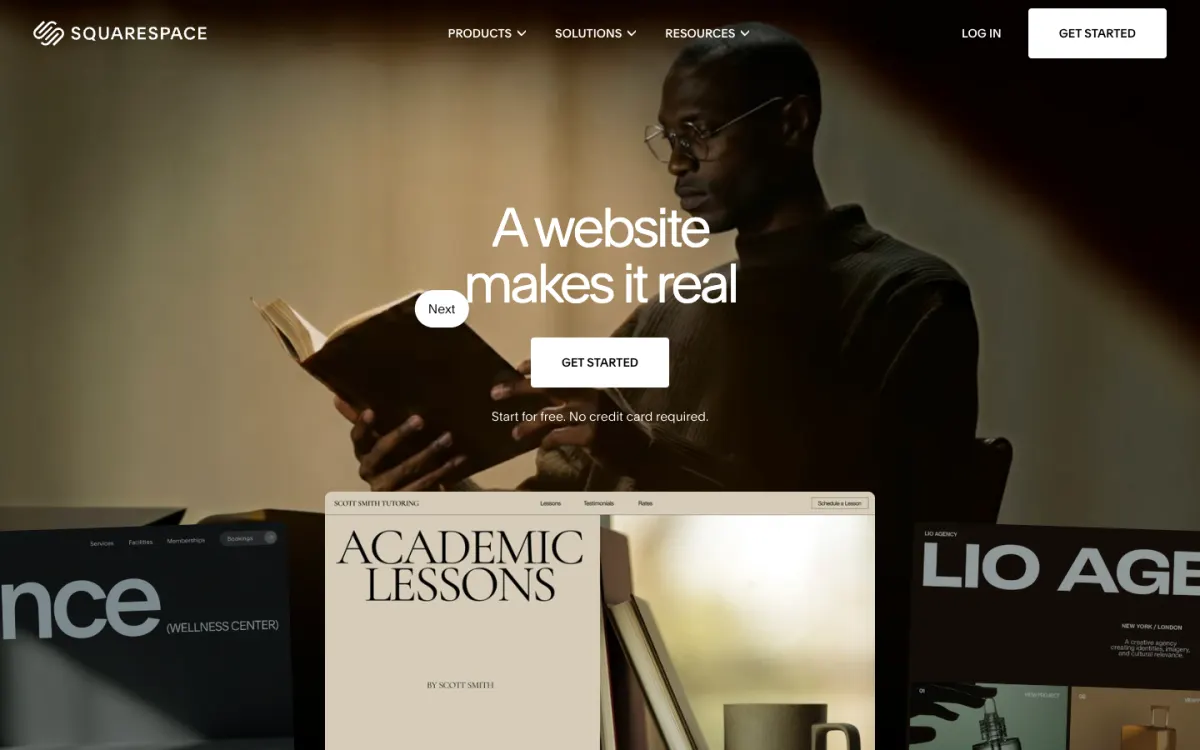
What it is. Squarespace is known for polished templates, and its Blueprint AI builds a full multi-page site, choosing pages, copy, imagery, colors, and fonts, then hands it to the editor.
Why it suits small businesses. Every plan can sell, and invoicing and point of sale are included on all plans, which suits makers and shops that sell both online and in person. The templates make it hard to build an ugly site.
The catch. There is no free plan, only a 14-day trial. Basic charges a 2% transaction fee on store sales on top of card fees, which disappears on Core. Scheduling and Email Campaigns are paid add-ons, not part of the plans, and AI credits are limited by plan (10 once on Basic).
Pricing. Basic $19/mo yearly or $25 monthly, Core $29 or $39, Plus $49 or $65, Advanced $99 or $139. Card fees are 2.9% + 30¢ on Basic and Core and lower on the higher plans. A free domain comes with annual plans.
Best for. Brands where looks sell: photographers, restaurants with a strong identity, boutiques, and makers who also sell at markets. Torn between the two biggest names? Our Wix vs Squarespace comparison goes through them side by side.
4. Shopify: best for selling products online
What it is. Shopify is the ecommerce platform most online shops grow up on: products, inventory, shipping, tax, checkout, and thousands of apps, with Sidekick, its AI assistant, on every plan.
Why it suits small businesses. If selling products is the business, Shopify’s checkout, payments, and app ecosystem are hard to beat, and it scales from a first product to a large catalog without moving platforms. Shopify POS lets you sell in person from the same stock.
The catch. Shopify is a store first and a website second, so it is expensive for a business that mostly needs a brochure site. If you use a payment provider other than Shopify Payments, Shopify adds its own fee (2% on Basic). The old Starter plan is no longer available to new stores.
Pricing. Basic $29/mo yearly or $39 monthly, Grow $89 or $105, Advanced $359 or $399. Online card rates start at 2.9% + 30¢ on Basic. The trial is 3 days free with no card, then $1 a month for the first 3 months.
Best for. Businesses whose website is the shop: product brands, online stores, and retailers adding ecommerce.
5. GoDaddy Airo: best for a fast AI start
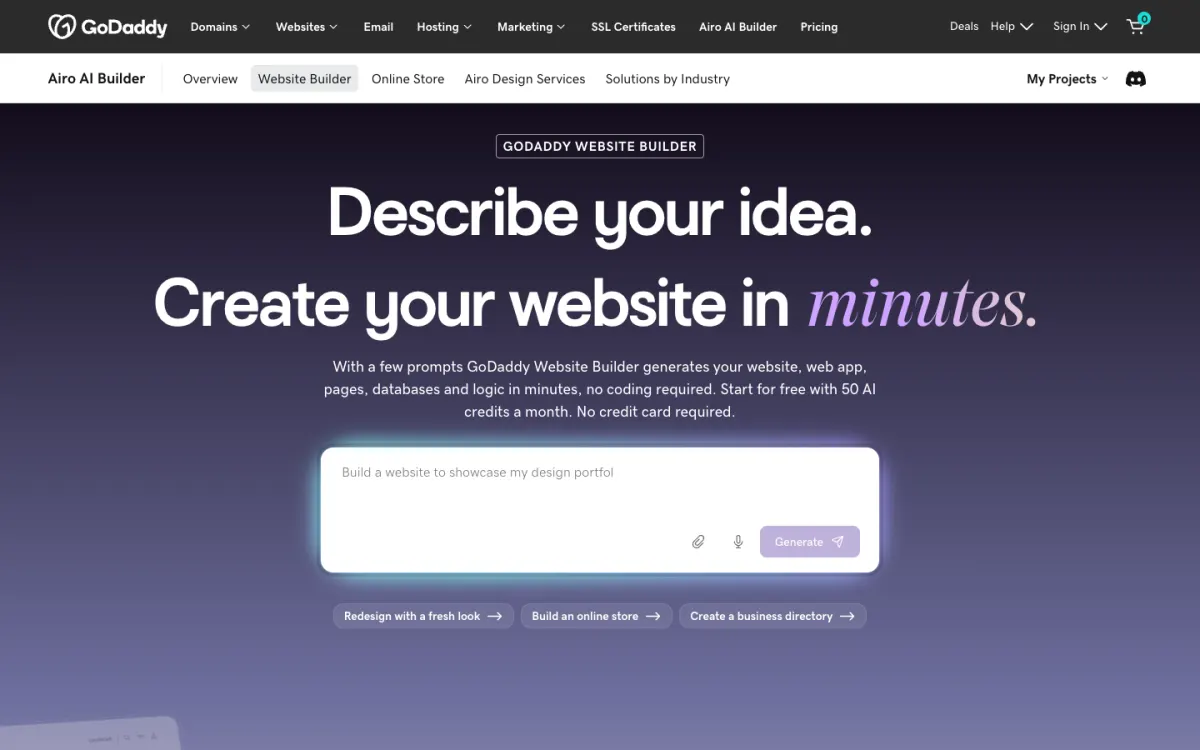
What it is. GoDaddy’s website builder is now the Airo AI Builder: you describe the business, and it generates the site, pages, and simple web apps, with domains and email from the same company.
Why it suits small businesses. It is one of the quickest ways from nothing to a live site with a domain, especially if you already bought your domain at GoDaddy. From the Professional plan it adds online payments, appointment bookings, a product catalog, and sales tax.
The catch. Changes run on AI credits that reset each billing cycle and don’t roll over (150 a month on Starter). The free plan is for building and previewing; publishing with your own domain starts on Starter. GoDaddy’s renewal prices are not on the plans page, so check them before you commit.
Pricing. Free $0 (50 credits a month, no publishing on your domain). Starter $9.99/mo billed yearly with a custom domain for 1 site. Professional $24.99/mo adds bookings and payments. Ultimate $99.99/mo.
Best for. Owners who want a site live today with the least effort and keep their domain and email at GoDaddy.
6. Square Online: best for restaurants and shops already on Square
What it is. Square Online is the website builder inside Square, the payments and point-of-sale company, so online orders, in-store sales, and stock share one system.
Why it suits small businesses. It is the only builder here whose free plan sells: you can take orders online without a monthly fee and pay only card fees. For a café or a shop that already uses Square at the counter, the website plugs straight into the same menu and inventory.
The catch. It is built around Square’s payments, so it makes most sense if you use Square in person too. The free plan’s online card rate is higher, 3.3% + 30¢, against 2.9% + 30¢ on paid plans. Design options are simpler than Wix or Squarespace.
Pricing. Square Free $0, Plus $49 a month and Premium $149 a month, each per location. Plus and Premium come with a 30-day free trial.
Best for. Restaurants, cafés, bakeries, and retail shops that sell in person with Square and want online ordering without another subscription.
7. WordPress.com: best for publishing a lot of content
What it is. WordPress.com is the hosted version of WordPress, the software behind a large share of the web, with themes, a block editor, and plugins from the Personal plan up.
Why it suits small businesses. If your marketing is content, such as a weekly blog, guides, recipes, or case studies, WordPress is the strongest publishing tool here, and the cheapest plan with your own domain is only $4 a month. Because it runs on WordPress, you can move to any other WordPress host later.
The catch. WordPress has more to learn and more to look after than an all-in-one builder. Payment fees fall as plans rise: 8% on Personal, 4% on Premium, 2% on Business, and 0% only on the Commerce plan, so selling seriously means Commerce at $45 a month.
Pricing. Free $0. Personal $4/mo yearly or $9 monthly, Premium $8 or $18, Business $25 or $40, Commerce $45 or $70. Two- and three-year terms cost less per month. Your own domain starts on Personal, with a free domain on annual plans.
Best for. Businesses that win customers with articles and want a site they can take anywhere.
8. Webflow: best for a marketing site that will grow
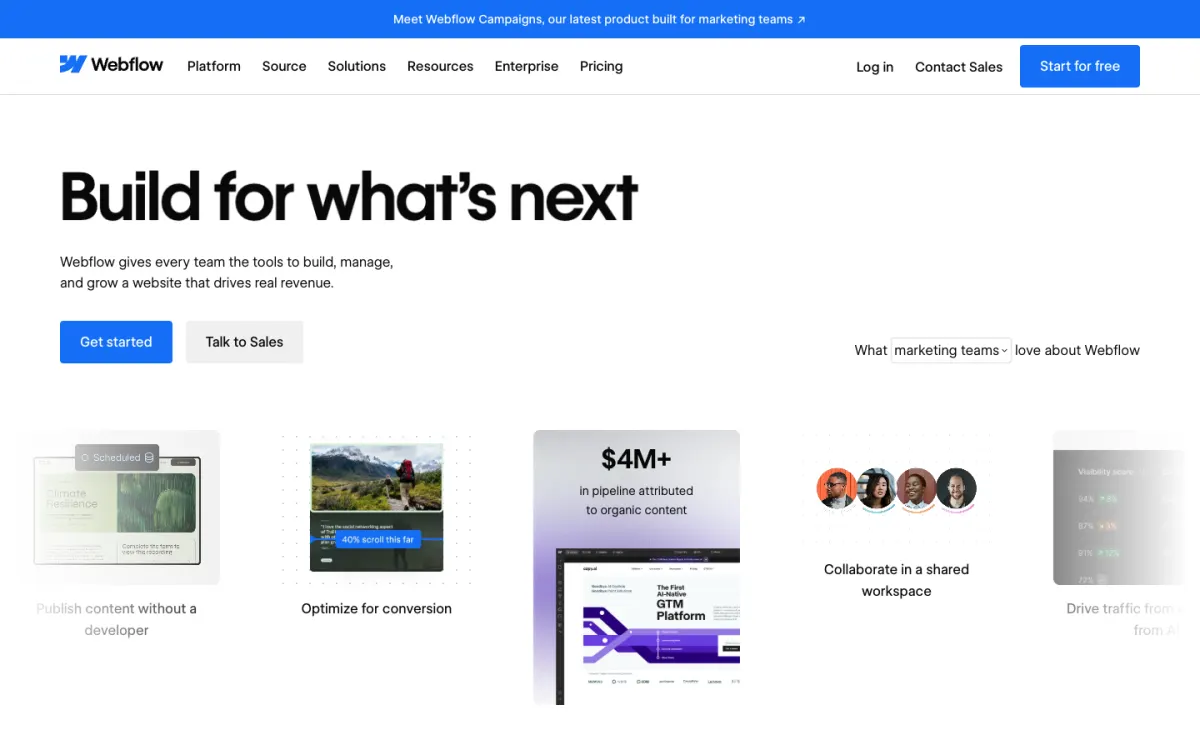
What it is. Webflow is the most powerful visual builder here, with a professional design tool, a CMS for structured content, and Webflow AI that generates pages and sections you keep editing.
Why it suits small businesses. Webflow suits a business that expects its site to grow into dozens of pages, with landing pages for campaigns, case studies, and a team or agency editing it. It exports clean code on paid workspace plans.
The catch. Webflow has a real learning curve, and its plans have changed: the old CMS and Business plans are gone, replaced by Premium, whose price rises with your bandwidth. Ecommerce is a separate set of plans, and the cheapest one charges a 2% fee.
Pricing. Starter $0 (2 pages on a webflow.io address). Basic $15/mo yearly or $25 monthly adds your own domain. Premium from $25/mo yearly or $39 monthly adds the CMS. Ecommerce Standard $29/mo yearly (500 items, 2% fee).
Best for. Growing companies with a designer or agency, where the website is a marketing channel in its own right. If Webflow feels like more tool than you need, see our Webflow alternatives.
9. Hostinger Website Builder: lowest cost over several years
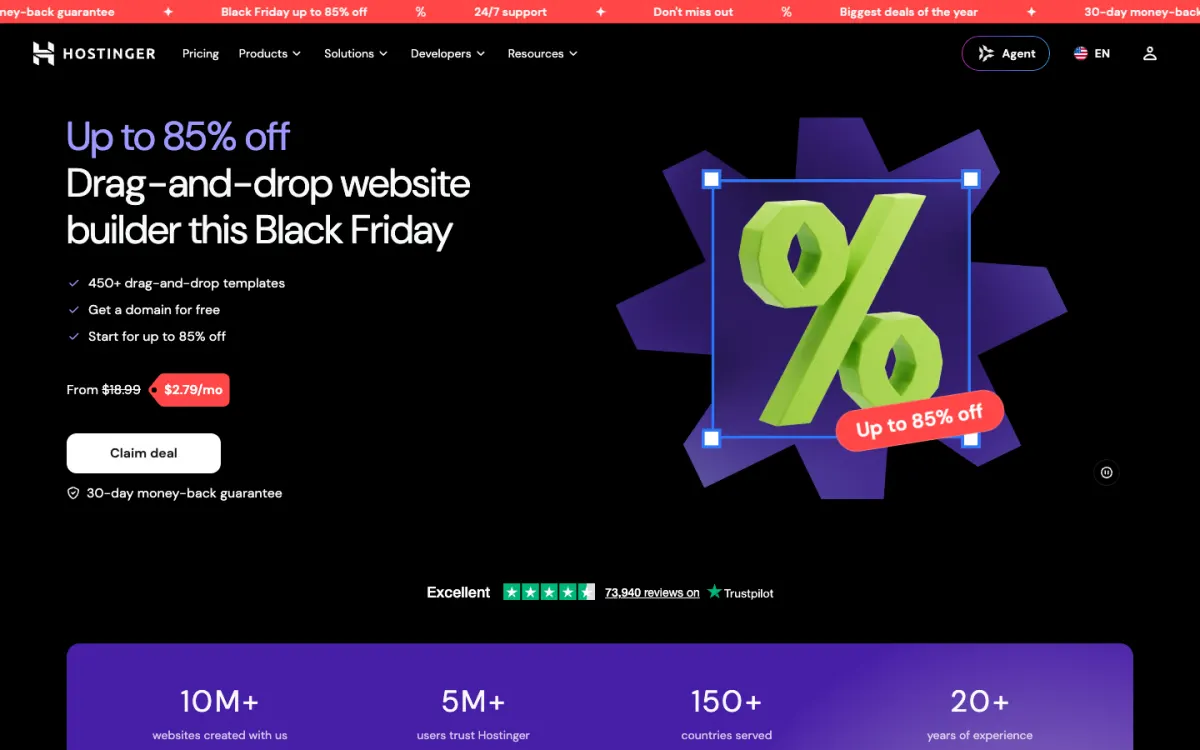
What it is. Hostinger’s website builder combines a drag-and-drop editor with an AI Builder that creates a site from a prompt, plus an AI SEO assistant and Hostinger Reach for email marketing.
Why it suits small businesses. Committed for four years, it is the cheapest way to a business website with your own domain, and the higher plans list an online store with no transaction fees from Hostinger.
The catch. The headline price needs a long term paid up front, and renewal costs several times more. Premium is $1.99 a month on a 48-month term, $95.52 paid at once, then renews at $10.99 a month.
Pricing. Premium $1.99/mo on 48 months (renews at $10.99), Unlimited $2.79/mo (renews at $16.99), Cloud Startup $7.99/mo (renews at $25.99). A free domain for the first year, a 14-day trial, and a 30-day money-back guarantee.
Best for. Owners who know they will keep the site for years and want the lowest total cost.
What a small business website really costs
The monthly plan is only part of the bill. Before you choose, add up four things:
- The plan after the first term. Introductory prices on long terms (Hostinger) and free domain vouchers (most builders) end after year one. Check the renewal price, not the headline.
- Payment fees. If you sell, card fees of about 2.9% + 30¢ apply almost everywhere, and some plans add the builder’s own fee on top: 2% on Squarespace Basic, 2% to 8% on WordPress.com below Commerce, and 2% on Webflow’s cheapest store plan. On $5,000 a month of sales, a 2% fee is $100 a month, more than most plans cost.
- Add-ons. Paid scheduling, email marketing, extra staff seats, and premium apps can double the price of a cheap plan.
- Your domain and email. A domain costs around $10 to $20 a year after the free first year, and a business email address is usually a separate subscription.
For a simple service business site, the realistic yearly cost runs from about $84 (Siter.io Solo) to about $350 (Wix Core) before payment fees. A small online shop on Shopify Basic starts at $348 a year plus card fees.
Can you move your site later?
Most small businesses stay on their first builder for years, so check the way out before you build. Wix and Squarespace keep you on their platform: Wix has no export, and Squarespace exports only a WordPress-format file without bulk images. WordPress.com moves to any WordPress host. Webflow exports code on paid workspace plans, and Siter.io downloads a page at a time as HTML on Pro. Whichever you pick, keep your text, photos, and customer list outside the builder, and register your domain in your own name so you can point it anywhere.
How to choose
- You need bookings, a store, and marketing in one place: Wix.
- You run a local service, take enquiries, and want a site that looks designed for little money: Siter.io.
- Design sells your business and you also sell in person: Squarespace.
- Selling products is the business: Shopify.
- You want a site live today with the least effort: GoDaddy Airo.
- You run a café or shop on Square: Square Online.
- You publish every week: WordPress.com.
- Your site will grow with a designer or agency: Webflow.
- You want the lowest cost and will commit for years: Hostinger.
If you would rather generate a site with AI and pay nothing to start, our guide to free AI website builders compares what each free plan really publishes. Once your site is live, set up uptime monitoring so you hear about downtime before your customers do, and a privacy-friendly analytics tool to see which pages bring in enquiries.
FAQ
What is the best website builder for a small business?
Wix is the best website builder for most small businesses in 2026, because bookings, payments, a store, and marketing tools all come in one product from $29 a month. If you run a service business that takes enquiries rather than payments, Siter.io gives you a designed site with booking requests for $7 a month, and if selling products is the business, Shopify is the better choice.
Is Squarespace or Wix better for small business?
Wix is better if you need many business tools in one place, such as scheduling, a store, and email marketing, because it includes them on its Core plan. Squarespace is better if design matters most and you sell in person, because invoicing and point of sale come with every plan. Squarespace has no free plan and charges a 2% fee on Basic store sales.
Is Wix or GoDaddy a better website builder?
Wix is the more complete builder, with more templates, more control over design, and more business tools. GoDaddy’s Airo AI Builder is faster to start and cheaper, from $9.99 a month with your own domain, and suits owners who want a simple site live quickly and already keep their domain at GoDaddy.
What is the cheapest website builder for a small business?
For a site on your own domain, WordPress.com Personal at $4 a month and Siter.io Solo at $7 a month, both billed yearly, are the cheapest regular prices here. Hostinger starts at $1.99 a month, but only on a 48-month term paid up front, and it renews at $10.99. Square Online can sell with no monthly fee if you only pay card fees.
Can ChatGPT build a website for my business?
ChatGPT can write the code for a simple website, but it cannot host it, keep it updated, or give you an editor, so you need a host and some comfort with code. Most website builders now include AI that drafts the site for you and keeps it editable, which suits a business owner better.
Do I need a custom domain for my small business website?
Yes. A domain such as yourbusiness.com looks trustworthy, lets you use a matching email address, and stays yours if you change builders. Every builder here offers it on its first paid plan, and most include a free domain for the first year on annual billing.
Which website builder is best for local SEO?
All of the builders here let you set page titles, descriptions, and clean addresses, which covers the basics. Local SEO depends more on what you do outside the builder: a complete Google Business Profile, reviews, your own domain, and a page for each service and area you cover.
Build your Bootstrap theme
Design a custom Bootstrap 5 theme visually with a live preview, then export clean Sass or CSS.
Open the Builder