NeverBounce Alternatives in 2026: Cost, Expiry, Catch-All
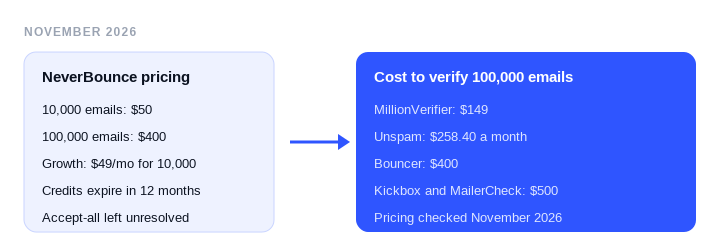
NeverBounce charges $50 to verify 10,000 emails and $400 for 100,000, its pay-as-you-go credits expire 12 months after purchase, and it leaves accept-all (catch-all) addresses unresolved. This guide is for teams leaving NeverBounce: it compares six alternatives on cost per 10,000 and 100,000 verifications, credit expiry, catch-all handling, integrations, and what changes when you migrate, with every price checked on the vendor’s own page in November 2026.
TL;DR
- Best for verification plus deliverability testing: Unspam. $42.40 a month for 10,000 verifications, unknown results free, and spam tests, inbox placement, and DMARC monitoring in the same plan.
- Cheapest overall: MillionVerifier. $39 for 10,000 and $149 for 100,000, credits that never expire, and catch-all resolution at no extra cost.
- Best like-for-like replacement: Bouncer. Credits that never expire, unknowns and duplicates free, deep catch-all verification, and EU data hosting.
- Best real-time API for signup forms: Kickbox, with unknown results refunded and flags for role, free, disposable, and accept-all addresses.
- Best for ESP-connected lists with credits that last: MailerCheck, with credits that never expire, native ESP integrations including MailerLite, and placement tests on the same credits.
NeverBounce pricing in November 2026
NeverBounce sells verification two ways. One credit verifies one address.
| Option | Price | What you get |
|---|---|---|
| Pay as you go | $8 for 1,000, $40 for 5,000, $50 for 10,000, $400 for 100,000 | Credits that expire 12 months after purchase |
| Growth | $49/mo for up to 10,000, $159/mo for up to 100,000 | Monthly credits, auto-sync with your CRM, AI lead suggestions and scoring |
| Enterprise | Custom, typically 250,000+ a month | Custom rules, account manager |
That works out to $5.00 per 1,000 at 10,000 and $4.00 per 1,000 at 100,000, falling to $0.002 an address at 2 million. NeverBounce removes duplicates and bad syntax for free, gives a free list analysis that estimates your bounce rate before you pay, and lists 80+ integrations. Its help center says new accounts get 10 free credits.
NeverBounce does two things few alternatives match: Growth’s auto-sync re-checks connected lists and charges only for new, unique addresses, and a bounce guarantee refunds the difference if more than 3% of addresses marked valid bounce.
Why people look for NeverBounce alternatives
Price alone is rarely the reason. At 10,000 addresses NeverBounce is cheaper than four of the six alternatives below. The reasons are mostly about terms and coverage:
- Credits expire after a year. NeverBounce’s terms say each purchased credit is valid for 365 days and unused credits expire automatically. The terms also say no refunds or replacement credits are given once credits are bought. Since 10,000 credits cost only $10 more than 5,000, it is tempting to overbuy, and credits you don’t use within a year are lost.
- Accept-all addresses stay unresolved. NeverBounce returns catch-all addresses as “Accept all (Unverifiable)”. Its help center says there is no definitive way to tell whether these are valid.
- The guarantee has exclusions. The 3% bounce guarantee covers only addresses marked valid. It excludes accept-all, unknown, and disposable results, and addresses at freemail providers such as Gmail, Outlook, and Yahoo. The list must have at least 500 unique addresses and be mailed within 72 hours of cleaning.
- No published exemption for unknowns. The pricing page lists duplicates and syntax errors as free. It says nothing about unknown results, which several alternatives refund or never charge.
- ZoomInfo ownership. NeverBounce’s terms say the site is operated by “ZoomInfo Technologies LLC d/b/a NeverBounce”, and the pricing page now also sells AI-picked leads and a “GTM Guard” for AI agents.
- Verification only. NeverBounce doesn’t test whether your email reaches the inbox.
NeverBounce alternatives at a glance
| Tool | Best for | Free credits | Credits expire | Catch-all handling | Real-time API | Extras |
|---|---|---|---|---|---|---|
| Unspam | Verification plus deliverability tests | 10 addresses a day, no signup | Monthly allowance resets; top-ups never expire | Detected, not resolved | No, asynchronous | Spam tests, inbox placement, previews, DMARC |
| MillionVerifier | Lowest price, B2B lists | 100 | Never | Resolved at 1 credit, unresolved free | Yes | Daily EverClean sync |
| Bouncer | Like-for-like replacement | 100 | Never | Deep catch-all verification | Yes, Shield for forms (paid) | Deliverability Kit (paid) |
| Kickbox | Signup form checks | 100 | 1 year after purchase | Flagged as accept-all | Yes | Deliverability consulting |
| MailerCheck | ESP integrations, credits that last | 10 | Never | Flagged | Yes | Inbox placement, email insights |
| ZeroBounce | Verification plus warmup in one plan | 100 a month | Never with ONE; rules may apply without it | AI scoring, 1 extra credit | Yes | Warmup, placement, DMARC on ONE |
| NeverBounce (for reference) | Auto-synced CRM lists | 10 | 12 months after purchase | Flagged as accept-all | Yes | JavaScript widget, free list analysis, 3% guarantee |
What it costs to verify 10,000 and 100,000 emails
Regular one-time prices, except Unspam, which sells verification as a monthly allowance.
| Tool | 10,000 emails | Per 1,000 | 100,000 emails | Per 1,000 |
|---|---|---|---|---|
| MillionVerifier | $39 | $3.90 | $149 | $1.49 |
| Unspam | $42.40 a month | $4.24 | $258.40 a month | $2.58 |
| NeverBounce | $50 | $5.00 | $400 | $4.00 |
| Bouncer | $60 | $6.00 | $400 | $4.00 |
| Kickbox | $70 | $7.00 | $500 | $5.00 |
| MailerCheck | $80 | $8.00 | $500 | $5.00 |
| ZeroBounce | $129 | $12.90 | $649 | $6.49 |
Only MillionVerifier and Unspam beat NeverBounce at both volumes. Several vendors are running Black Friday offers: Unspam takes 40% off the first payment of a new subscription until December 1, Kickbox adds 25% bonus credits through November 30, and ZeroBounce offers bonus credits until December 3. The table uses regular prices.
The best NeverBounce alternatives, reviewed
1. Unspam: best for verification plus deliverability testing
What it is. Unspam is a deliverability testing tool (spam tests, seed-based inbox placement, previews in 60+ email clients, and DMARC monitoring) that also verifies single addresses and whole lists.
Why it replaces NeverBounce. It costs less than NeverBounce at both volumes and charges only for definitive results: unknown results, duplicates, and malformed rows are never charged. Lists of up to 100,000 rows are checked for duplicates, typos, malformed rows, and disposable domains before any credit is used, so you see what a file holds before you pay. The bigger difference is that the same plan tests the email itself. A spam test costs $0.18, an inbox placement test across a seed list at Gmail, Outlook, Yahoo, and other providers costs $0.50, and the first DMARC domain is free.
Pricing. Free: 10 addresses a day on the verifier page with no account, plus a Free plan with 21 tests a month. Verification comes with the Custom plan, which has a $5 monthly minimum. At regular prices, 10,000 verifications a month cost $42.40 ($4.24 per 1,000) and 100,000 cost $258.40 ($2.58 per 1,000). Annual billing takes 15% off, and there is a 14-day refund window.
Limitations. MillionVerifier is cheaper at both volumes. The monthly allowance resets on your billing date, so a one-off clean means one month of the plan; top-up credits never expire but need an active Custom plan. Things a NeverBounce user gives up:
- No scheduled re-verification like NeverBounce’s Sync, and no native ESP or CRM integrations. Lists go in as CSV or TXT uploads, through the REST API, or through the MCP server.
- No form widget. The API answers asynchronously (you submit, then poll for the result), so it won’t hold a signup form while it checks.
- Uploads are capped at 100,000 rows per file.
- No bounce guarantee.
- Catch-all addresses are detected, not resolved.
Good for: marketers who want to clean a list and check that the next campaign reaches the inbox, in one account.
2. MillionVerifier: best for the lowest price
What it is. MillionVerifier is a bulk-focused verifier with a single-email checker, CSV, TXT, and XLSX uploads, a real-time REST API, 40+ integrations, and EverClean.
Why it replaces NeverBounce. It is the cheapest tool here at both volumes, and its credits never expire, which removes NeverBounce’s 12-month clock. Catch-all resolution is part of the standard one-credit check. MillionVerifier says it resolves 30% to 40% of catch-all addresses into valid or invalid, and it charges nothing for unknown or unresolved catch-all results. EverClean verifies new contacts every day inside Mailchimp, HubSpot, or ActiveCampaign, which is the closest replacement here for NeverBounce’s auto-sync.
Pricing. 100 free credits. $39 for 10,000, $149 for 100,000, and $449 for 1,000,000.
Limitations. It is verification only: no inbox placement, spam tests, or DMARC monitoring. EverClean syncs with three platforms; MillionVerifier lists 40+ integrations overall, against NeverBounce’s 80+. The 30% to 40% catch-all figure is the vendor’s own, so test it on a sample of your list.
Good for: outbound and B2B teams with large lists full of company domains that accept all mail.
3. Bouncer: best like-for-like replacement
What it is. Bouncer is an EU-based verifier with list uploads, a verification API, integrations, an MCP server, Bouncer Shield for forms, and a separate Deliverability Kit.
Why it replaces NeverBounce. It keeps what NeverBounce users like (bulk cleaning, an API, integrations) and fixes the terms. Credits never expire, whether bought on demand or by subscription, and Bouncer never charges for duplicates or unknown results. Its homepage lists deep catch-all verification, and data is stored only in EU AWS data centers, which helps teams with GDPR reviews.
Pricing. 100 free credits. Minimum purchase 1,000 credits for $8. $35 for 5,000, $60 for 10,000, $400 for 100,000, $2,000 for 1,000,000. A monthly subscription is also offered.
Limitations. It costs $10 more than NeverBounce at 10,000 and the same at 100,000. Bouncer Shield, the real-time form check, is a separate monthly subscription. The Deliverability Kit for inbox placement and blocklist tests is another, from $25 a month for 250 test emails and 10 monitored IPs or domains.
Good for: teams who want NeverBounce-style verification with credits that last and EU data hosting.
4. Kickbox: best real-time API for signup forms
What it is. Kickbox is a pay-as-you-go verifier with list cleaning and a real-time API, with verification and support in the US and EU.
Why it replaces NeverBounce. If you used NeverBounce’s real-time API at signup, Kickbox is the closest swap: each response returns a result, a reason, a typo suggestion, a Sendex quality score, and flags for role, free, disposable, and accept-all addresses. Unknown results are refunded as credits, which NeverBounce doesn’t publish.
Pricing. 100 free verifications. $5 for 500, $70 for 10,000, $500 for 100,000, $2,999 for 1,000,000.
Limitations. It costs more than NeverBounce at both volumes, and its terms say credits expire one year after purchase, the same as NeverBounce. Catch-all addresses are flagged, not resolved. If ownership was your reason to leave, note that Kickbox’s footer names J2 Martech Corp, a Ziff Davis company.
Good for: developers checking addresses at signup and checkout. Our tutorial on stopping spam signups with an email verification API shows the pattern.
5. MailerCheck: best for ESP integrations with credits that last

What it is. MailerCheck verifies lists, single addresses, and signups through a real-time API, and sells Email Insights and inbox placement tests on the same credits.
Why it replaces NeverBounce. Credits never expire, and it connects to MailerLite, Mailchimp, ActiveCampaign, ConvertKit, GetResponse, Zapier, and Make, so you can verify inside your ESP without exports. Results flag catch-all and role-based addresses.
Pricing. 10 free credits for list verification. $10 for 1,000, $80 for 10,000, $500 for 100,000, $2,000 for 1,000,000. Email Insights and inbox placement cost 200 credits each.
Limitations. The minimum purchase is 1,000 credits, and its pricing page says refunds are given only if MailerCheck ends the service without cause.
Good for: ESP-connected senders who want credits that never expire.
6. ZeroBounce: best for verification plus warmup in one plan
What it is. ZeroBounce is a verification platform with 18 validation tools, AI scoring for catch-all addresses, an email finder, and a subscription (ZeroBounce ONE) that adds warmup, inbox placement tests, blacklist monitors, and DMARC monitoring.
Why it replaces NeverBounce. It scores catch-all addresses instead of leaving them as accept-all, never charges for unknown results or duplicates, and guarantees 99.6% validation accuracy. Credits never expire while you have an active ONE subscription, and ONE is one of the few plans that bundles verification with warmup.
Pricing. Freemium: 100 credits a month (signup with a business or premium domain). Pay as you go: $39 for 2,000 (minimum), $129 for 10,000, $649 for 100,000. ZeroBounce ONE: $99 a month for 10,000 credits plus the deliverability tools, 20% off billed yearly.
Limitations. It is the most expensive option here at both volumes. Scoring a catch-all uses one extra credit on top of validation. Without ONE, ZeroBounce’s FAQ says expiration rules may apply depending on when the account was created or credits were bought. See our ZeroBounce alternatives guide.
Good for: teams who want verification, catch-all scoring, and warmup under one monthly subscription.
Migration notes: moving off NeverBounce
- Spend or schedule remaining credits. NeverBounce credits expire 365 days after purchase and aren’t refunded. Check the purchase dates on your balance and run your next clean before the oldest credits lapse.
- Turn off Growth auto-upgrade or cancel. On Growth, NeverBounce’s help center says that when credits run out with auto-upgrade on, it moves you to the next plan size and charges immediately. Switch this off, or cancel, before you stop using the account.
- Map result codes. NeverBounce returns valid (0), invalid (1), disposable (2), accept all (3), and unknown (4). Kickbox uses deliverable, undeliverable, risky, and unknown, with accept-all as a separate flag. Unspam uses deliverable, risky, disposable, undeliverable, and unknown.
- Replace auto-sync. If you relied on Sync or Growth to clean connected lists, pick a replacement before cancelling: MillionVerifier EverClean (Mailchimp, HubSpot, ActiveCampaign), MailerCheck’s ESP integrations, or a scheduled export and upload.
- Check the API pattern. NeverBounce sells its single-check API and JavaScript widget for checking addresses as they are submitted. Kickbox and MillionVerifier offer real-time APIs for the same job. Unspam’s API returns an id that you poll, so it suits list jobs and back-office checks, not a form waiting on a response.
- Compare on a sample. Run the same small sample through two tools’ free credits before moving the full list.
Which NeverBounce alternative should you choose?
- You want to clean lists and test inbox placement in one account: Unspam, if you can live without native integrations and a form widget. Our best email deliverability tools guide covers what else that stack can include.
- You want the lowest price and credits that never expire: MillionVerifier.
- Your list is B2B and full of accept-all domains: MillionVerifier, which resolves catch-alls in the standard check, or ZeroBounce, which scores them for an extra credit.
- You want NeverBounce’s workflow with better terms: Bouncer.
- You verify addresses at signup in real time: Kickbox, or Bouncer Shield.
- You send through MailerLite or another connected ESP and want credits that never expire: MailerCheck.
- You want warmup in the same plan as verification: ZeroBounce ONE.
If you are comparing verifiers in general rather than replacing NeverBounce, see our email verification tools roundup. A clean list is only part of the job: if mail still lands in spam, check whether your domain or IP is listed with our email blacklist removal guide, and for outbound, see why cold emails go to spam.
FAQ
What is the best NeverBounce alternative?
It depends on why you are leaving. Unspam suits teams that also want spam and inbox placement tests, MillionVerifier is the cheapest with credits that never expire, and Bouncer is the closest like-for-like replacement with free unknowns and EU hosting.
How much does NeverBounce cost?
Pay as you go costs $8 for 1,000 credits, $50 for 10,000, and $400 for 100,000, falling to $0.002 an address at 2 million. The Growth subscription costs $49 a month for up to 10,000 addresses and $159 a month for up to 100,000, with auto-sync to your CRM.
Do NeverBounce credits expire?
Yes. NeverBounce’s terms say each purchased credit is valid for 365 days and unused credits expire automatically, with no refunds once credits are bought. MillionVerifier, Bouncer, and MailerCheck sell credits that never expire, and Unspam’s top-up credits never expire on an active plan.
Who owns NeverBounce?
NeverBounce’s terms of use say the site is operated by ZoomInfo Technologies LLC, doing business as NeverBounce, and the site footer carries a ZoomInfo copyright.
Which NeverBounce alternative handles catch-all emails best?
MillionVerifier resolves catch-all addresses inside the standard one-credit check and doesn’t charge for those it can’t resolve. ZeroBounce gives them a quality score from 1 to 10 for an extra credit, and Bouncer lists deep catch-all verification. NeverBounce, Kickbox, MailerCheck, and Unspam flag them without resolving them.
Does NeverBounce charge for unknown results?
NeverBounce’s pricing page lists duplicates and syntax errors as free but publishes no exemption for unknown results. Unspam, Bouncer, Kickbox, MillionVerifier, and ZeroBounce all say they don’t charge for unknowns.
Build your Bootstrap theme
Design a custom Bootstrap 5 theme visually with a live preview, then export clean Sass or CSS.
Open the Builder