Tiiny Host Alternatives: 8 Best Static Hosts (2026)
Tiiny Host is the fastest way to drag a folder or .zip online and get a live link in seconds, with no build step and no Git. That simplicity is exactly why people love it, and exactly why they start looking for alternatives: the free plan expires after 7 days, file-size caps are tight, custom domains and ad-free hosting sit behind paid tiers, and there is no integrated editor for iterating on a site over time.
If you are a Bootstrap developer shipping portfolios, landing pages, client demos, or docs, you want the same upload-and-go feel but with more room to grow. This guide compares the best Tiiny Host alternatives for simple static website hosting in 2026, from drag-and-drop hosts to Git-based platforms with free SSL and custom domains. Our top pick is Static.app, the closest like-for-like replacement and bootstrap.build’s hosting partner. Pricing was verified in June 2026.
Tiiny Host Alternatives Compared
The table below summarizes the strongest alternatives at a glance. “Best for” reflects the kind of Tiiny Host user each one suits, not a generic ranking.
| Platform | Free tier | Starting price | Custom domain + SSL | Best for |
|---|---|---|---|---|
| Static.app | 1 site, 50MB, free SSL (7-day trial of paid features) | $6/mo ($5/mo annual) | Paid plans; free SSL on all tiers | Drag-and-drop replacement with an editor, forms, and analytics |
| GitHub Pages | Free for public repos, free TLS | $0 (Pro ~$4/mo for private repos) | Yes; free auto TLS | Sites already in a GitHub repo |
| Netlify | Free plan, 300 credits/mo, free SSL | $9/mo (Personal) | Yes on all plans; free auto SSL | Git push deploys with previews and forms |
| Cloudflare Pages | Unlimited sites + unlimited bandwidth, free SSL | $0 (Pro $20/mo) | Yes (100 domains/project free); free SSL | Unlimited traffic with a global edge CDN |
| Vercel | Hobby (personal use), free SSL | $20/mo per seat (Pro) | Yes on all plans; free auto SSL | Next.js and modern framework apps |
| Surge.sh | Unlimited deploys, free custom domains, basic SSL | $30/mo (Professional) | Yes, free; custom SSL is paid | One-command CLI deploys for developers |
| Render | Free static sites, free SSL | $25/mo (Pro workspace) | Yes (2 free); free auto TLS | Static front end plus a full-stack backend |
| Firebase Hosting | Spark free: 10GB storage, 10GB/mo transfer, free SSL | Pay-as-you-go (Blaze) | Yes; free auto SSL | Google/Firebase ecosystem projects |
The Best Tiiny Host Alternatives in 2026
Static.app (best overall and closest to Tiiny Host)
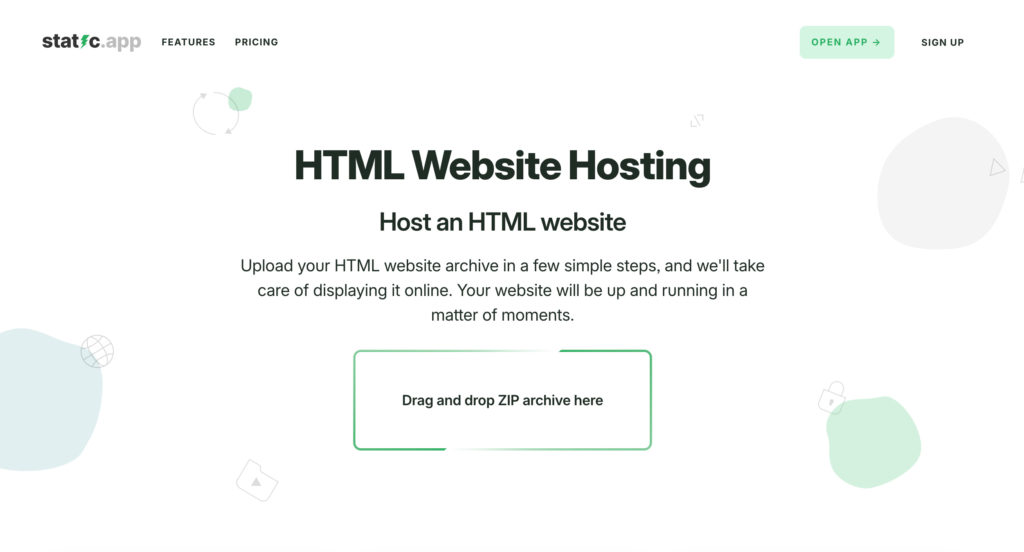
Static.app is the alternative that feels most like Tiiny Host, because it keeps the same “upload, don’t deploy” workflow: drag and drop a folder or .zip, or sync from the Mac/Windows desktop app, and your site is live with no build pipeline to configure. Where it pulls ahead is everything that happens after the first upload. It adds an integrated in-browser code editor, so you can tweak your HTML, CSS, or JavaScript directly on the platform without re-zipping and re-uploading. That single feature changes the workflow from “share a finished file” to “maintain a living site,” which is the main thing people miss when they outgrow Tiiny Host.
Beyond the editor, Static.app bundles managed extras that static hosts usually make you bolt on yourself: built-in form handling with spam protection, visitor analytics, password-protected pages, QR codes, and a REST API plus an MCP server for AI agents. Continuous deployment is available through GitHub Actions for teams that want it, while the drag-and-drop path stays available for everyone else.
Free SSL is included on every tier, including the free plan. The free plan gives you 1 site with 50MB of storage and a free subdomain (a 7-day trial unlocks the paid features), and paid plans run $6/month (Starter, 2 sites, 500MB), $12/month (Medium, 7 sites, 3GB), and $18/month (Large, 30 sites, 10GB) with unlimited traffic and custom domains, dropping to $5, $10, and $15 a month on annual billing.
- Strengths: Drag-and-drop or desktop-sync simplicity, an in-browser editor for real-time edits, built-in forms and analytics, free SSL on all tiers, unlimited traffic on paid plans, and predictable flat pricing.
- Weaknesses: Static files only (no serverless functions, SSR, or databases), tight storage caps on lower tiers, no custom domain on the free plan, and a smaller global edge footprint than Cloudflare or Netlify.
- Best for: Freelancers, non-technical users, and Bootstrap developers who want the Tiiny Host experience with room to maintain and grow a site.
If you want a standalone scratchpad for editing before you publish, an HTML tester pairs well with this workflow.
GitHub Pages (best free option for repo-based sites)
GitHub Pages is the most natural alternative when your site already lives in a GitHub repository. You push code and the live site updates automatically, which makes every change repeatable and auditable in version control. It is genuinely free for public repositories, with free auto-renewing TLS via Let’s Encrypt and full custom-domain support for both apex and subdomains.
Publishing works two ways: the built-in Jekyll build, or a custom GitHub Actions workflow that supports any static site generator (Hugo, Astro, a Next.js export, Vite, and more) with full CI. There is no drag-and-drop UI, so it is more developer-oriented than Tiiny Host or Static.app.
- Strengths: Free for public static sites, free HTTPS and custom domains, tight Git integration with push-to-deploy, and Actions for any SSG. Backed by GitHub/Microsoft infrastructure.
- Weaknesses: Static only, private-repo publishing needs a paid plan (Pro around $4/month or Team $4/user/month), a 1GB site-size cap and a soft 100GB/month bandwidth limit, and no drag-and-drop or per-PR deploy previews out of the box.
- Best for: Developers and maintainers hosting free static sites, docs, blogs, and portfolios straight from a repo.
Netlify (best for Git-based deploys with previews)
Netlify takes the drag-and-drop idea further into a full Jamstack platform. You can deploy by dragging a folder into the UI, but most teams connect a Git repo and get automatic CI/CD: every push builds and deploys, and every pull request gets an immutable deploy preview you can share. It auto-detects build settings for frameworks like Astro, Hugo, 11ty, Next.js, Nuxt, and SvelteKit.
The free plan includes custom domains with free auto SSL, a global edge CDN, serverless and edge functions, and unlimited form submissions. In 2026 Netlify uses a credit-based model: the free plan grants 300 credits per month and is hard-capped, so a busy site can pause once credits run out. Paid plans start at $9/month (Personal, 1,000 credits) and $20/month (Pro, 3,000 credits with unlimited team seats).
- Strengths: Frictionless Git deploys with previews and one-click rollback, broad framework support, free SSL on custom domains, free form submissions, and an integrated edge plus serverless platform.
- Weaknesses: The credit model can make costs hard to predict, the free plan pauses sites when credits are exhausted, and unused monthly credits do not roll over.
- Best for: Developers who want zero-config Git deploys, deploy previews, and built-in forms without managing infrastructure.
Cloudflare Pages (best for unlimited traffic)
Cloudflare Pages stands out for one reason most static hosts cannot match: truly unlimited bandwidth and unlimited static requests on every tier, including free. There are no surprise overage bills for traffic, which matters if a project goes viral or serves heavy assets. It deploys static sites and dynamic SSR apps from Git to Cloudflare’s global edge network, with automatic free SSL and HTTP/3 out of the box.
The free plan covers unlimited sites with up to 100 custom domains per project, 500 builds per month, and serverless Pages Functions on the Workers runtime if you need dynamic features later. Note that for new full-stack and SSR projects in 2026 Cloudflare now steers users toward Workers with static assets, while Pages remains fully supported.
- Strengths: Unlimited bandwidth and sites on every tier, a large global edge CDN, free SSL, smooth Git CI with unlimited preview deploys, and an optional path to edge serverless functions.
- Weaknesses: New full-stack projects are being pointed at Workers instead of Pages, build limits are by count with one concurrent build on free, and the best value assumes buy-in to the Cloudflare ecosystem.
- Best for: Anyone who wants free hosting with no metered-traffic billing and a fast global CDN.
Vercel (best for Next.js and modern frameworks)
Vercel offers a polished, zero-config Git deploy experience and is the company behind Next.js, so it is the smoothest host for SSR, ISR, and edge React apps. Every push gets an automatic build and a preview URL, and framework detection covers Next.js, Astro, SvelteKit, Nuxt, Remix, Vite, and most SSGs. You can also drag-and-drop a build via Vercel Drop.
The Hobby plan is free for personal, non-commercial use, with 100GB/month bandwidth, automatic free SSL, and up to 50 custom domains per project. Commercial use requires Pro at $20 per developer seat per month, which is metered above an included usage credit.
- Strengths: Best-in-class developer experience, first-class Next.js support, a fast global edge CDN with free SSL, and flexible deploy paths (Git, CLI, drag-and-drop).
- Weaknesses: The free plan is personal-use only, Pro is per-seat with usage-based overages that can produce surprise bills, and there is strong gravity toward the Next.js ecosystem.
- Best for: Frontend and full-stack teams shipping Next.js or modern Jamstack apps.
Surge.sh (best CLI-first option)
Surge.sh is for developers who would rather live in the terminal than a dashboard. Install it with npm, run surge in your project directory, and your pre-built static files go to a global CDN in seconds. The free plan is generous: unlimited projects, unlimited deploys, free custom domains, and basic SSL on the surge.sh subdomain.
There is no managed build step, no Git-push auto-deploy, and no PR previews, so you build locally or in your own CI and Surge just hosts the output. It works with any static site generator.
- Strengths: Extremely fast one-command CLI deploys, a genuinely generous free tier, free custom domains, predictable flat pricing, and good static-site ergonomics (SPA pushState support, custom 404s, CORS).
- Weaknesses: Static only, no managed build or Git-push/PR previews, and pricing jumps straight from free to $30/month with key production features (custom SSL upload, force-HTTPS, password protection) gated behind that paid plan.
- Best for: Front-end developers who want instant, no-config CLI deployment of static sites and SPAs.
Render (best when you may need a backend)
Render is a unified platform: it hosts static sites for free, but it can also run containerized web services, background workers, cron jobs, and managed Postgres from the same Git workflow. That makes it a good pick if your Bootstrap front end might one day need a real backend without re-platforming. Static sites deploy over a global CDN with free DDoS protection and instant cache invalidation.
Custom domains and free auto-renewing TLS are included on all plans (2 domains on the free Hobby workspace). Paid workspaces start at $25/month (Pro), and compute for dynamic services is billed separately per instance.
- Strengths: One Git-driven workflow for static sites plus full-stack apps and databases, free auto TLS on custom domains, a real free tier, and zero-downtime deploys with PR preview environments.
- Weaknesses: Free web services spin down after 15 minutes idle with a cold start, 2026 plan changes cut included bandwidth sharply, and the container model is heavier than a pure static host for simple sites.
- Best for: Developers who want a static front end today and the option of a full-stack backend later.
Firebase Hosting (best for Google ecosystem)
Firebase Hosting serves static sites and SPAs over Google’s global CDN with automatic free SSL and custom domains. Deploys run through the Firebase CLI with a single firebase deploy, and GitHub Actions integration enables push-based CI. It fits naturally if you already use Firebase Auth, Firestore, or Cloud Functions, and it can grow into SSR via Cloud Functions, Cloud Run, or the newer Firebase App Hosting.
The free Spark plan includes 10GB of stored content and 10GB/month of transfer with free SSL. Dynamic and SSR features require the pay-as-you-go Blaze plan, which has no hard spending cap by default.
- Strengths: A generous always-free static tier, automatic global CDN, free auto-renewing SSL and custom domains, simple one-command CLI deploys, and tight Firebase/Google Cloud integration.
- Weaknesses: Pay-as-you-go Blaze billing has no default spending cap, SSR is fragmented across multiple products, and the modest free transfer quota means busy sites must upgrade.
- Best for: Developers already in the Google/Firebase ecosystem who may add dynamic features later.
Static.app vs Tiiny Host: A Closer Look
Static.app is our top recommendation, so it is worth a deeper head-to-head against Tiiny Host. Both let you publish without a build step, but they suit different stages of a project.
Ease of use
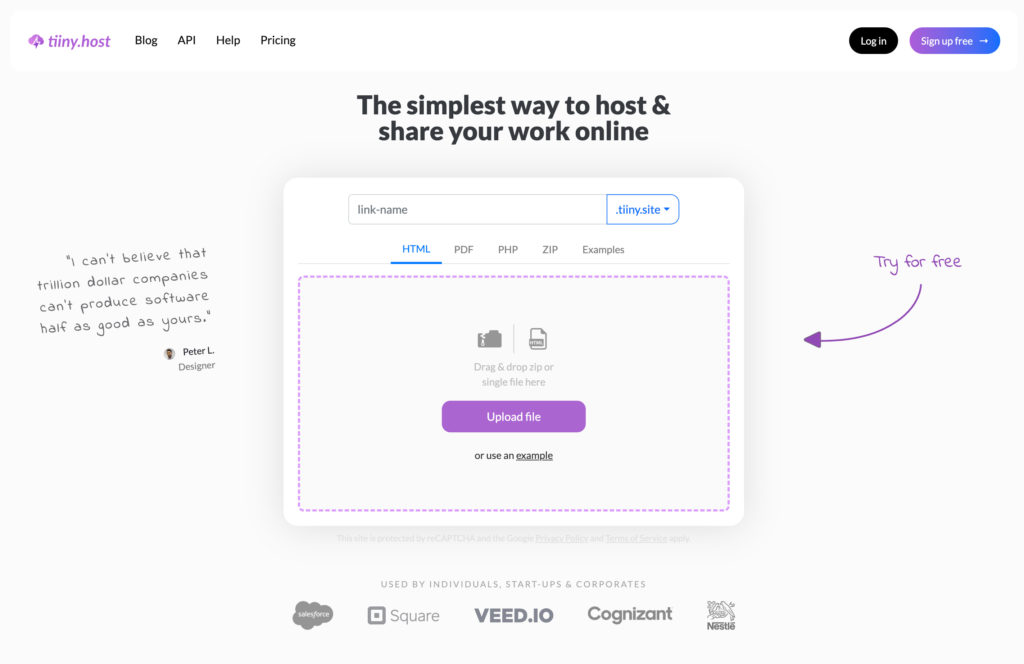
Tiiny Host features a drag-and-drop interface: upload your HTML, CSS, and JavaScript as a .zip archive and your site is live within seconds. That simplicity is ideal for one-off file shares, quick prototypes, and beginners who want the lowest possible entry friction, but it lacks tools for iterative development.
Static.app matches that drag-and-drop simplicity and adds an integrated code editor, so you can make real-time edits to your responsive design without re-uploading. If your workflow involves frequent tweaks to Bootstrap components like grids, modals, or navigation bars, the in-browser editor is the bigger draw. If you just need to push a finished build, Tiiny Host gets you there a touch faster.
Features
Both platforms support free subdomains and custom domains, and both provide free SSL certificates, which is critical for security and SEO. The differences show up in the extras:
- Form handling: Static.app includes built-in form handling for contact forms and subscriptions with no backend code. Tiiny Host lacks this, making it less suitable for interactive sites that capture submissions.
- Code editor: Static.app allows real-time edits directly in the platform. Tiiny Host requires local editing and re-uploading.
- Analytics: Static.app offers detailed visitor analytics on paid plans. Tiiny Host provides basic visitor stats with less depth.
- Storage and traffic: Static.app offers up to 10GB of storage and unlimited traffic on its top plan, suited to asset-heavy Bootstrap sites. Tiiny Host limits storage per site and caps monthly visits on its plans.
- Password protection: Both offer password protection for private projects and client demos.
Pricing
Tiiny Host:
- Free Plan: 1 live site for 7 days, 3MB file limit, and Tiiny Host branding.
- Tiny Plan: $9/month or $5/month (billed annually). 1 live site, custom domain, 50MB uploads, and ad-free hosting.
- Solo Plan: $18/month or $13/month (billed annually). 5 live sites, 75MB uploads, custom domains, and 100,000 visits/month.
- Pro Plan: $38/month or $31/month (billed annually). Unlimited live sites, 100MB uploads, and advanced features.
Static.app:
- Free Plan: 1 site with 50MB storage, free SSL, and a 7-day trial of paid features.
- Starter Plan: $6/month, or $60/year (an effective $5/month). 2 sites, 500MB storage, unlimited traffic, custom domains, and form handling.
- Medium Plan: $12/month, or $120/year (an effective $10/month). 7 sites, 3GB storage, analytics, and integrations.
- Large Plan: $18/month, or $180/year (an effective $15/month). 30 sites, 10GB storage, unlimited traffic, and premium features.
Static.app generally offers more generous storage, unlimited traffic, and developer-friendly features at a competitive price, while Tiiny Host’s lower entry tiers keep things simple if all you need is one site live fast.
How to Choose the Right Tiiny Host Alternative
The right pick depends on what you are building and how you work:
- Want the closest drag-and-drop replacement with room to grow? Choose Static.app for its editor, forms, analytics, and unlimited traffic.
- Already on GitHub? GitHub Pages is free and pushes live from your repo.
- Want zero-config Git deploys with previews and forms? Choose Netlify.
- Expecting heavy or spiky traffic? Cloudflare Pages gives unlimited bandwidth on every tier.
- Building a Next.js or modern framework app? Vercel is the smoothest fit.
- Prefer the terminal? Surge.sh ships a site with one command.
- Might need a backend later? Render hosts static sites and full-stack apps together.
- Already using Firebase? Firebase Hosting keeps everything in one ecosystem.
For more options and the trade-offs between drag-and-drop hosts and Git-based platforms, see our guide on where to host an HTML website and our deeper overview of static website hosting. Once you have a host, our walkthrough on how to build and publish a website gets your Bootstrap project live, and it is worth setting up one of the best website monitoring tools so you know the moment your site goes down.
FAQ
What is the best Tiiny Host alternative?
Static.app is the best overall Tiiny Host alternative for static and Bootstrap sites. It keeps Tiiny Host’s drag-and-drop simplicity but adds an integrated code editor, built-in form handling, analytics, up to 10GB of storage, and unlimited traffic, so it suits developers who maintain projects over time rather than sharing one-off files.
What is the best free Tiiny Host alternative?
For free hosting, GitHub Pages (free for public repos), Cloudflare Pages (unlimited sites and bandwidth on the free tier), and Netlify’s free plan are the strongest options. All include free SSL and custom-domain support. Static.app also has a free plan with 1 site and 50MB of storage if you want the closest drag-and-drop experience.
Is Static.app free?
Static.app has a free plan with 1 site and 50MB of storage that includes a 7-day trial of the paid features. Free SSL is included. Paid plans start at $6/month (or $60/year, an effective $5/month) for the Starter tier with 2 sites, 500MB, and unlimited traffic.
Does Tiiny Host have a free plan?
Yes. Tiiny Host’s free plan gives you 1 live site for 7 days with a 3MB file limit and Tiiny Host branding, intended for quick, temporary sharing. Custom domains, larger uploads, and ad-free hosting require a paid plan.
Which Tiiny Host alternatives offer free custom domains and SSL?
Most do. Static.app, Netlify, Cloudflare Pages, Vercel, GitHub Pages, Render, and Firebase Hosting all support custom domains with free, auto-renewing SSL certificates. Surge.sh includes free custom domains and basic SSL, but uploading your own certificate is a paid feature.
What is the best Tiiny Host alternative for Bootstrap developers?
It depends on your workflow. Static.app is the easiest drag-and-drop choice with an editor and forms for iterative work. GitHub Pages is best if your code is already in a repo, Netlify and Cloudflare Pages are strong for Git-based deploys, and Surge.sh suits developers who prefer the command line. All handle responsive Bootstrap sites well.
Can I host a dynamic or full-stack app on these platforms?
Static.app, GitHub Pages, and Surge.sh are static-only, so dynamic behavior must come from client-side JavaScript and external APIs. Netlify, Cloudflare Pages, Vercel, Firebase Hosting, and Render support serverless or SSR features, and Render can run full containerized backends and databases, so they are better if you expect to add dynamic functionality.
Build your Bootstrap theme
Design a custom Bootstrap 5 theme visually with a live preview, then export clean Sass or CSS.
Open the Builder