WordPress Alternatives in 2026: 10 Options by Use Case
The best WordPress alternatives in 2026 depend on what you actually use WordPress for: Static.app if you only need finished HTML pages online, Siter.io or Webflow if you are a designer who wants visual control, Ghost for a blog or newsletter, Squarespace or Wix for an all-in-one small business site, and Hugo, Astro, Kirby, or Statamic if you are a developer who wants a lighter CMS. This guide is for site owners, designers, and developers who are tired of maintaining a WordPress install for a site that does not need one. Every price and limit below was checked on the vendor’s own page in November 2026.
TL;DR
- Best for designers who want a visual site with nothing to update: Siter.io. A free-form canvas with hosting, forms, and a built-in CMS and blog, from $7 a month billed yearly.
- Best for HTML you already have: Static.app. Drag and drop a ZIP and go live on your own domain with SSL and forms, from $5 a month billed yearly.
- Best for a blog or paid newsletter: Ghost. Publishing, email newsletters, and memberships in one app, from $15 a month billed yearly, or free to self-host.
- Best for large content sites built visually: Webflow, from $15 a month billed yearly, $25 with the CMS.
- Best all-in-one for a small business: Squarespace or Wix. Templates, hosting, and selling tools in one subscription.
- Best for developers: Hugo or Astro for static sites, Kirby or Statamic for a flat-file CMS with an editing panel.
Why people look for WordPress alternatives
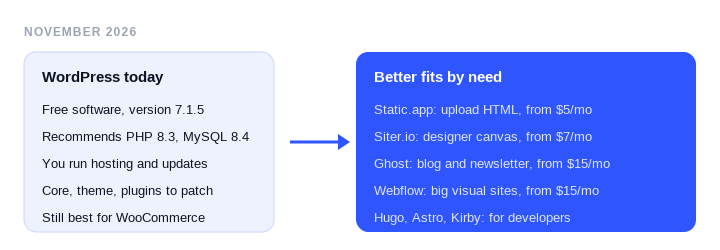
WordPress itself is free. The current release on WordPress.org is version 7.1.5, and the download page recommends PHP 8.3 or greater and MySQL 8.4 or MariaDB 10.11 or greater. In other words, a self-hosted WordPress site is a PHP application with a database, and someone has to run it.
- Maintenance. Core, the theme, and every plugin update on their own schedules, and each update is something to test before it breaks a live page.
- More CMS than the site uses. A portfolio, a studio site, or a landing page with five pages does not need a database, user roles, and a plugin directory.
- Design control. Getting a layout to look exactly like a design file usually means a page builder plugin on top of a theme. The Elementor alternatives guide covers that layer in detail.
- Cost creep. Hosting, premium themes, and yearly plugin licenses add up, even though the software is free.
There is also a clear case for staying. If the site is a busy publication with many authors, a store that depends on WooCommerce, or something only a specific plugin can do, WordPress is still the better tool. Siter.io’s own WordPress comparison says the same for blogs, shops, and publications.
Match the alternative to what you use WordPress for
Most WordPress sites do one of five jobs, and this guide is grouped the same way: hosting static pages you already have, a designer-led visual site, a blog or newsletter, an all-in-one small business site, or a developer-built site with a light editing panel. Pick the job first and the list gets short.
WordPress alternatives at a glance
Prices are the cheapest plan that publishes to your own domain, billed yearly unless noted. Framer, Squarespace, and Kirby showed prices in euros when checked, so they are printed in EUR.
| Tool | Best for | Free plan | Own domain from | Key limit |
|---|---|---|---|---|
| Static.app | Upload a finished static site | No, 7-day trial, no card | $5/mo ($6 monthly) | No visual editor or blog engine |
| Siter.io | Designer-led visual sites | No, 3-day trial (card required) | $7/mo ($8 monthly) | No ecommerce |
| Webflow | Large visual content sites | Yes, webflow.io, 2 static pages | $15/mo (CMS from $25/mo) | Steep learning curve |
| Framer | Motion-heavy design sites | Yes, Framer domain | EUR 10/mo per site | Extra editors EUR 20/mo each |
| Ghost | Blogs and paid newsletters | Self-host free; 14-day trial | $15/mo (up to 1,000 members) | Paid subscriptions from $29/mo |
| Squarespace | Polished small business sites | No, 14-day trial, no card | EUR 12/mo | 2% store fee on Basic |
| Wix | Small business tools | Yes, Wix branding, no own domain | Paid plans (offer pricing on page) | Payments start on Core |
| Hugo / Astro | Developer static sites | Free, open source | Free (pay for hosting) | Code and Markdown only |
| Kirby | Flat-file CMS for designers and devs | Free to try locally | EUR 99 per site, one-time | PHP hosting required |
| Statamic / Craft CMS | Developer CMS with client panel | Free core editions | $349 / $399 per site | $99 a year for updates after year one |
Static sites you upload: the best WordPress alternative, reviewed
1. Static.app: best for HTML you already have
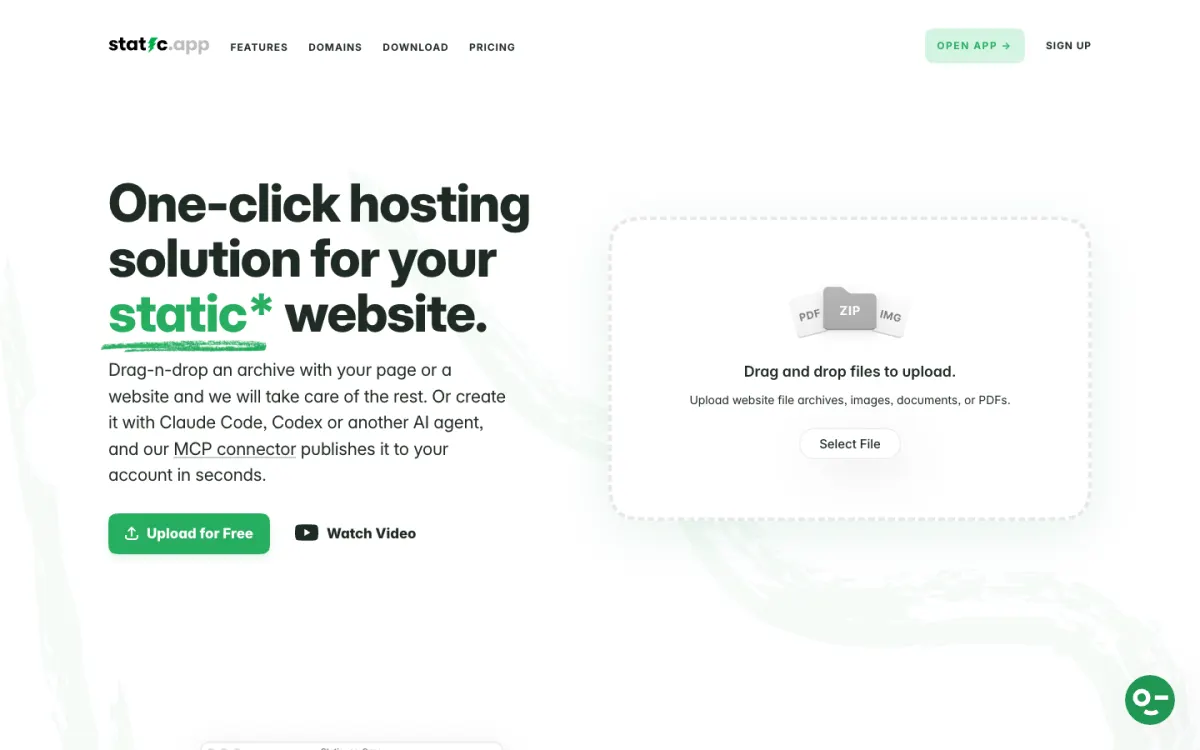
What it is. Static.app is one-click hosting for static websites. You drag and drop a ZIP of your site, single HTML files, images, or PDFs, and it goes live with SSL. A desktop app turns a local folder into a website and publishes every save, and an MCP connector lets AI coding agents publish straight to your account.
Why it replaces WordPress. If the site is already HTML, CSS, and JavaScript (from a Bootstrap theme, a static site generator, a design export, or an AI builder), there is no database, PHP, or plugin to maintain. Forms work by adding a static-form attribute to an existing form tag, and entries show in the dashboard with CSV export. Static.app says every website is snapshotted daily with one-click rollback (Large adds 3 backup slots), pages can be password protected, and a migration tool copies pages and assets from a live URL into a new Static.app site.
Pricing. A free 7-day trial with no card (1 website, 50 MB, free subdomain). Starter is $5 a month billed yearly ($60 a year, or $6 month to month) for 2 websites, 500 MB, custom domains, forms, analytics, and unlimited traffic. Medium is $10 a month billed yearly for 7 websites, 3 GB, and 1 team seat. Large is $15 a month billed yearly for 30 websites, 10 GB, 3 team seats, and 3 backup slots.
Limitations. There is no visual page builder and no blog engine, so a site that needs posts written by non-technical editors needs a generator or a builder upstream. Custom domains require a paid plan.
Good for: designers, freelancers, and developers with finished HTML who want it online on their own domain in minutes. For more options, see static website hosting.
Designer-led visual sites: the best WordPress alternatives, reviewed
2. Siter.io: best for designers who want a visual site with nothing to update
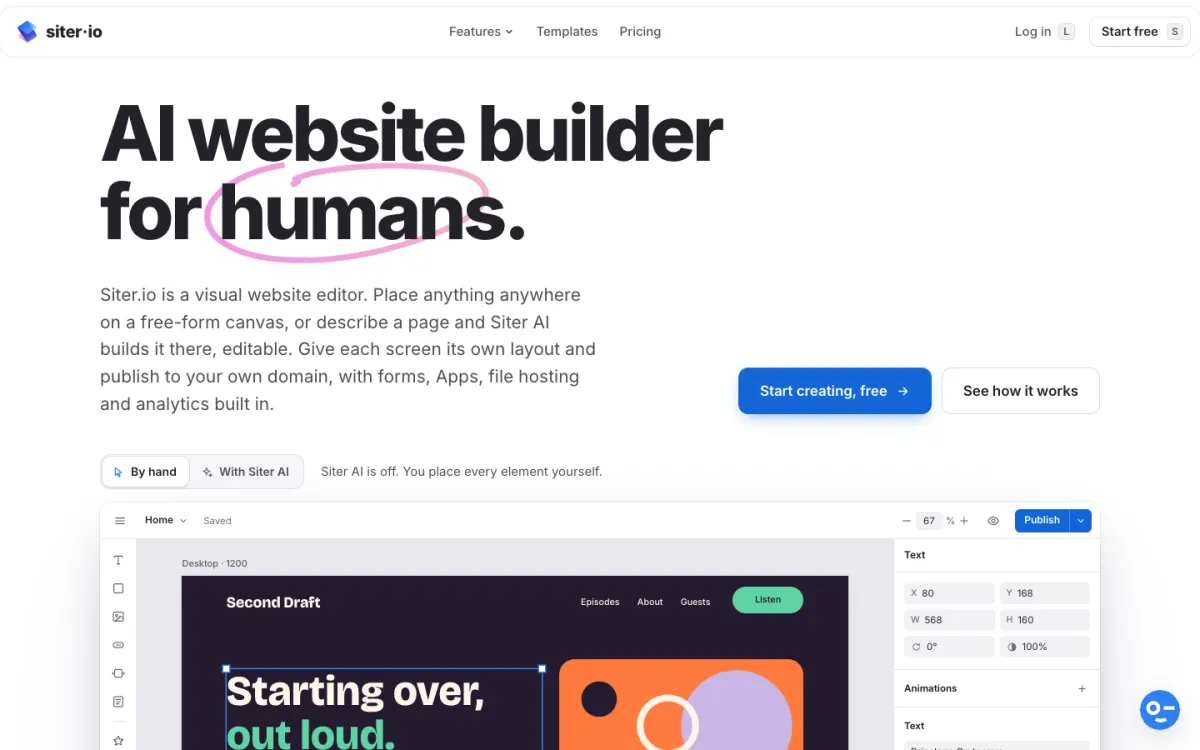
What it is. Siter.io is a hosted visual website editor with a free-form canvas. You place and size elements by hand, the way you would in a design tool, and give desktop, tablet, and phone their own layouts. Siter AI can also draft a page on the same canvas, and everything it makes stays editable.
Why it replaces WordPress. There is no theme, plugin, or core update. Hosting, SSL, a custom domain, forms with unlimited submissions, file hosting, and analytics come with every plan. The built-in CMS covers the part of WordPress most designers actually use: blog posts with their own pages, an RSS feed, scheduled publishing, and five collection kinds (Blog, Projects, Team, Events, Testimonials). A Figma plugin, components, hover states, and scroll animations are included, plus 143 templates.
Pricing. Solo is $7 a month billed yearly ($8 month to month) for 1 website, 10 pages, 3 forms, and 25 GB of monthly traffic. Plus is $12 a month billed yearly ($14 monthly) for 3 websites and 50 pages. Pro is $24 a month billed yearly ($28 monthly) for 5 websites, unlimited pages, and HTML download.
Limitations. No free plan: every plan starts with a 3-day trial that needs a card and charges on day 3 unless you cancel. No online store, so a shop needs another tool. HTML download is on Pro only. There is no plugin ecosystem, so anything a WordPress plugin did must be an embed or an integration.
Good for: designers and freelancers publishing portfolios, studio sites, and client landing pages with a simple blog. The best website builders for designers roundup compares it with other design-first tools.
3. Webflow: best for large content sites built visually
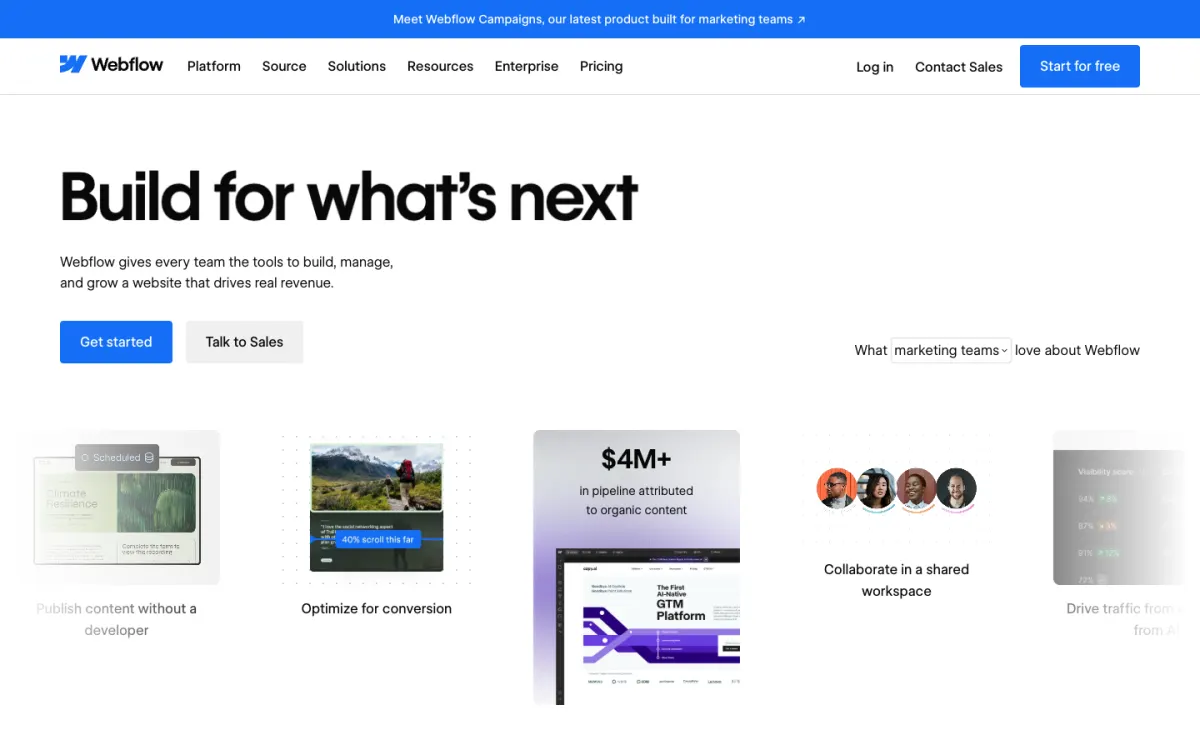
What it is. Webflow is a visual development platform with hosting, a CMS, and a class-based style system that maps closely to HTML and CSS.
Why it replaces WordPress. It is the closest hosted match for a content-heavy marketing site: structured CMS collections, interactions, and hosting in one product, with no server to manage. For a head-to-head breakdown, see Webflow vs WordPress.
Pricing. All prices are USD per site. Starter is free on a webflow.io address with 2 static pages, 1 GB of bandwidth, and 50 form submissions. Basic is $15 a month billed yearly with a custom domain, 300 static pages, 10 GB of bandwidth, and unlimited form submissions, but no CMS. Premium is $25 a month billed yearly and adds the Webflow CMS.
Limitations. One of the steepest learning curves here, since you are effectively writing CSS visually. A blog needs Premium, not Basic. See Webflow alternatives for lighter options.
Good for: marketing teams and agencies running large sites.
4. Framer: best for motion-heavy design sites
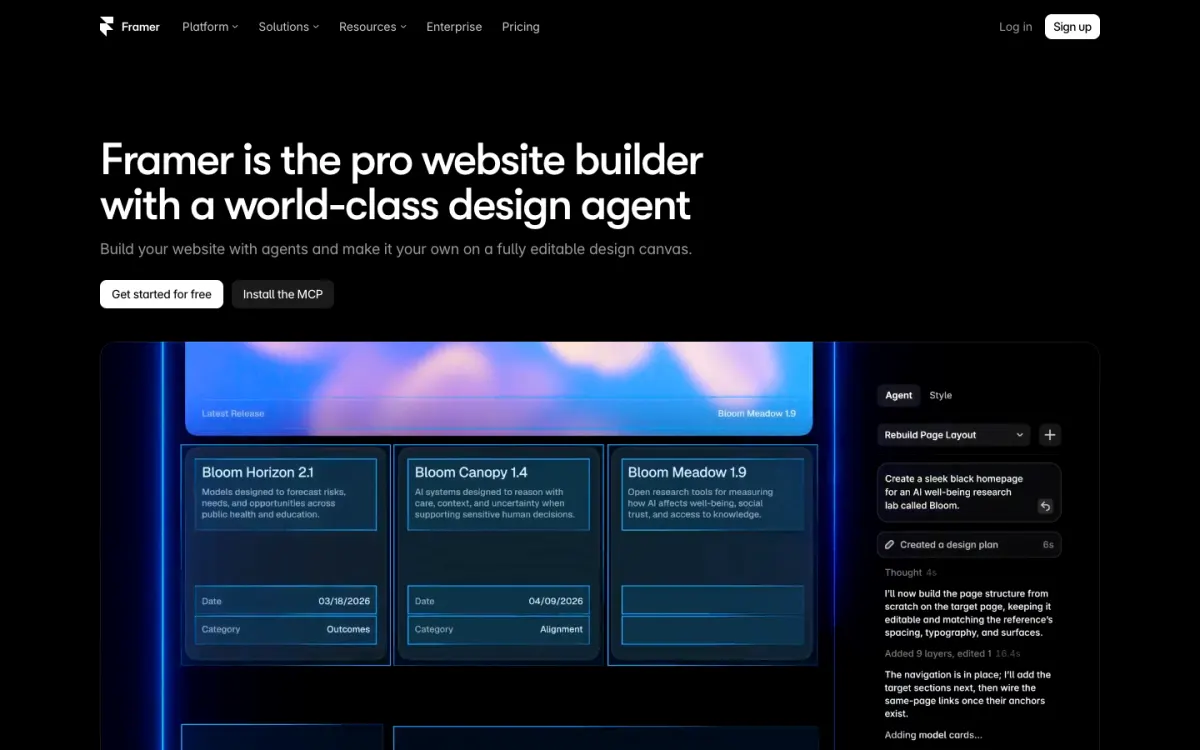
What it is. Framer is a design-first site builder with hosting, a CMS, and AI agents that build and edit pages.
Pricing. Prices showed in euros when checked, with yearly billing. Free on a Framer domain with 500 AI credits a month. Basic is EUR 10 a month per site with a custom domain, 30 pages, 2 CMS collections, and 50 GB of bandwidth. Pro is EUR 30 a month per site with 150 pages, 10 CMS collections, a staging environment, and site redirects. Additional editors are EUR 20 a month each. More detail is in Framer pricing.
Limitations. Pricing is per site, and editors beyond the workspace owner cost extra. Connecting your own domain requires a paid plan.
Good for: startups and designers who want motion-led marketing sites.
Blogs and newsletters: the best WordPress alternative, reviewed
5. Ghost: best for a blog or paid newsletter
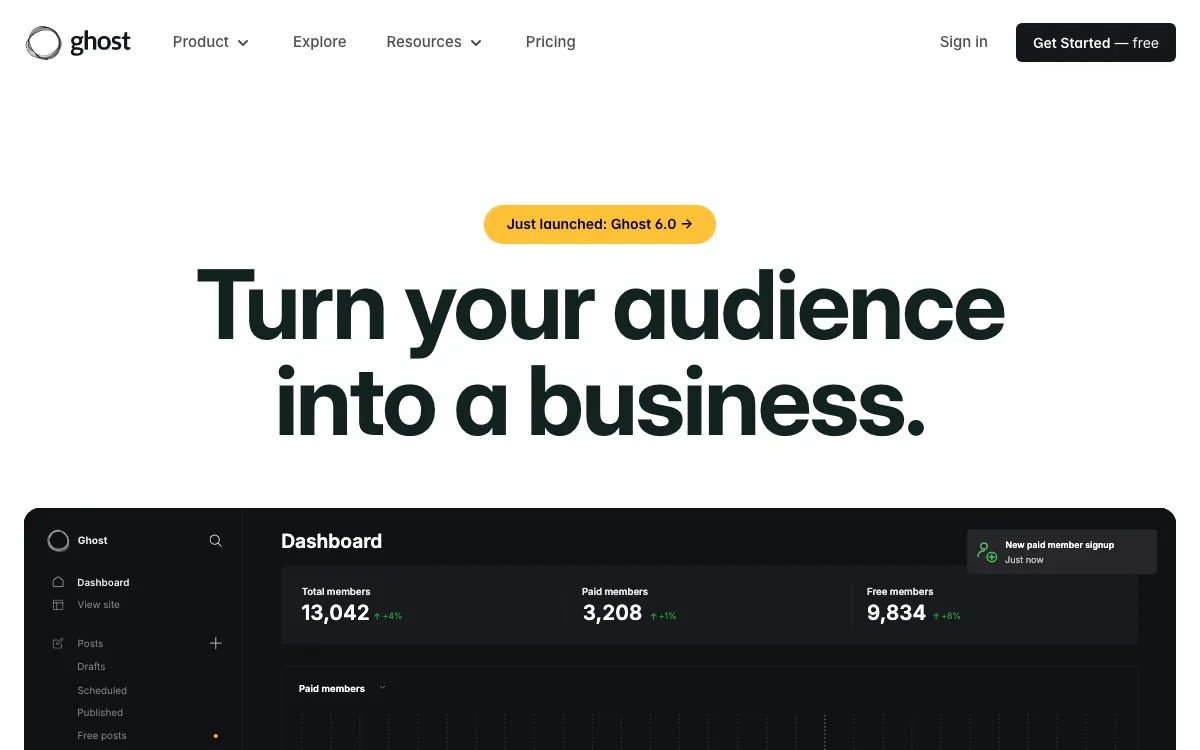
What it is. Ghost is a publishing platform for blogs, newsletters, and paid memberships. Ghost 6.0 is the current major release. The software is open source under the MIT license, so you can self-host it or pay for Ghost(Pro), the official managed hosting.
Why it replaces WordPress. Writing, email newsletters, member signups, and paid subscriptions are built in, which on WordPress usually means several plugins. Ghost(Pro) plans list unlimited email sends, RSS feeds, and SEO tools on every tier, and paid plans take 0% transaction fees on subscriptions.
Pricing. Ghost(Pro) prices scale with audience size; these are for up to 1,000 members, billed yearly. Starter is $15 a month for 1 staff user, a custom domain, an email newsletter, and simple design settings. Publisher is $29 a month for 3 staff users, custom themes, paid subscriptions, and Zapier and webhook integrations. Business is $199 a month for 15 staff users and 10,000 members. There is a 14-day free trial. Self-hosting is free, and Ghost recommends an Ubuntu server with at least 1 GB of memory.
Limitations. Starter cannot sell paid subscriptions or use custom themes. Ghost is built around posts, so a design-heavy brochure site is not its strength. Self-hosting brings back server maintenance.
Good for: writers, independent publishers, and creators who want a blog and a newsletter in one place.
All-in-one builders: the best WordPress alternatives, reviewed
6. Squarespace: best for polished small business sites

What it is. Squarespace is an all-in-one website builder with templates, hosting, and selling tools.
Why it replaces WordPress. Every plan includes hosting, unlimited bandwidth, built-in AI tools, and selling functionality.
Pricing. The pricing page showed euros when checked: Basic EUR 12 a month, Core EUR 18, Plus EUR 32, and Advanced EUR 69, billed annually. Basic includes 2 contributors and charges a 2% online store transaction fee; Core and up have no store transaction fee. A 14-day free trial needs no card. US prices may differ.
Limitations. Layouts follow the template system, with much less freedom than a canvas builder. See Squarespace alternatives for other options.
Good for: small businesses that want a good-looking site anyone on the team can edit.
7. Wix: best for small business tools
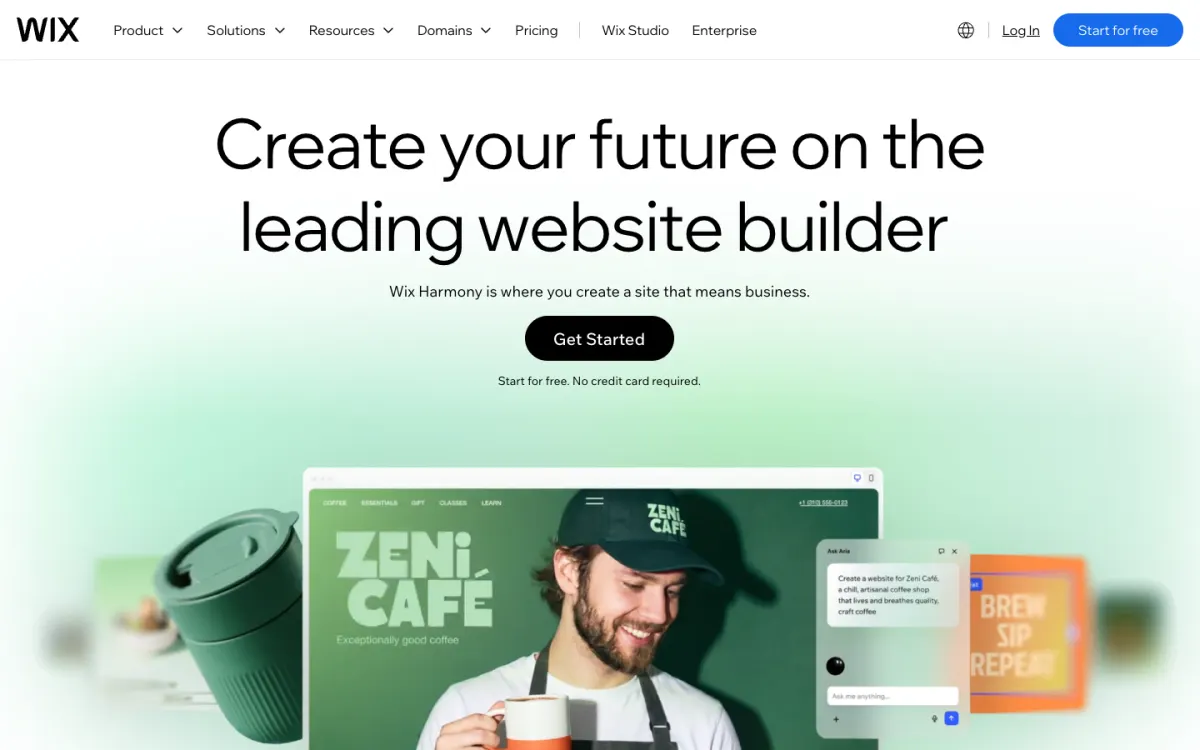
What it is. Wix is a drag-and-drop website builder with an AI site generator, more than 2,000 templates, and business apps for stores, bookings, and blogs.
Pricing. A free plan publishes with Wix branding and no custom domain. On November 25, 2026, the plans page showed time-limited offer prices valid only for the initial term, so regular prices are not printed here; check the renewal price at checkout. Paid plans come with a 14-day money-back guarantee. Light includes 2 GB of storage; accepting payments starts on Core.
Limitations. The cheapest paid plan cannot take payments, and the free plan cannot use your own domain.
Good for: small businesses that want booking, payments, and marketing tools in one dashboard.
Developer options: the best WordPress alternatives, reviewed
8. Hugo and Astro: best free static site generators
What they are. Hugo is an open-source static site generator written in Go, distributed under the Apache 2.0 license. Astro is an MIT-licensed JavaScript web framework for content-driven websites; version 7.4 is the current release.
Why they replace WordPress. Both turn Markdown files and templates into plain HTML at build time, so the live site has no database or admin login to attack. Hugo has built-in multilingual support, taxonomies, and an image processing pipeline. Astro has typed content collections for Markdown and MDX, ships zero JavaScript by default, and lets you use React, Vue, Svelte, and other UI components where needed.
Pricing. Free. You pay only for hosting, and the built output can go to any static host, including Static.app.
Limitations. No editing panel for non-technical users out of the box. Content changes mean editing files and rebuilding.
Good for: developers who want version-controlled sites and docs.
9. Kirby: best flat-file CMS for designers who code
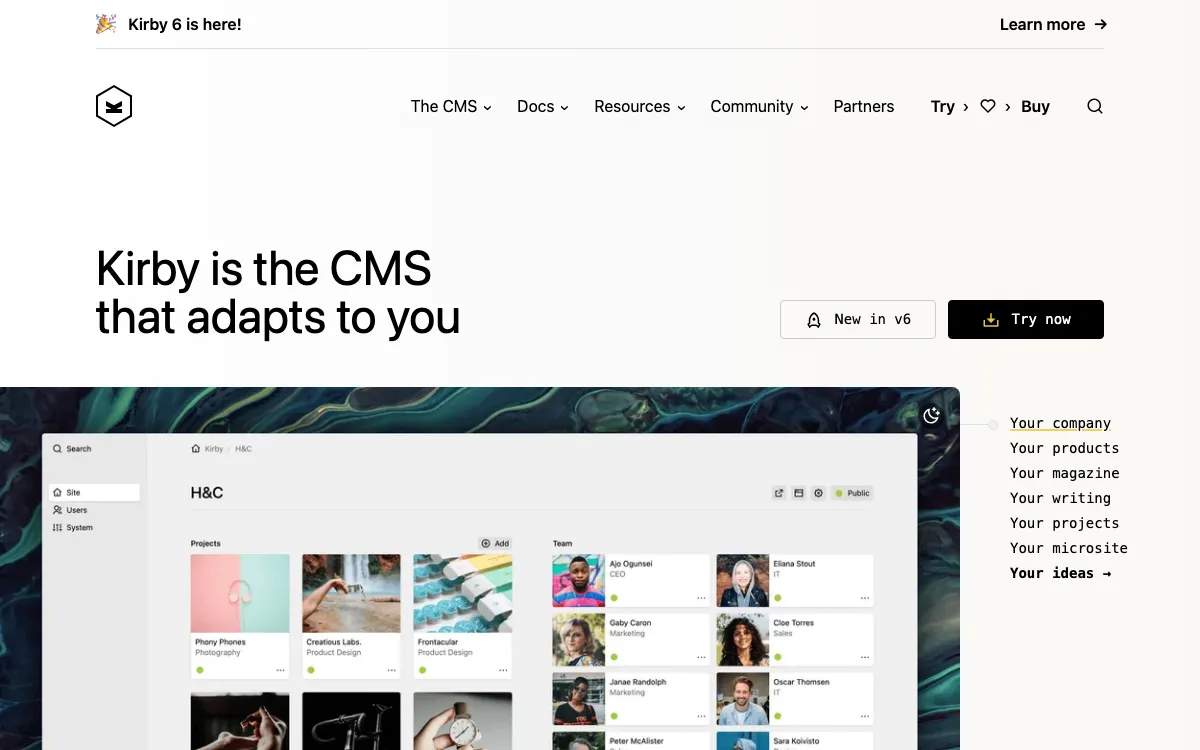
What it is. Kirby is a PHP CMS that stores content in plain text files, with folders as pages. Kirby 6 is the current release. It can render templates or serve content headless.
Why it replaces WordPress. No database, a clean editing panel you configure for each project, and content that lives in files you can keep in Git.
Pricing. Prices showed in euros: Basic is EUR 99 per site for individuals and small teams with total annual revenue or funding under EUR 1 million, and Enterprise is EUR 349 per site with no revenue limit. Both are one-time licenses with 3 years of feature updates, all features included, and no subscription. You can try it free in an online demo or on your own computer.
Limitations. You still need PHP hosting and someone to build the templates.
Good for: designers who code and small agencies building client sites with a simple panel.
10. Statamic and Craft CMS: best developer CMS with a client panel
What they are. Statamic is a Laravel-based CMS that runs in flat-file mode or database mode. Craft CMS is a PHP CMS known for flexible content modeling.
Pricing. Statamic Core is free with one admin user and one content form; Pro is $349 per site with unlimited users, revisions, a REST and GraphQL API, and multi-site, including one year of updates and $99 a year after that. Craft Solo is free with one user account; Team is $279 per project for up to five users, and Pro is $399 per project for unlimited users, each with one year of updates and $99 a year after that.
Limitations. Both need a developer to build and host the site. On Craft, forms and SEO tools come from plugins.
Good for: agencies building custom sites for clients who need to edit structured content.
Which WordPress alternative should you choose?
- You have finished HTML and just need it online on your domain: Static.app.
- You are a designer and want a visual site with a blog and nothing to update: Siter.io.
- You run a large marketing site with a team that knows CSS: Webflow.
- You want animation-first pages: Framer.
- You write a blog or newsletter and may charge for it: Ghost.
- You need a shop, bookings, or payments in one dashboard: Squarespace or Wix. Siter.io has no store, and Static.app hosts your files.
- You are a developer and want everything in Git: Hugo or Astro, deployed to a static host.
- You build client sites and need a light editing panel: Kirby, Statamic, or Craft CMS.
- You depend on WooCommerce or a specific plugin: stay on WordPress.
FAQ
What is the best alternative to WordPress?
It depends on the job. For designers, Siter.io gives a free-form canvas with hosting, forms, and a blog from $7 a month billed yearly. For a finished static site, Static.app hosts it from $5 a month billed yearly. For a blog or newsletter, Ghost is the closest specialist.
Is there a free alternative to WordPress?
Yes. Hugo and Astro are free and open source, Ghost is free to self-host, and Statamic Core and Craft Solo are free editions. Webflow, Framer, and Wix have free plans, but none of those free plans connect your own domain.
What is the best WordPress alternative for blogging?
Ghost is built for blogs and newsletters, with email delivery and paid subscriptions included. Siter.io includes a CMS with posts, RSS, and scheduled publishing, which suits a designer’s portfolio blog. For a large multi-author publication, WordPress is still a strong choice.
Can I move my WordPress site to a static host?
Yes, if the site does not need server-side features. You can export pages as HTML with a static export plugin or rebuild them with a generator, then upload the files. Static.app also has a migration tool that copies pages and assets from a live URL.
Is WordPress still worth using in 2026?
For publications, WooCommerce stores, and sites that rely on specific plugins, yes. For a portfolio, landing page, or small brochure site, a hosted builder or a static host usually means less maintenance and fewer moving parts.
Build your Bootstrap theme
Design a custom Bootstrap 5 theme visually with a live preview, then export clean Sass or CSS.
Open the Builder