Best AWS Amplify Alternatives in 2026 (8 Compared)
AWS Amplify Hosting is a capable, fully managed home for static sites, single-page apps, and SSR frameworks like Next.js and Nuxt, with a polished git-based CI/CD pipeline and deep ties into the rest of AWS (Lambda, DynamoDB, Cognito, S3, Route 53). If you already live in AWS, that integration is the whole point. But plenty of developers and site owners go looking for an alternative, and the reasons are fair rather than petty.
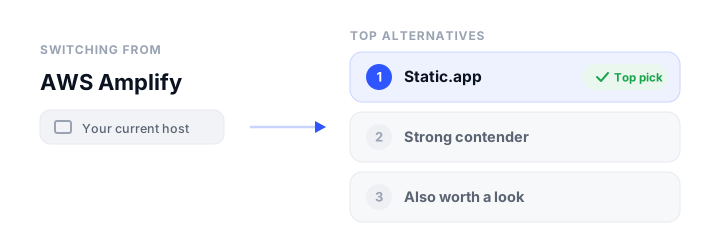
The first is pricing. Amplify is pure pay-as-you-go with no flat plan: you are billed separately for build minutes, CDN storage, data transfer out, SSR requests, and SSR compute. That is flexible but hard to predict, and a traffic spike can surprise you, with data transfer out at around $0.15/GB on the pricey side for busy sites. The second is the free tier: it is genuinely useful (about 1,000 build minutes, 15 GB served, and 500,000 SSR requests per month) but it only lasts 12 months, with no permanent free hosting tier for traffic and storage after that. The third is lock-in and complexity: Amplify’s tight coupling to AWS services, plus the broader IAM and console ecosystem, adds friction for newcomers and makes leaving harder later.
This guide covers eight alternatives in depth, from edge-native JAMstack platforms to full-stack container hosts to the simplest drag-and-drop static option. Because Amplify spans static, SSR, and full-stack, the honest answer is that the right replacement depends on which part of Amplify you actually use. Prices were verified in June 2026.
How we picked
Every platform here was judged against the same practical criteria, the things you would check before committing a project:
- Free tier: is there a genuinely usable free plan, or only a trial?
- Pricing model: flat and predictable, or usage-metered, and what are the bandwidth and build limits?
- Static vs dynamic: can it host plain static files only, or also SSR, serverless functions, containers, and databases?
- Build and deploy workflow: Git push, CLI, drag-and-drop, and whether builds and previews are automatic.
- Custom domains and free SSL: supported on the free tier, and how many domains you get.
- Ease of use: how much config stands between you and a live site.
If you only need a plain static site, the calculus is different from a full-stack app, so this list spans both. For background on the static side, see our guide to static website hosting and where to host an HTML website.
The best AWS Amplify alternatives at a glance
| Platform | Free tier | Starting price | Static / Dynamic | Custom domain + SSL | Best for |
|---|---|---|---|---|---|
| Cloudflare Pages | Yes (unlimited bandwidth) | $20/mo (Pro) | Both (Functions/SSR) | Yes, free SSL | Static or JAMstack with no traffic bills |
| Vercel | Yes (Hobby, personal use) | $20/seat/mo (Pro) | Both (SSR/edge) | Yes, free SSL | Next.js and modern SSR apps |
| Static.app | Yes (1 site, 50 MB) | $6/mo (Starter) | Static only | Paid plans, free SSL | Simplest plain static sites |
| Netlify | Yes (300 credits/mo) | $9/mo (Personal) | Both (functions/SSR) | Yes, free SSL | Frictionless JAMstack deploys |
| Render | Yes (Hobby workspace) | $25/mo (Pro) | Both (containers + DB) | Yes, free SSL | Full-stack apps and databases |
| Firebase Hosting | Yes (Spark plan) | Pay-as-you-go (Blaze) | Both (via Functions/Run) | Yes, free SSL | Google/Firebase ecosystem apps |
| Azure Static Web Apps | Yes (100 GB bandwidth) | $9/app/mo (Standard) | Both (Functions/SSR) | Yes, free SSL | Teams already on Azure |
| Railway | Trial only ($5 credit) | $5/mo (Hobby) | Both (containers + DB) | Yes, free SSL | Container PaaS with managed DBs |
The best AWS Amplify alternatives, reviewed
These are ordered roughly by how widely they fit, leading with the most flexible all-rounders for Amplify’s static-and-SSR sweet spot, then the full-stack and ecosystem picks, and finishing with the simplest static option. Your best choice still depends on which part of Amplify you use, which the “How to choose” section breaks down.
Cloudflare Pages
What it is. A JAMstack and full-stack host that deploys static sites and dynamic SSR apps from Git to Cloudflare’s global edge network, with serverless Pages Functions powered by Workers. It is the strongest all-round Amplify alternative for most websites because it covers both static and SSR without metering your traffic.
Who it is for: developers and teams who want unlimited bandwidth and free SSL, and who may grow from a static site into edge functions and databases.
Strengths: the standout is truly unlimited bandwidth and static requests on every tier, including free, which directly fixes the thing people fear most about Amplify, the per-GB egress bill. The free plan also covers unlimited sites and up to 100 custom domains per project, git-push builds with unlimited preview deployments, and broad framework auto-detection (Next.js, Astro, SvelteKit, Hugo, and more). For dynamic work, Pages Functions run on the Workers runtime with first-class access to KV, the D1 SQL database, and R2 object storage.
The catch. As of 2026 Cloudflare is steering new full-stack and SSR projects toward Workers (with Static Assets) rather than Pages. Pages remains fully supported but receives less new feature work, so there is some platform-direction uncertainty. Free builds also cap at 500/month with one concurrent build.
Pricing: Free $0; Pro $20/month billed annually ($25 monthly); Business $200/month annually. Bandwidth stays unlimited on all tiers; dynamic Functions usage is billed separately through Workers (Workers Paid from $5/month). See our Cloudflare Pages alternatives roundup for the full field.
Vercel
What it is. A frontend cloud for deploying static sites, JAMstack apps, and dynamic SSR applications, built by the company behind Next.js. If the part of Amplify you care about is SSR (especially Next.js), this is the most polished like-for-like replacement.
Who it is for: frontend and full-stack teams shipping Next.js or modern JAMstack and SSR apps who want the smoothest git-driven deploy experience.
Strengths: best-in-class developer experience, with zero-config git-push deploys, an instant preview URL per pull request, and automatic framework detection. Because Vercel builds Next.js, it is the smoothest host for SSR, ISR, and edge React apps. A fast global edge CDN comes with automatic free SSL on all plans (including wildcard domains), plus serverless and edge functions that scale to zero. The free Hobby plan includes 100 GB/month of fast data transfer, 1M edge requests, and 1M function invocations.
The catch. The free Hobby plan is non-commercial, personal use only, so a business needs Pro even for a small site. Pro is metered above its included credit (bandwidth around $0.15/GB, plus per-minute build and function charges), so like Amplify it can produce surprise bills under a spike, and it is $20 per developer seat per month.
Pricing: Hobby free (personal use); Pro $20 per seat/month with a $20 monthly usage credit, 1 TB transfer, and 10M edge requests included; Enterprise custom. For more options see our Vercel alternatives guide.
Static.app
What it is. A simple, one-click static-website host where you publish pre-built HTML, CSS, and JS by drag-and-drop, ZIP upload, desktop sync, REST API, MCP server, or GitHub Actions, with free SSL and managed extras like form collection and analytics. It is bootstrap.build’s hosting partner, and the simplest and cheapest pick when your Amplify project is really just a static site.
Who it is for: non-technical users, freelancers, and developers who need to publish portfolios, landing pages, or docs quickly and cheaply, without a build pipeline or a backend.
Strengths: it is genuinely beginner-friendly. Drag-and-drop or desktop sync gets a site live instantly with zero config, and pricing is flat with unlimited traffic on paid plans, so there is no per-bandwidth or per-build-minute metering, which is the cleanest possible answer to Amplify’s hard-to-predict bill. Free SSL is on every tier, plus useful managed extras (forms with spam protection, analytics, password-protected pages, QR codes). The deploy surface is modern for the niche: REST API, an MCP server for AI agents, GitHub Actions CI, and webhooks. Because there is no platform build step, any static site generator works as long as you supply the compiled output. To go from idea to live page fast, see building and publishing a website with Claude.
The catch. It is static files only: no SSR, serverless or edge functions, containers, or databases, so it cannot host the dynamic or full-stack parts of an Amplify app. There is also no platform-side build pipeline (you produce the output yourself, for example via your own GitHub Actions), storage caps are tight (Free 50 MB, Starter 500 MB), and the free plan has no custom domain.
Pricing: Free $0 (1 site, 50 MB, subdomain only); Starter $6/month, or $5/month billed annually (2 sites, 500 MB, unlimited traffic, custom domains, analytics, forms, API/MCP); Medium $12/month ($10/month annually); Large $18/month ($15/month annually).
Netlify
What it is. A JAMstack and composable web platform that builds, deploys, and hosts static and SSR sites from Git, CLI, drag-and-drop, or AI prompts, with a global edge CDN, serverless and edge functions, managed Postgres, and blob storage. It is often the easiest setup for static-first and non-Next.js frameworks.
Who it is for: developers and teams shipping static and JAMstack/SSR sites who want frictionless git-based deploys and previews without managing infrastructure.
Strengths: excellent zero-config CI/CD with instant deploy previews, branch deploys, and one-click rollback, plus broad first-class framework support (Astro, Hugo, 11ty, Next.js, Nuxt, SvelteKit, Remix) with auto-detected builds. The integrated platform is generous: global edge CDN, free auto SSL on custom domains, serverless plus free Deno edge functions, managed Postgres, blob storage, Identity, and unlimited free form submissions even on the free plan. The Pro plan now includes unlimited team seats, which makes collaboration cheaper than seat-based rivals.
The catch. The 2026 credit-based model can make costs hard to predict: bandwidth, compute, requests, deploys, and AI usage all draw from one credit pool, and a traffic spike drains it fast (around 20 credits per GB of bandwidth, 15 per production deploy). The free plan is hard-capped at 300 credits/month, after which web projects pause and show a “Site not available” page.
Pricing: Free $0 (300 credits/month); Personal $9/month (1,000 credits); Pro $20/month (3,000 credits, unlimited seats); Enterprise custom. See our Netlify alternatives roundup if the credit model is a dealbreaker.
Render
What it is. A unified cloud that deploys static sites, containerized web services, background workers, cron jobs, and managed Postgres and key-value databases from one Git push, positioned as a simpler Heroku and AWS alternative. If you used Amplify alongside Lambda and DynamoDB for a full backend, Render replaces all of it in a more conventional container model.
Who it is for: developers and small-to-mid teams who want Heroku-like simplicity to deploy full-stack apps, SSR sites, and databases from Git without managing cloud infrastructure.
Strengths: one Git-driven workflow covers static sites, long-running containers (any language or Docker), workers, cron, and managed databases, which is simpler than wiring the equivalent together in AWS. There is a real free tier with no credit card (free static sites, web services, and Postgres), free auto-renewing TLS on custom domains, zero-downtime deploys, PR preview environments, autoscaling, and Infrastructure-as-Code Blueprints. Static sites are served over a global CDN with free DDoS protection.
The catch. The free tier has gotchas: free web services spin down after 15 minutes idle with a 30 to 60 second cold start, and free Postgres is deleted around 30 days after creation, so it is not for production. The 2026 plans also cut included bandwidth sharply (Hobby 5 GB/month, Pro 25 GB/month, then $0.15/GB), and workspace fees stack on top of per-instance compute and database charges.
Pricing: Hobby free; Pro $25/month flat (25 GB bandwidth, 15 custom domains); Scale $499/month; Enterprise custom. Compute is billed separately per instance from around $7/month, and managed Postgres from around $6/month. Our Render alternatives guide compares the container-host field.
Firebase Hosting
What it is. Google’s global-CDN-backed platform for deploying static sites and single-page apps, with optional SSR and dynamic content routed to Cloud Functions or Cloud Run, all part of the broader Firebase and Google Cloud ecosystem. It is the natural Amplify analogue if you prefer Google’s stack to Amazon’s.
Who it is for: developers already in the Google and Firebase ecosystem shipping static sites, SPAs, or framework apps that may grow into dynamic backends.
Strengths: a generous always-free static tier (Spark) with automatic global CDN, free auto-renewing SSL, and custom domains. It integrates tightly with Firestore, Auth, Cloud Functions, and Cloud Run for adding dynamic features, deploys with a single firebase deploy CLI command, supports GitHub Actions CI, and offers preview channels and atomic rollbacks. Blaze includes $300 in free credit for eligible new users.
The catch. The pay-as-you-go Blaze plan has no hard spending cap by default, so traffic spikes can cause surprise costs (budget alerts notify but do not stop charges), which is the same predictability problem people leave Amplify over. SSR and dynamic content are also fragmented across Cloud Functions, Cloud Run, and the newer Firebase App Hosting, each requiring Blaze. The free Spark transfer quota is a modest 10 GB/month.
Pricing: Spark free (10 GB storage, 10 GB/month transfer); Blaze pay-as-you-go (keeps the free allotments, then $0.026/GB storage and $0.15/GB transfer, with dynamic usage billed at Google Cloud rates).
Azure Static Web Apps
What it is. A Microsoft Azure service that builds and deploys full-stack web apps to a globally distributed static host from a GitHub or Azure DevOps repo, with integrated serverless Azure Functions APIs and hybrid SSR support. For teams who want Amplify’s full-stack model but on Microsoft’s cloud, this is the direct counterpart.
Who it is for: developers and teams already invested in the Microsoft and Azure ecosystem who want git-driven hosting for static, JAMstack, or hybrid-SSR sites with integrated serverless APIs.
Strengths: a genuinely capable free tier, with 100 GB/month bandwidth, free SSL, custom domains, managed serverless APIs, and per-pull-request preview environments at $0. It is a true full-stack experience with first-class managed Azure Functions and hybrid SSR (Next.js, Astro, SvelteKit), auto-generated GitHub Actions or Azure DevOps pipelines, and deep integration with Azure auth, Cosmos DB, and Azure SQL.
The catch. Standard billing is per-app and per-environment ($9/month each, plus $0.20/GB overage), so each kept-alive preview or staging environment and any Functions usage adds up, with users reporting surprise charges, much like Amplify’s metered model. Free-tier storage is tight (500 MB total, 15,000 files), the 100 GB bandwidth cap on Free is hard (no overage, the site can stop serving), and there is no drag-and-drop deploy. Hybrid Next.js SSR remains in preview as of 2026.
Pricing: Free $0; Standard $9 per app per month (both plans include 100 GB bandwidth/month; Standard overage $0.20/GB). The older Dedicated plan was retired in October 2025.
Railway
What it is. A usage-based, container-oriented PaaS that deploys full-stack apps, services, and databases from a git push or CLI, scaling resources per second rather than per site. It is a strong fit if you used Amplify as glue for a backend and would rather have containers plus managed databases in one place.
Who it is for: developers shipping full-stack or dynamic and SSR apps that need an integrated database and long-running containers, not hobbyists hosting a free static site.
Strengths: a single platform for app plus database plus networking, with managed Postgres, MySQL, Redis, or MongoDB provisioned in a few clicks from a large template marketplace. Deploys are frictionless: git-push auto-deploy, CLI, your own Dockerfile, or zero-config Nixpacks builds, and static sites deploy with no setup. There are no fixed build-minute quotas, free automatic SSL on custom domains, and per-second billing so you pay only for what runs.
The catch. There is no real free tier, only a one-time $5 trial credit that expires in 30 days, so it is a poor fit for the hobby static sites that competitors host free. Usage-based pricing can also be unpredictable, idle or overspend surprises are common, and it is overkill and pricier than a dedicated static host for purely static sites.
Pricing: Hobby $5/month (includes $5 of usage, charged even if you use less); Pro $20/month per seat (includes $20 of usage per seat); Enterprise custom. Resource rates run at $10/GB RAM/month, $20/vCPU/month, and $0.05/GB egress.
How to choose
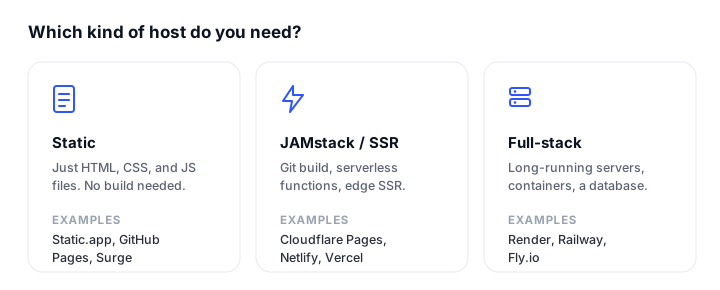
The right Amplify alternative depends on which part of Amplify you were leaning on:
- A plain static site (portfolio, landing page, docs, blog): for the absolute simplest path with no build pipeline and flat pricing, Static.app is the easy pick. If you want unlimited bandwidth and a Git workflow, Cloudflare Pages is the strongest free option.
- A JAMstack or SSR app (Next.js, Astro, SvelteKit, Nuxt): Vercel is the smoothest for Next.js specifically; Netlify is the most frictionless for static-first and non-Next.js frameworks; Cloudflare Pages wins if you want SSR without traffic bills.
- Full-stack with a database or containers (the Lambda + DynamoDB part of Amplify): Render is the most Heroku-like and beginner-friendly, Railway is the cleanest container-plus-database PaaS, and Azure Static Web Apps or Firebase Hosting make sense if you are already on Microsoft’s or Google’s cloud.
- The simplest no-build option: if you already have built files and never want to think about a pipeline, Static.app’s drag-and-drop or desktop sync is the least friction of anything here.
Whichever you choose, plan to keep it online: set up uptime checks with one of our best website monitoring tools so you hear about an outage before your visitors do.
FAQ
What is the best free AWS Amplify alternative?
For a static or JAMstack site, Cloudflare Pages is the strongest free option because bandwidth and static requests are unlimited on every tier, including the free one, so you never get a surprise traffic bill. Azure Static Web Apps has a capable free tier too (100 GB/month plus managed serverless APIs), and Firebase Hosting’s Spark plan is genuinely always-free for static content. Netlify and Vercel both offer real free plans, though Vercel’s Hobby plan is personal-use only.
Is there a cheaper alternative to AWS Amplify?
It depends on usage, but yes for most sites. Amplify’s pay-as-you-go model (build minutes, storage, egress at around $0.15/GB, and SSR compute) can climb under traffic. Flat-rate options remove that uncertainty: Static.app starts at $6/month ($5/month billed annually) with unlimited traffic for static sites, Netlify Personal is $9/month, and Render Pro is $25/month flat. Cloudflare Pages keeps bandwidth unlimited and free, which is often the cheapest outcome for high-traffic static or JAMstack sites.
Which alternatives support SSR and full-stack apps like Amplify?
Amplify is not static-only, so its closest matches also do dynamic work. For SSR, Vercel (Next.js), Netlify, Cloudflare Pages (via Functions), Azure Static Web Apps, and Firebase Hosting (via Cloud Functions or Cloud Run) all qualify. For full-stack apps with long-running containers and managed databases, Render and Railway are the best fits. Only Static.app on this list is static-only.
Can I host a static site without a build pipeline?
Yes. Static.app is built for exactly this: drag-and-drop a folder or ZIP, sync from a desktop app, or push from your own GitHub Actions, and the compiled files go live with free SSL, no platform build step required. Surge and GitHub Pages are other no-frills static routes, covered in our Surge alternatives and GitHub Pages alternatives guides.
How hard is it to migrate off AWS Amplify?
For a static site, very easy: your built HTML, CSS, and JS are portable, so you point a new host at the same Git repo (or upload the output) and update DNS. SSR and full-stack apps are harder, because Amplify ties into AWS-specific services (Lambda, DynamoDB, Cognito). Moving those means re-implementing the backend on the new platform’s equivalents, so factor that in. A like-for-like SSR move (Amplify Next.js to Vercel, for example) is usually the smoothest.
Do these alternatives include free SSL and custom domains?
Yes. Every platform reviewed here provides automatic, free, auto-renewing SSL/TLS certificates on custom domains, just like Amplify’s managed ACM certificate. The one caveat is Static.app, where custom domains require a paid plan (Starter and up); the free plan is limited to a Static.app subdomain. Domain count limits vary by tier, so check the plan if you host many sites.
Should I use a static host or a dynamic platform?
Match the host to the site. If your pages are prebuilt HTML, CSS, and JS with no server-side logic, a static host (Static.app, Cloudflare Pages, GitHub Pages) is cheaper, faster, and simpler. If you need SSR, server-side APIs, authentication, or a database, choose a dynamic platform (Vercel, Netlify, Render, Railway, Azure, Firebase). Our static website hosting guide explains the trade-offs in more detail.
Build your Bootstrap theme
Design a custom Bootstrap 5 theme visually with a live preview, then export clean Sass or CSS.
Open the Builder