Best Cloudflare Pages Alternatives in 2026 (8 Compared)
Cloudflare Pages is a genuinely strong host: unlimited bandwidth and static requests on every tier, free SSL, a global edge network, and serverless Functions for dynamic and SSR work. For most static and JAMstack sites it is hard to beat on price, because traffic is never metered. So why look for an alternative at all?

A few honest reasons. As of 2026, Cloudflare is steering new full-stack and SSR projects toward Workers (with Static Assets) rather than Pages, which stays fully supported but receives less new feature work, so some teams want a platform with a clearer roadmap. The dynamic side leans on the separate Workers runtime and its own pricing and daily request caps, so the “free” picture for dynamic apps is more nuanced than the unlimited-bandwidth headline suggests. Build limits are by count (500 builds per month and one concurrent build on the free plan) with a 20-minute timeout, which can bottleneck busy teams. And the best tooling assumes buy-in to the Cloudflare ecosystem (D1, R2, KV, Durable Objects), which can feel like lock-in for data-backed apps. Others simply find the Wrangler and bindings model heavier than they want for a plain HTML site.
This guide reviews eight alternatives in depth: Netlify, Vercel, GitHub Pages, Render, Cloudflare Workers, Azure Static Web Apps, Firebase Hosting, and Static.app. Some match Cloudflare Pages feature for feature on dynamic and SSR work; others are simpler static hosts that win on ease of use and predictable pricing. Pricing and limits were verified in June 2026.
How we picked
The platforms below are weighed against the things that actually matter when you are choosing where to put a website:
- Free tier. Is there a real, permanent free plan, and is it usable for a production site or just a trial?
- Pricing model and limits. Flat subscription or usage-based metering? What happens to bandwidth and build limits, and how predictable is the bill?
- Static vs dynamic/SSR support. Plain HTML/CSS/JS only, or serverless functions, SSR, containers, and databases too?
- Build and deploy workflow. Git-push CI, CLI, drag-and-drop, preview deployments, and which frameworks are auto-detected.
- Custom domains and free SSL. Custom domain support with automatic, free, auto-renewing certificates.
- Ease of use. How much config and platform knowledge it takes to get a site live and keep it that way.
If you are weighing this against the broader field, our guide to static website hosting and the roundup of where to host an HTML website cover the landscape in more depth.
The best Cloudflare Pages alternatives at a glance
| Platform | Free tier | Starting price | Static / Dynamic | Custom domain + SSL | Best for |
|---|---|---|---|---|---|
| Static.app | Free: 1 site, 50MB, subdomain only | $6/mo (Starter) | Static only | Yes, free SSL (custom domain on paid) | Simple static sites with no build step |
| Netlify | Free: 300 credits/mo | $9/mo (Personal) | Static + serverless/SSR | Yes, free auto SSL | Frictionless JAMstack/SSR deploys |
| Vercel | Hobby free (personal use) | $20/seat/mo (Pro) | Static + serverless/SSR | Yes, free auto SSL | Next.js and modern SSR apps |
| Cloudflare Workers | Free: 100k requests/day | $5/mo (Workers Paid) | Static + serverless/SSR | Yes, free auto SSL | Edge apps with no bandwidth bills |
| GitHub Pages | Free for public repos | $4/user/mo (private) | Static only | Yes, free Let’s Encrypt SSL | Free docs, blogs, portfolios from a repo |
| Render | Free Hobby workspace | $25/mo (Pro workspace) | Static + containers/SSR | Yes, free managed SSL | Full-stack apps with a database |
| Azure Static Web Apps | Free: 100 GB bandwidth/mo | $9/app/mo (Standard) | Static + serverless/hybrid SSR | Yes, free auto SSL | Azure-based teams wanting managed APIs |
| Firebase Hosting | Spark free: 10 GB transfer/mo | Pay-as-you-go (Blaze) | Static + SSR via Cloud Functions/Run | Yes, free auto SSL | Google/Firebase-ecosystem apps |
The best Cloudflare Pages alternatives, reviewed
Static.app
What it is. Static.app is a simple, one-click static hosting platform where you publish pre-built HTML/CSS/JS by drag-and-drop, ZIP upload, a desktop sync app, a REST API, an MCP server, or GitHub Actions, with free SSL and managed extras like form collection and analytics.
It is for the people Cloudflare Pages over-serves: anyone hosting a plain static site (portfolio, landing page, docs, a finished Bootstrap build) who does not want to learn Wrangler, bindings, or a CI pipeline. You drag a folder in and it is live. There is a live in-browser code editor for quick tweaks, free SSL on every tier including the free plan, and useful managed features (forms with spam protection, analytics, password-protected pages, QR codes). Pricing is flat and predictable: Free ($0, 1 site, 50MB), Starter $6/mo, or $5/mo billed annually, for 2 sites and 500MB with unlimited traffic and custom domains, Medium $12/mo ($10/mo annually) for 7 sites and 3GB, and Large $18/mo ($15/mo annually) for 30 sites and 10GB. No per-bandwidth or per-build metering means no surprise bills.
The catch. It is static only: no serverless or edge functions, no SSR, no containers, no databases. There is no platform-side build pipeline either, so you must supply pre-built output (any SSG works if you build it yourself, for example via your own GitHub Actions). Storage caps are tight (50MB free, 500MB on Starter), the free plan has no custom domain, and it is a smaller vendor with a more limited edge story than Cloudflare. If your site is purely static, none of that matters, and it is the easiest pick here.
Netlify
What it is. A JAMstack/composable platform that builds, deploys, and hosts static and dynamic/SSR apps from Git, CLI, drag-and-drop, or AI prompts, with a global CDN, serverless and edge functions, managed Postgres, and blob storage.
This is the closest direct substitute for Cloudflare Pages on the static-plus-dynamic spectrum, and often the easiest setup for non-Next.js frameworks. The Git-based CI/CD is excellent: zero-config builds on push, an immutable deploy preview for every PR, branch deploys, and one-click rollback. Framework support is broad (Astro, Hugo, 11ty, Next.js, Nuxt, SvelteKit, Remix). Even the free plan includes custom domains with free auto-renewing SSL, serverless and free Deno edge functions, a managed Postgres database, blob storage, and unlimited form submissions. Custom domains carry automatic Let’s Encrypt SSL on every plan.
The catch. Since September 2025 Netlify uses a credit-based model: bandwidth (around 20 credits/GB), production deploys (15 credits each), compute, and requests all draw from one pool, which makes costs harder to predict and a traffic spike can drain credits fast. The free plan is hard-capped at 300 credits per month; when they run out, the site pauses and shows a “Site not available” page, and unused monthly credits do not roll over. Paid plans start at Personal $9/mo (1,000 credits), then Pro $20/mo (3,000 credits, unlimited team seats). For comparable static traffic, Cloudflare Pages’ unlimited bandwidth can be cheaper. See our Netlify alternatives breakdown if the credit model is a sticking point.
Vercel
What it is. A frontend cloud from the company behind Next.js, for deploying static sites, JAMstack apps, and dynamic/SSR applications, with git-driven deploys, a global edge CDN, and serverless/edge compute.
Vercel is the smoothest host in this list for Next.js and modern SSR React apps, with best-in-class developer experience: zero-config git-push deploys, an instant preview URL per PR, and automatic framework detection (Next.js, Astro, SvelteKit, Nuxt, Remix, Vite, and more). The free Hobby plan is generous (100 GB/month bandwidth, 1M edge requests, 1M function invocations, up to 200 projects, automatic free SSL, wildcard custom domains), and exceeding limits pauses the feature rather than billing you. Functions support multiple runtimes (Node, Python, Go) with scale-to-zero.
The catch. Hobby is restricted to personal, non-commercial use, so a business site needs Pro at $20 per developer seat/month. Pro is usage-metered above a $20 credit (bandwidth around $0.15/GB, plus edge requests, invocations, and per-minute build time), so a traffic spike can produce a surprise bill, which is the opposite of Cloudflare Pages’ unmetered traffic. There is also strong gravity toward Next.js and the Vercel ecosystem. Our Vercel alternatives guide digs into the trade-offs.
Cloudflare Workers
What it is. Cloudflare’s serverless edge platform that deploys static assets and Worker code together as one unit across 330+ cities, serving static sites, SPAs, and full-stack/SSR apps. As of 2026 Cloudflare positions Workers (with Static Assets) as the recommended successor to Pages for new projects.
If you like Cloudflare but want the platform the company is actively investing in, this is it, and migration is a short hop rather than a leap. Static asset serving is free and unlimited with no bandwidth or egress fees, so it keeps the single biggest advantage of Pages. The same project scales from a pure static site to full SSR and full-stack with edge databases (D1, KV, R2, Durable Objects, Queues, Workers AI) without re-platforming. The free plan allows 100,000 requests/day with 10 ms CPU per invocation, free custom domains with automatic TLS, and up to 20,000 files per version. Workers Paid starts at $5/mo (10M requests and 30M CPU-ms included), with static asset requests still free.
The catch. It has the steepest learning curve here: Wrangler config, the assets/Worker routing model (the ASSETS binding, run_worker_first), and bindings all take effort. There is no drag-and-drop deploy; you use Wrangler or Git via Workers Builds. The free plan’s 100k requests/day and 10 ms CPU caps mean SSR routes can hit limits under load, and deep use of D1/KV/R2 creates the same ecosystem lock-in as Pages.
GitHub Pages
What it is. A free static-site host that publishes HTML/CSS/JS (optionally built with Jekyll or GitHub Actions) directly from a GitHub repository, with changes going live on every push.
For free static hosting straight from a repo, this is the default for a reason: it is genuinely free for public repositories, includes free auto-renewing HTTPS via Let’s Encrypt and custom domains, and ties tightly into Git. You get push-to-deploy plus GitHub Actions for any SSG (Hugo, Astro, Next.js export, Vite) and full CI. There is no build-minute metering on Pages itself; the 10-builds/hour soft limit is bypassed entirely when you publish via an Actions workflow. It is backed by GitHub/Microsoft infrastructure, so it is reliable and low-maintenance.
The catch. It is static only: no serverless, SSR, edge runtime, containers, or databases, so dynamic and full-stack apps are out of scope (unlike Cloudflare Pages Functions). Publishing from a private repo requires a paid plan (GitHub Pro around $4/user/month, or Team at $4/user/month). There is a hard 1 GB site-size cap and a soft 100 GB/month bandwidth limit with no built-in way to pay to raise them, and there are no per-PR deploy previews out of the box. If you want the same Git-first model with more headroom and dynamic options, our GitHub Pages alternatives article compares the field.
Render
What it is. A unified cloud platform that deploys static sites, containerized web services, background workers, cron jobs, and managed Postgres/key-value databases from Git, positioned as a simpler Heroku/AWS alternative.
Where Cloudflare Pages does dynamic work through edge functions, Render does it with real long-running containers, which is the better model if you need a persistent server, background workers, or a managed database alongside your frontend. The free Hobby workspace needs no credit card and includes 5 GB outbound bandwidth/month, around 500 build minutes, 2 custom domains, free static sites, free web services (750 instance-hours), and a free Postgres database. Deploys are Git-push driven with zero-downtime releases and automatic per-PR preview environments, plus Docker, a CLI, a REST API, and Infrastructure-as-Code Blueprints. Custom domains get free, fully managed, auto-renewing TLS plus free DDoS protection on every plan.
The catch. The free tier has real gotchas: free web services spin down after 15 minutes idle with a 30 to 60 second cold start, and free Postgres is deleted around 30 days after creation. The 2026 plans cut included bandwidth sharply (Hobby 5 GB/mo, Pro 25 GB/mo) with $0.15/GB overage, so a media-heavy or busy static site can run up costs that Cloudflare Pages would not meter. Workspace fees ($25/mo Pro, $499/mo Scale) are separate from per-instance compute and database charges, so the real bill stacks up. For plain static sites it is heavier than it needs to be; our Render alternatives guide covers lighter options.
Azure Static Web Apps
What it is. A Microsoft Azure service that builds and deploys full-stack web apps to a globally distributed static host from a GitHub or Azure DevOps repo, with integrated serverless Azure Functions APIs and hybrid SSR support.
This is the natural pick for teams already on Azure who want a managed JAMstack experience with serverless APIs built in. The free plan is capable: 100 GB bandwidth/month, free auto-renewing SSL, custom domains, managed Azure Functions APIs, PR preview environments (3 on Free), and up to 10 apps, all at $0. It auto-generates a GitHub Actions or Azure Pipelines workflow to build and deploy on push, supports common SSGs and SPA frameworks (React, Angular, Vue, Svelte, Next.js, Astro), and offers hybrid SSR. Builds run on GitHub Actions rather than a metered Azure build pool. Standard is a flat $9 per app per month for production workloads, with bandwidth overage at $0.20/GB.
The catch. Per-app, per-environment billing can add up: each kept-alive preview/staging environment on Standard counts as its own $9/month unit, and users report surprise charges. Quotas are tight (250 MB per environment, 500 MB total storage, 15,000 files on Free), the free plan’s 100 GB bandwidth is a hard cap with no overage (the site can stop serving), and the best experience is locked to GitHub or Azure DevOps with no drag-and-drop deploy. Hybrid Next.js SSR remains in preview as of 2026.
Firebase Hosting
What it is. Google’s global-CDN-backed platform for deploying static sites and SPAs, with optional SSR and dynamic content via Cloud Functions or Cloud Run, as part of the broader Firebase/Google Cloud ecosystem.
Firebase makes sense if you are already using Google’s tools (Firestore, Auth, Cloud Functions) and want hosting that plugs straight into them. The always-free Spark plan includes a global CDN, automatic free SSL on custom domains, multiple sites per project, 10 GB stored content, and 10 GB/month transfer (roughly 360 MB/day, the same quota expressed differently). Deploys are a single firebase deploy CLI command, with GitHub Actions for CI, preview channels, and atomic rollbacks. For dynamic and SSR work, Hosting routes to Cloud Functions or Cloud Run, and Google now steers server-rendered apps to the newer Firebase App Hosting.
The catch. The free Spark transfer quota (around 10 GB/month) is modest next to Cloudflare Pages’ unlimited bandwidth, and going beyond it means upgrading to the pay-as-you-go Blaze plan rather than a flat tier. Blaze has no hard spending cap by default (budget alerts notify but do not stop charges), so traffic spikes can surprise you, with overage around $0.026/GB storage and $0.15/GB transfer. SSR and dynamic features are fragmented across Cloud Functions, Cloud Run, and App Hosting, each requiring Blaze, and the Google Cloud coupling adds a learning curve.
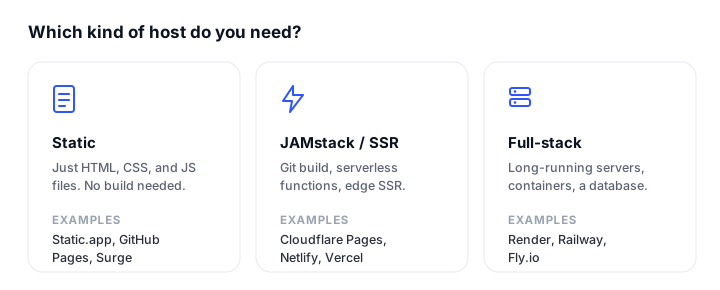
How to choose
Plain static site (portfolio, landing page, docs, a finished Bootstrap build). If you want zero config and predictable cost, Static.app is the simplest pick: drag-and-drop, flat $6 to $18/mo pricing ($5 to $15/mo billed annually), free SSL, and unlimited traffic on paid plans. If you already live in GitHub and your repo is public, GitHub Pages is free and reliable. If you want unlimited bandwidth and do not mind a CLI, Cloudflare Workers (static assets) keeps traffic free. And if you arrived here after trying Cloudflare’s new drag-and-drop Drop tool, our Cloudflare Drop alternatives guide compares that specific field in depth.
JAMstack or SSR app. Netlify is the easiest all-rounder for non-Next.js frameworks and gives you previews, edge functions, and a database on the free plan. Vercel is the smoothest path for Next.js specifically. Cloudflare Workers is the strongest choice if avoiding bandwidth bills is your priority and you are comfortable with its tooling.
Full-stack with a database or containers. Render is the cleanest option when you need real long-running services, background workers, cron jobs, and a managed Postgres database from one Git workflow. Azure Static Web Apps and Firebase Hosting fit teams already committed to Azure or Google Cloud, respectively, with serverless APIs and SSR baked in.
The simplest no-build option. When there is no build step at all, just finished files you want online today, Static.app is the lowest-friction choice in this guide, and you can wire up CI later with its GitHub Actions or REST API if the project grows. Whatever you choose, pair it with one of the best website monitoring tools so you find out before your visitors do if the site goes down.
FAQ
What is the best free Cloudflare Pages alternative?
For free dynamic-capable hosting, Cloudflare Workers (static assets) is the closest match: it keeps unlimited free static traffic and adds 100,000 Worker requests/day on the free plan. For free static-only hosting, GitHub Pages (free for public repos) and Azure Static Web Apps (100 GB bandwidth/month free) are the strongest. Netlify and Vercel also have real free tiers, though Vercel’s free Hobby plan is personal-use only.
Is there a cheaper alternative to Cloudflare Pages?
Cloudflare Pages is already very cheap because bandwidth is unlimited and free, so beating it on a high-traffic static site is hard. For low to moderate traffic, GitHub Pages is free, and Static.app’s flat $6 to $18/mo plans ($5 to $15/mo billed annually) give predictable costs with unlimited traffic on paid tiers. Usage-metered platforms like Netlify, Vercel, Render, and Firebase can end up more expensive than Pages once traffic grows, since they meter bandwidth that Pages does not.
Which alternative is best for a static site with no build step?
Static.app is built for exactly this: you upload pre-built HTML/CSS/JS by drag-and-drop, ZIP, desktop sync, or API, with free SSL and no platform build pipeline to configure. Surge.sh is another no-build option if you prefer the command line. Both host the compiled output of any static site generator without running the build for you. See our Surge alternatives guide for more CLI-style hosts.
Can these alternatives handle dynamic or SSR apps like Cloudflare Pages?
Yes, several can. Netlify, Vercel, and Cloudflare Workers all support serverless functions and SSR for modern frameworks. Render and Azure Static Web Apps add full-stack capability through containers and managed serverless APIs respectively, and Firebase Hosting handles SSR via Cloud Functions or Cloud Run. GitHub Pages and Static.app are static only, so dynamic behavior there must come from client-side JavaScript calling external APIs.
How hard is it to migrate from Cloudflare Pages?
For a static site it is straightforward: most of these hosts connect to the same GitHub or GitLab repo and build on push, so you point them at your repo, set the build command and output directory, and move your custom domain’s DNS. Cloudflare Workers is the smallest migration since it stays within Cloudflare. For dynamic apps, the work is in porting Pages Functions and any bindings to D1/KV/R2, which usually means rewriting that logic for the new platform’s runtime and database.
Do all of these offer free SSL and custom domains?
Yes. Every platform reviewed here provides custom domain support with automatic, free, auto-renewing TLS/SSL certificates. The differences are in the details: GitHub Pages allows one custom domain per site, Static.app reserves custom domains for paid plans (the free plan uses a subdomain), and Azure and Render gate the number of included domains by tier.
Is Cloudflare Workers a replacement for Cloudflare Pages?
Increasingly, yes. As of 2026 Cloudflare recommends Workers with Static Assets as the path for new static, SPA, and full-stack projects, and it now has feature parity for static assets, SSR, and custom domains. Pages remains fully supported, so existing sites do not need to move, but new projects that want the actively developed platform should start on Workers.
Build your Bootstrap theme
Design a custom Bootstrap 5 theme visually with a live preview, then export clean Sass or CSS.
Open the Builder